Last updated: 1 August 2026
Quick answer
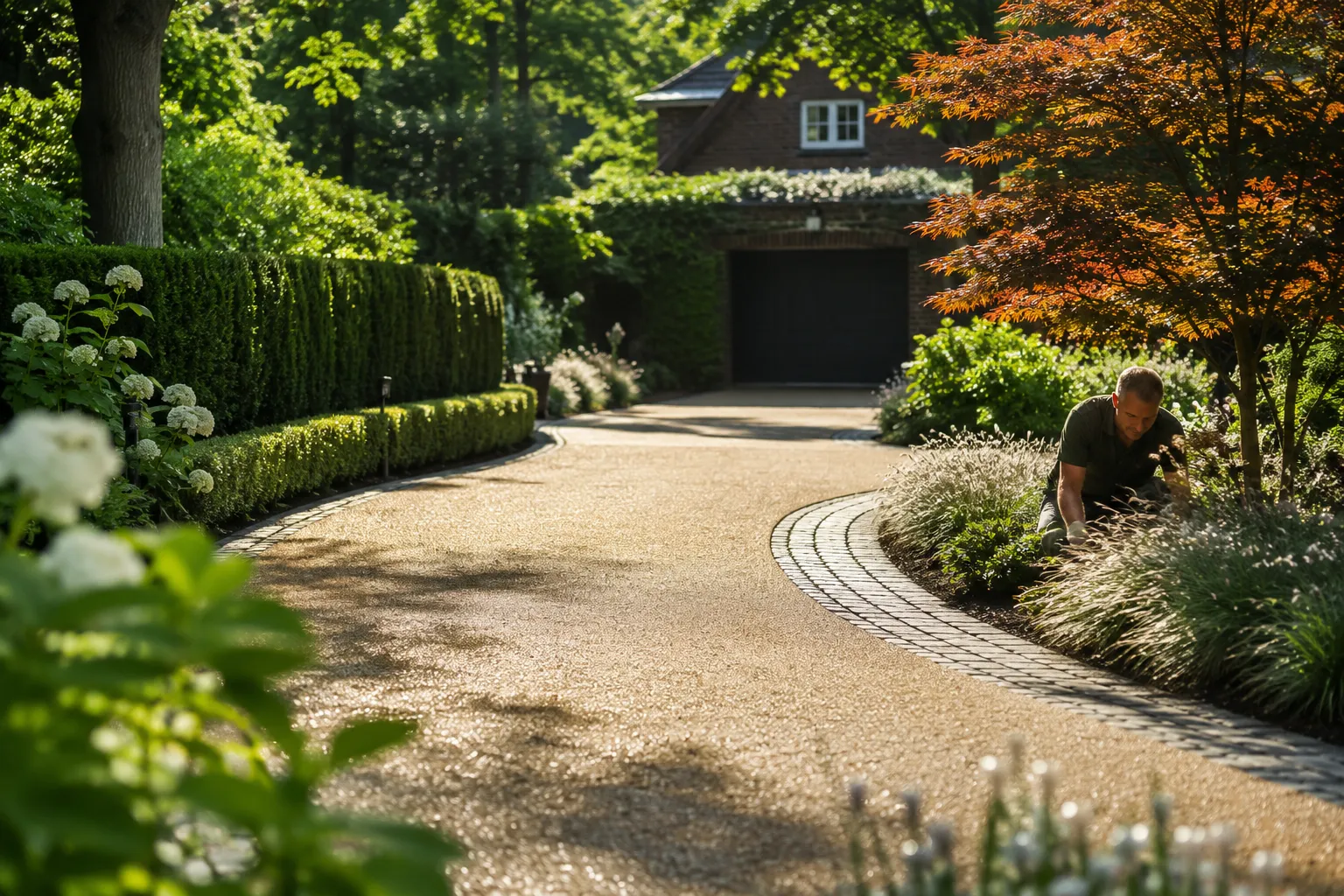
Landscape-led driveway design treats the surface, planting and hardscape as one composition rather than three separate jobs. You choose the driveway material (resin, tarmac or gravel) to suit how you use the space, then frame it with borders, trees, edging kerbs and screening to soften the vehicle zone, direct water into planting, and lift kerb appeal. Done well, it improves drainage, meets UK SuDS guidance, and can add measurable value to your home.
Key takeaways
- Landscape-led design starts with the whole plot, not the driveway alone.
- Resin, tarmac and gravel all pair beautifully with planting when detailed correctly.
- Permeable surfaces plus planted borders help meet UK SuDS rules and often avoid planning permission on domestic driveways over 5 m².
- Root barriers, generous tree pits and slow-growing species prevent long-term damage to the surface.
- Structural hardscape (setts, kerbs, granite edging) protects planting from tyres and keeps lines crisp.
- Even narrow or small plots benefit from layered planting; you don’t need acres to get the look.
- A well-designed driveway landscape can lift kerb appeal and, agents suggest, add several per cent to home value.
)
What is landscape-led driveway design and how does it work?
Landscape-led driveway design is an approach where the driveway is designed as part of the garden, not as a separate slab of surfacing dropped onto the front of the house. The planting, edging, trees, drainage and surface material are all specified together, so they support each other visually and functionally.
In practice, that means a designer or experienced installer will look at:
- 🌳 Sightlines from the road, front door and living room windows.
- 💧 Where surface water naturally wants to go, and how planting can absorb it.
- 🚗 Turning circles, parking bays and pedestrian routes.
- 🪴 Screening for bins, EV chargers and utility boxes.
- 🧱 Hardscape edging that keeps materials contained and tyres off borders.
“The best driveways don’t shout. They sit inside the garden like they belong there. Get the planting and the edges right, and even a simple tarmac drive looks bespoke.” – Tony Flook, Managing Director, Driveways Plus
Compare that with a purely functional approach: rip out the lawn, lay a rectangle of surfacing, done. The finish works, but the house looks stripped bare. Landscape-led design gives you the parking you need without sacrificing the front garden.
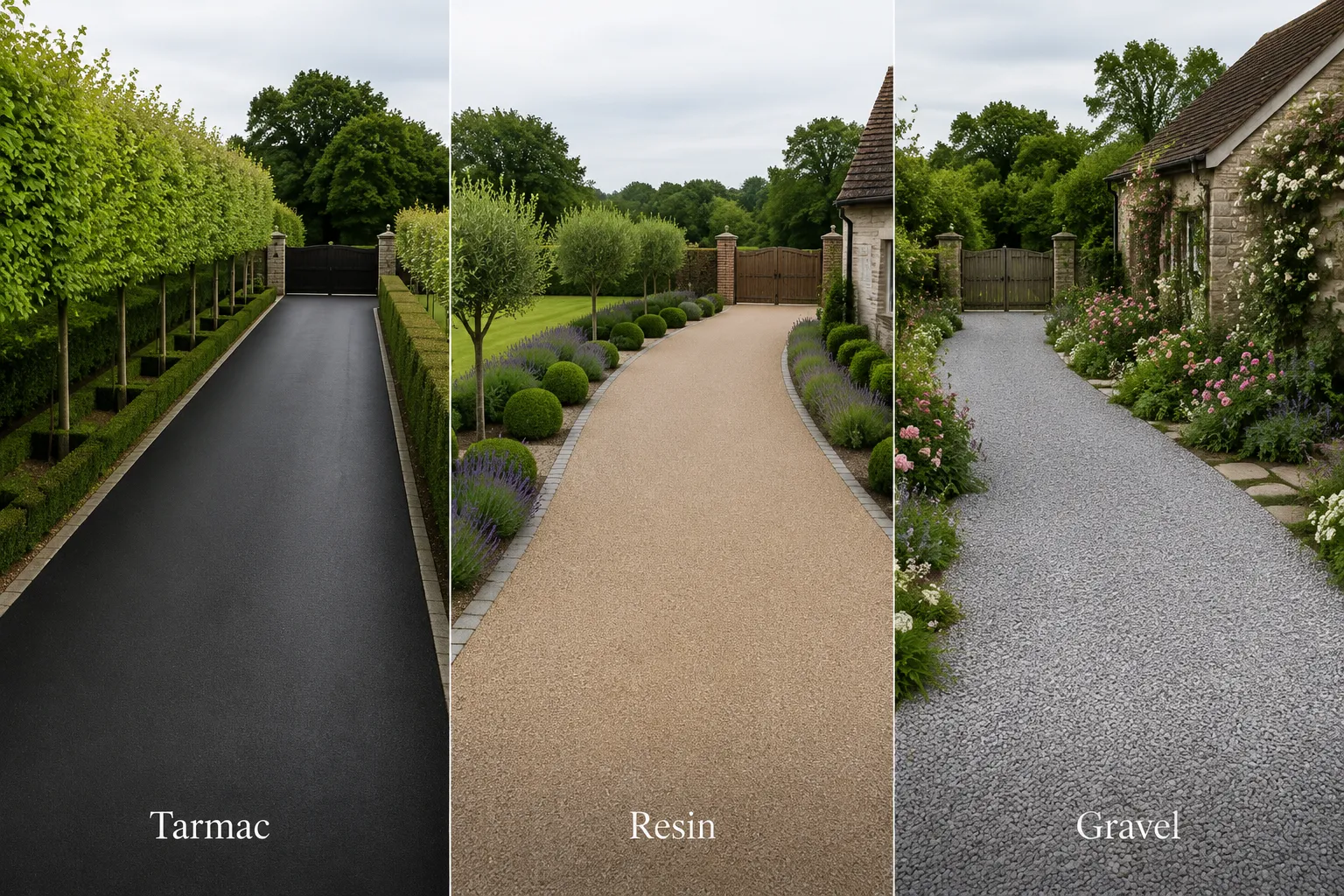
Resin vs tarmac vs gravel driveways: which is best for a landscaped scheme?
Short answer: resin is best for crisp modern schemes with structured planting, tarmac is best for larger sweeping drives on a budget, and gravel is best for cottage, rural and heritage properties. All three can be permeable when built correctly.
Here’s how they compare when planting is part of the picture:
Feature |
Resin-bound |
Tarmac |
Gravel |
|---|---|---|---|
Best planting style |
Clipped, structural, contemporary |
Traditional, formal hedging |
Cottage, naturalistic, meadow |
Permeability |
High (when bound, not bonded) |
Porous options available |
Excellent |
Weed pressure at edges |
Low |
Low |
Moderate (needs a grid) |
Softens with age |
Slightly |
Yes |
Yes, beautifully |
Kerb appeal |
Very high |
Solid, understated |
Very high, character-led |
For deeper cost and spec detail, see our driveway installation cost guide for 2026 and the best driveway material comparison.
What are the best plants for framing a driveway entrance?
The best plants for a driveway entrance are hardy, slow-growing evergreens for structure, plus one or two feature shrubs or small trees for height and seasonal interest. You want plants that look good all year, cope with car exhaust and salt spray, and don’t drop sticky sap or big leaves onto the surface.
Reliable choices that consistently perform in front-garden settings:
- 🌿 Buxus sempervirens (box) or Ilex crenata as a low structural hedge (60-90 cm).
- 🌸 Lavandula ‘Hidcote’ for sunny south-facing borders.
- 🌱 Hebe ‘Emerald Gem’ for tidy evergreen mounds.
- 🍁 Acer palmatum as a feature specimen in a sheltered spot.
- 🌲 Taxus baccata (yew) for taller screening, clipped tight.
- 🌾 Stipa tenuissima or Hakonechloa for movement and softness.
Skip anything with aggressive roots (willow, poplar), heavy fruit drop (crab apple over the parking bay), or thorny sprawl right beside the passenger door.
How do you use hardscaping to frame a driveway?
Hardscaping frames a driveway by creating deliberate lines and transitions between the surface, the planting and the house. It’s the difference between a driveway that looks “installed” and one that looks designed.
The main hardscape elements to consider:
- 🧱 Edging kerbs in granite sett, natural stone or concrete: contain the surface and stop tyres crushing borders.
- 🪨 Mowing strips between lawn and driveway: keep lines crisp and cut maintenance.
- 🚪 Piers and gate posts in matching stone or brick: anchor the entrance.
- 💡 Bollard or recessed lighting: safety plus theatre after dark.
- 🌾 Cobble or sett bands across a long drive: break up big expanses of surfacing.
“A £200 granite sett edge can make a £6,000 tarmac drive look like a £15,000 job. Details cost pennies compared to the whole install, and they carry the whole scheme.” – Ben Sperring, Surfacing Manager
)
What are the best permeable driveway materials that work with plantings?
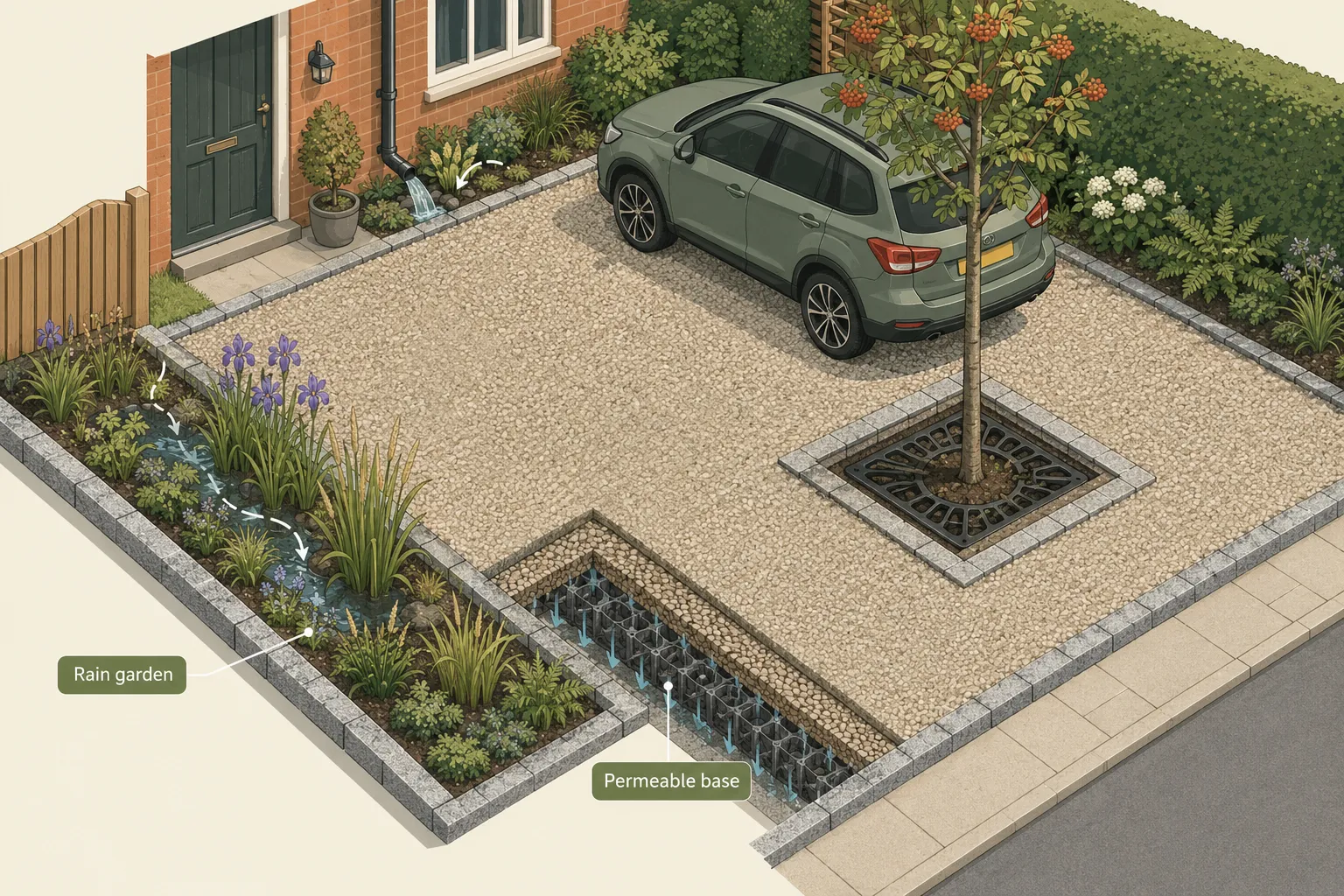
The best permeable options are resin-bound aggregate, porous asphalt, permeable block paving and gravel over a grid system. All four let rain soak through the surface into a sub-base, which you can then link to planted borders and rain gardens.
UK guidance is explicit here. The National Standards for Sustainable Drainage Systems (SuDS), updated in 2026, require developments to intercept the first 5 mm of rainfall and to integrate vegetation wherever water is held near the surface. For homeowners, most councils now confirm that domestic driveways don’t need planning permission if you use a permeable surface or drain runoff to lawn or borders.
Pairing tips:
- 💧 Route downpipes into a planted rain-garden border, not to the road.
- 🌱 Choose species tolerant of both waterlogging and drought (iris, sedges, dogwood).
- 🪵 Use a hidden grid gravel system so stones stay put around planting pockets.
- 🧱 For blockwork, consider a SuDS-compliant permeable design.
Landscape design ideas for narrow driveways and small gardens
For narrow driveways, go vertical with planting and use the boundary rather than the middle. A single strong material (usually resin or tarmac) plus climbers, pleached trees and one repeated shrub reads far better than a fussy mix.
Ideas that actually work on tight plots:
- 🌿 Pleached hornbeam along a fence: privacy without stealing ground space.
- 🧱 A single sett band across the drive at the threshold to add character.
- 🌸 Climbers on wires (clematis, star jasmine) to green up a boundary wall.
- 🪴 Large statement pots either side of the front door instead of ground borders.
- 🚗 Grasscrete or reinforced gravel for occasional parking that reads as green.
For layout help on tight sites, our narrow driveway design guide walks through the geometry.
How much does a landscaped driveway cost in 2026?
A landscape-led driveway in the UK typically costs 20-40% more than a plain surfacing job of the same size, because you’re paying for edging, planting, drainage detailing and often a designer’s time. As a rough 2026 guide, expect £120,£180 per m² for resin with proper edging and borders, £70,£110 per m² for tarmac with hardscape framing, and £60,£100 per m² for gravel with grids and planted borders.
The cost splits roughly like this on a typical £15,000 project:
- Surfacing and sub-base: 55-65%
- Edging, kerbs and hardscape: 10-15%
- Planting and topsoil: 8-12%
- Drainage and SuDS detailing: 8-12%
- Design and setting out: 3-5%
For a more detailed breakdown, see the 2026 driveway installation cost guide.
Can you plant trees next to a resin driveway?
Yes, but you need to plan the tree pit properly and choose species with well-behaved root systems. Trees are fine next to resin, tarmac or gravel provided the pit is at least 1.2 m from the edge of the surface, the root ball has room to establish, and you install a root barrier where roots might travel under the drive.
Good choices for driveway settings:
- 🌳 Amelanchier lamarckii – small, multi-stemmed, four-season interest.
- 🌸 Prunus ‘Amanogawa’ – narrow, upright, minimal spread.
- 🍃 Sorbus ‘Autumn Spire’ – compact, good in urban air.
- 🌲 Carpinus betulus ‘Fastigiata’ – columnar hornbeam for structure.
Avoid: willows, poplars, large-canopy limes over parking (aphid drip), and anything self-seeding aggressively into gravel.
)
What are the most common mistakes in driveway landscape design?
The biggest mistake is treating the driveway and garden as separate projects awarded to separate contractors, months apart. That’s how you end up with mismatched levels, borders that flood, and edging that doesn’t line up with the front path.
Other common pitfalls worth flagging:
- 🚫 Planting trees too close to the surface without a root barrier.
- 🚫 Skipping edging kerbs to save money; the drive spreads and weeds invade.
- 🚫 Using thirsty planting on a sunny, reflective tarmac frontage.
- 🚫 Ignoring where rainwater actually goes once you’ve resurfaced.
- 🚫 Choosing feature lighting after the surface is laid, then trenching through it.
- 🚫 Forgetting turning circles and door swings on family cars.
For more on avoiding surface issues, our guide to common driveway problems and permanent fixes is worth a read.
Which low maintenance plants work best for driveway borders?
The lowest maintenance driveway plants are tough evergreens with a defined shape and long life: box, yew, Ilex crenata, Hebe, Pittosporum, and structural grasses like Stipa. These need one or two trims a year, cope with occasional neglect, and look tidy in every season.
A reliable low-maintenance planting mix:
- 60% evergreen structure (box balls, yew cones, clipped Pittosporum)
- 25% flowering shrubs or perennials (lavender, hardy geranium, catmint)
- 10% ornamental grasses for movement
- 5% seasonal bulbs (alliums, narcissi) for spring lift
Mulch borders 5-7 cm deep in bark or gravel to suppress weeds and lock in moisture. That single job saves more hours than any plant choice.
How do you prevent plants from damaging driveway surfaces?
You prevent plant damage by putting a physical barrier between roots and the sub-base, giving trees a proper pit, and avoiding aggressive-rooted species within 2 m of the edge. Most driveway root damage isn’t the plant’s fault – it’s poor detailing at design stage.
Practical measures:
- 🛡️ Install a rigid root barrier (600-900 mm deep) between mature trees and the drive.
- 🌱 Give each tree a pit at least 1 m × 1 m × 800 mm, backfilled with structural soil.
- 🧱 Use a proper haunched kerb to separate borders from the surface.
- 💧 Avoid overwatering right at the edge – it encourages roots to travel outward.
- ✂️ Prune to a schedule so canopies don’t overhang parking bays.
What hardscape edging options work best for driveways with plants?
Granite setts and natural stone kerbs are the strongest performing edges for planted driveways, followed by concrete kerbs, brick soldier courses and steel edging. Your choice depends on the house style and budget.
Quick decision guide:
- 🏡 Period or country home: granite setts, sawn Yorkstone, or reclaimed brick.
- 🏢 Contemporary home: sawn granite kerb, corten steel edging, or dark concrete.
- 💰 Budget-conscious: pressed concrete kerb in charcoal or buff.
- 🌾 Cottage / gravel: timber log roll or dry-laid stone edge.
Whatever you choose, it needs to be haunched in concrete below ground so tyres and mowers don’t shift it over time.
Do landscape-led driveways add home value?
Yes, a well-designed driveway with planting and hardscape can add real value, both in sale price and speed of sale. UK estate agents commonly cite kerb appeal improvements as adding 5-10% to asking price on the right property, with driveways among the most influential features. On prestige homes, the effect is bigger.
“Buyers form an opinion of a house in under 10 seconds when they pull up. If the drive is tired and the front garden’s gone, they’ve already knocked £20,000 off in their head before they open the car door.” – Tommy Clancy, Pre-Construction Consultant
The investment logic is strong: £15,000,£25,000 into a landscape-led drive on a £600,000 home can lift perceived value by significantly more, and it’s a job you enjoy every day you live there.
FAQ
Can I put a resin driveway over an existing tarmac base?
Often yes, provided the tarmac is sound, level and free of cracks or oil contamination. A qualified installer will assess the base first. If it’s failing, you’re better off starting again than resin-coating a problem.
How close can lavender be planted to a driveway edge?
Lavender is happy planted 20-30 cm back from a hard edge, provided drainage is good. Avoid tight against the tyre track – repeated brushing damages the woody stems.
Do I need planning permission for a landscaped driveway?
Not usually, if the surface is permeable or runoff goes to a lawn or border rather than the highway. Impermeable drives over 5 m² draining to the road generally need permission.
What’s the lowest maintenance driveway material with planting?
Resin-bound. It doesn’t weed like gravel, doesn’t fade like tarmac, and pairs cleanly with clipped evergreens that need only a couple of trims a year.
Will gravel migrate into my planting borders?
Only if you don’t edge properly. A haunched kerb or steel edging plus a hidden grid system keeps gravel where it belongs.
How long does a landscape-led driveway install take?
Typically 2-4 weeks including planting, versus 3-7 days for surfacing alone. The planting is often done last so it isn’t damaged during construction.
Conclusion: your next steps
Treating your driveway as part of the garden, not a bolt-on, is the single biggest upgrade you can make to a front elevation. Whether you land on resin, tarmac or gravel, the planting and hardscape framing is what turns a functional surface into something that lifts the whole home.
Start with three actions:
- Walk your frontage with a notepad and mark sightlines, sun, and where water pools.
- Decide on one strong material and one edging detail before you look at plants.
- Get a specialist installer involved early, so drainage, edging and planting are specified together.
Ready to talk it through? Book a free driveway consultation or browse recent installations for inspiration. If you are planning the whole frontage, start with the driveway design ideas guide, then see how we build in resin, tarmac, and gravel.