Last updated: April 28, 2026
Quick answer
Narrow Driveway Design works best when the layout, drainage, turning space, edging and surface material are planned together before any digging starts. For most compact UK homes in 2026, the smartest options are resin-bound surfacing, herringbone block paving, permeable gravel grids, tarmac with strong edging, or a ribbon driveway that reduces hard surfacing while keeping daily parking practical.
A good narrow driveway should make parking easier, protect your front garden from water problems, and lift kerb appeal without making the entrance feel cramped. The right answer depends on vehicle size, door opening space, gradient, drainage, planning rules and how the property is used day to day.
Key takeaways
- A narrow driveway is usually a design problem, not just a space problem. Marking out vehicle clearances often unlocks more usable room than homeowners expect.
- Herringbone block paving suits tight drives because the interlocking pattern spreads turning forces well and can make slim spaces look wider [2].
- Ribbon driveways are back in 2026 for premium homes because they reduce hard surfacing and soften narrow frontages with grass or planting [2].
- Resin-bound surfacing is a strong compact-drive choice when you want a smooth, modern finish with good drainage when installed on the correct build-up.
- Gravel grids help narrow drives stay tidy by reducing rutting and stone migration, especially on cottage, rural and heritage-style homes.
- Drainage must be designed from the start. Retrofitting channels after a narrow drive floods is usually more disruptive and more expensive.
- Door clearance matters as much as parking width. A car can technically fit, but still be annoying every single day.
- Choose low-contrast, continuous finishes if you want a narrow driveway to feel wider.
- Avoid squeezing too many materials into a small frontage. Two main finishes are usually enough.
- Book a proper survey before choosing a surface. Ground levels, thresholds and falls can change the best solution.
What is Narrow Driveway Design, and who needs it?
Narrow Driveway Design is the planning of a compact entrance so vehicles, pedestrians, drainage and kerb appeal all work within limited width. It suits terraced homes, townhouses, cottages, side-access plots, small commercial units, prestige homes with tight gateways, and developers trying to make small frontages feel valuable.
A narrow driveway is not always a bad driveway.
Handled well, it can look sharper than a large empty forecourt. The trick is to stop thinking only in square metres and start thinking in movements: drive in, open doors, walk to the front door, move bins, charge an EV, receive deliveries, and reverse safely.
At Driveways Plus, we often see compact drives across Bath, Bristol, the Cotswolds, Somerset, South Wales and the Thames Valley. Georgian terraces, village properties and newer infill developments all bring different limits. The same layout rarely works twice.
“A narrow driveway can still add real value when it feels deliberate. Buyers notice when a compact frontage has been designed, not just surfaced.”
Tony Flook, Managing Director, Driveways Plus, 25+ years’ experience
🚗 Typical signs you need a narrow driveway plan
- Your car fits, but the doors hit walls, hedges or bins.
- You reverse onto a busy road because there’s no turning space.
- Rainwater runs towards the house or pavement.
- The entrance looks squeezed beside planting, walls or steps.
- Visitors park partly on grass because the hardstanding feels too tight.
- You want EV charging but the cable route crosses a walkway.
A good first step is to browse proven design and finish ideas, then compare them with your actual site. Our driveway material comparison guide is useful if you’re still weighing resin, tarmac, gravel, block paving and concrete.
Quick example
A Bristol homeowner recently asked for a wider-looking drive without moving a boundary wall. The practical fix wasn’t demolition. It was a single-colour resin-bound surface, a slim contrasting block edge, relocated bin storage and a better fall towards a drainage channel.
Same footprint. Much easier to use.
Actionable takeaway
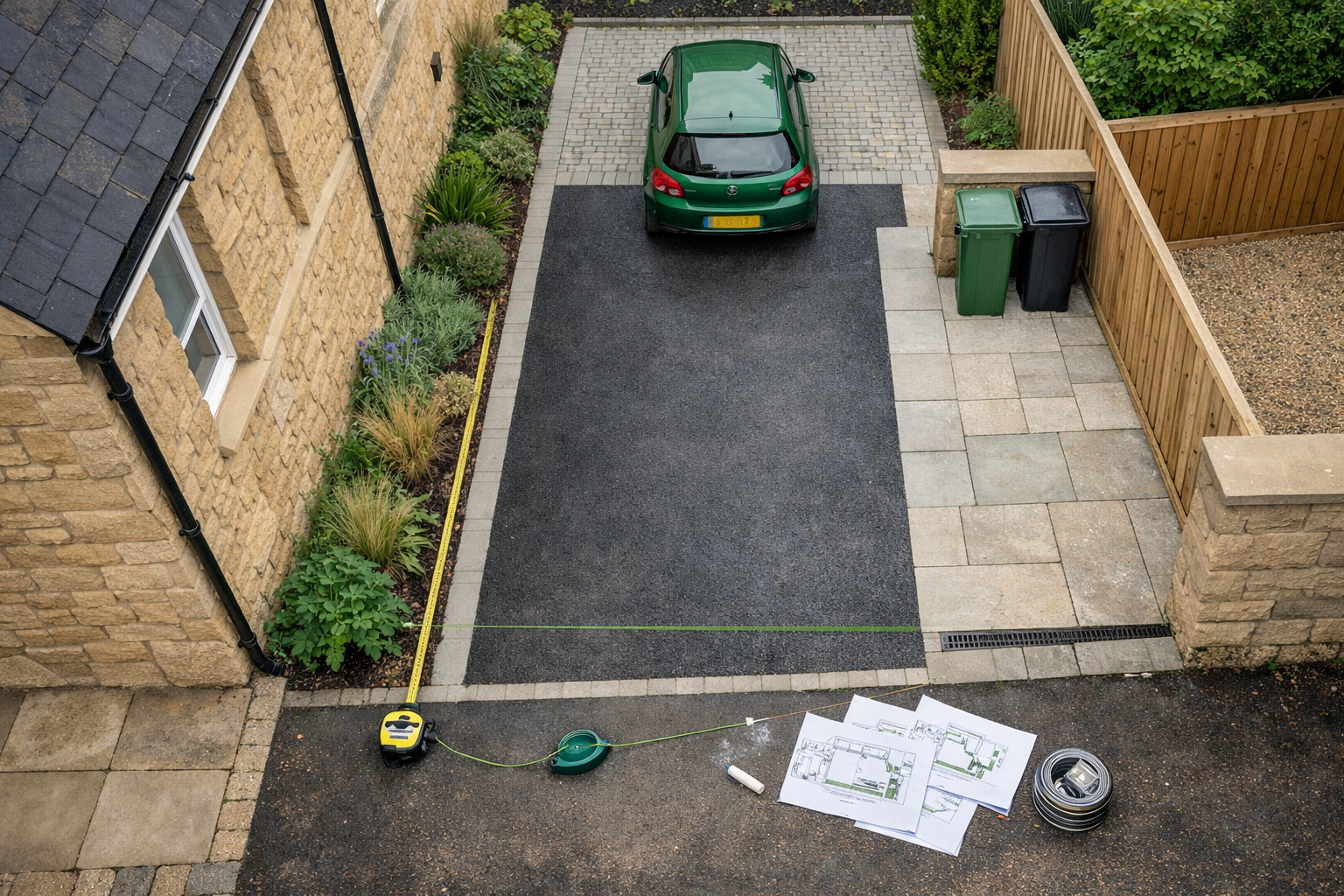
Before choosing any surface, mark your current parking bay with chalk or masking tape. Open every car door fully. Walk the route to your front door with shopping bags. That simple test tells you more than a brochure ever will.
How wide should a narrow driveway be for modern cars?
A single-car driveway should normally allow enough width for the vehicle plus safe door opening, mirrors and pedestrian movement. Many family cars are around 1.8 to 2.1 metres wide including mirrors, so a practical bay often needs more room than the parked vehicle alone.
If your frontage is tight, design around the car you actually use, not an average car from a drawing.
Large SUVs, estate cars and vans change everything. So do child seats, mobility needs and wall-side parking. A 2.4 metre space may hold a car, but it can be frustrating if a passenger can’t get out.
📏 Practical width guide for compact driveways
Use case |
Practical design aim |
Watch out for |
|---|---|---|
Small city car |
Around 2.4 to 2.7 m clear width |
Door opening beside walls |
Family hatchback |
Around 2.7 to 3.0 m clear width |
Mirror clearance and bins |
SUV or estate |
Around 3.0 to 3.3 m clear width |
Passenger access |
Accessible parking need |
More generous side clearance |
Level thresholds and gradients |
Shared narrow access |
Site-specific tracking needed |
Conflict with pedestrians |
These figures are practical design estimates, not a replacement for a site survey. Boundary walls, gate posts, steps, trees and highway visibility can all change the safe layout.
🧰 Tools we use and recommend
On professional surveys, tools matter. For tight sites, we’ll often use:
- Laser levels for accurate falls
- Tape measures and measuring wheels
- String lines and spray markers
- Plate compaction checks during build-up
- Simple vehicle tracking sketches for awkward entrances
- Drainage levels checked against thresholds
Ben Sperring puts it plainly:
“On a narrow drive, 50 millimetres can make the difference between neat and annoying. Set the levels properly, protect the edges, and don’t guess the drainage.”
Ben Sperring, Surfacing Manager, Driveways Plus, 25+ years’ experience
Common mistake
The biggest mistake is making the hard surface exactly the size of the car. That leaves no tolerance for mirrors, door swing, wheel angle or real life.
Actionable takeaway
Measure the full width of your car with mirrors out, then add space for at least one door to open comfortably. If the numbers feel tight, use layout changes rather than simply choosing the thinnest-looking material.
Which Narrow Driveway Design layouts save the most space in 2026?
The best space-saving layouts are straight single strips, offset parking bays, ribbon driveways, herringbone block paving bays, shared turning zones and mixed pedestrian-vehicle layouts. In 2026, homeowners are also using quieter luxury finishes, permeable pavers and greener edges to make compact driveways feel intentional rather than compromised [2].
A narrow drive should guide the eye.
Long lines make a frontage feel deeper. Continuous materials make it calmer. Strong edges stop the surface looking like an afterthought.
🌿 Ribbon driveway
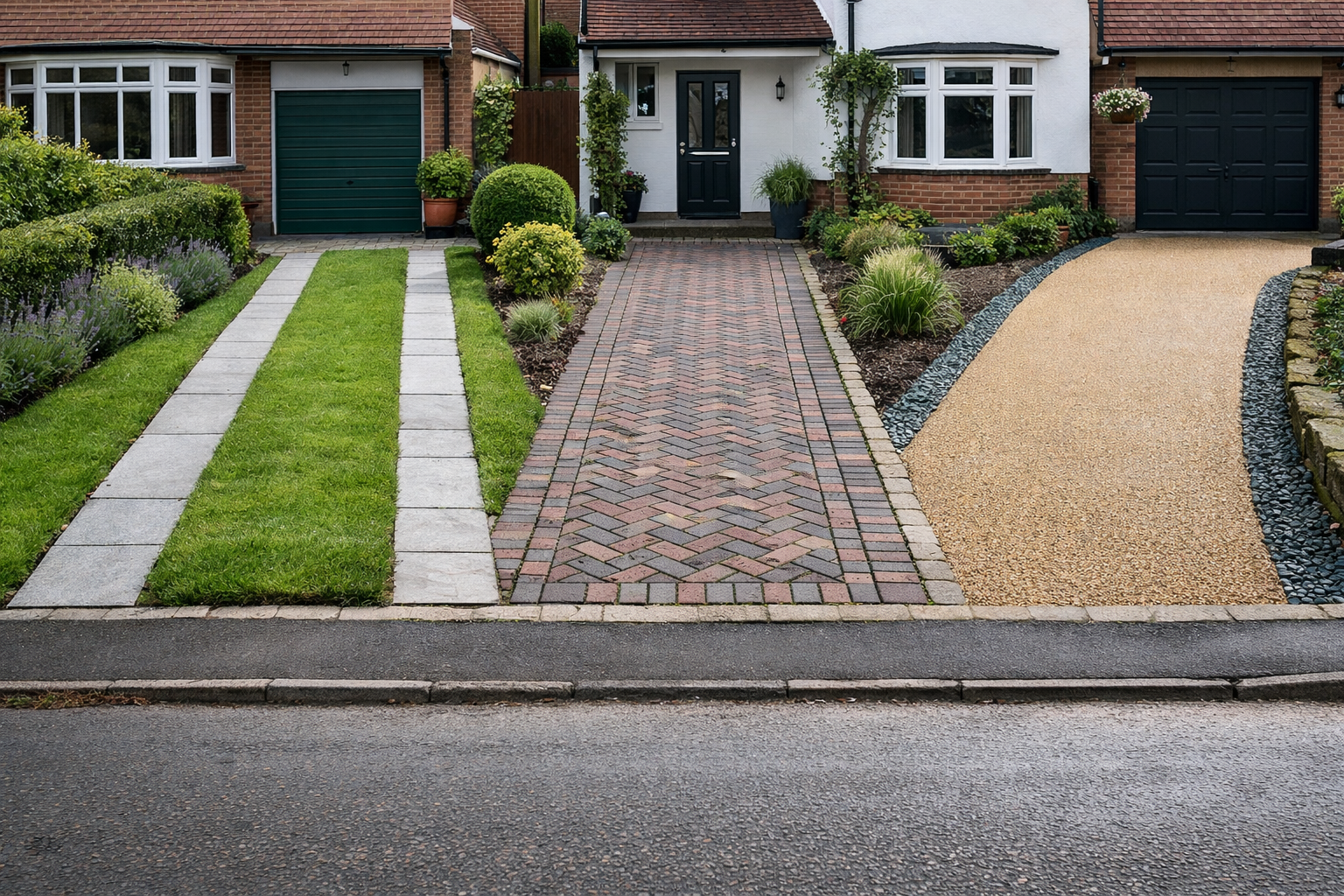
A ribbon driveway uses two hard tracks with grass, gravel or planting between them. The idea is old, but it’s seeing renewed interest in high-end neighbourhoods because it cuts down hard surfacing and adds softness to compact properties [2].
Choose a ribbon driveway if:
- You want a garden-led entrance
- You park in the same position daily
- Your property suits a cottage, period or prestige look
- You want less hard surface and more green frontage
Avoid it if your parking positions vary a lot or if delivery vans regularly use the drive.
🧱 Herringbone block paving
Herringbone block paving is a favourite for narrow drives because the interlocking pattern copes well with turning movements. The angled pattern can also help a slim driveway look wider and more refined [2].
For premium homes, herringbone can be paired with a soldier-course edge to frame the space neatly. If you’re considering this route, see our block paving driveway guidance for style and installation options.
Choose herringbone block paving if:
- Cars turn on the surface
- You want a traditional but smart finish
- You need repairability
- Your home suits detail and pattern
🪨 Gravel with hidden grids
Gravel works beautifully on narrow drives when the stone is stabilised. Modern grid systems help hold the gravel in place, reduce rutting and keep the surface easier to walk on.
Gravel and grass combinations are also popular for compact homes because they feel more natural than a full hardstanding [5]. For a deeper look at stabilised systems, read our guide to gravel driveways with hidden grids.
Choose gravel grids if:
- You want a softer rural look
- Drainage is a priority
- Your frontage is informal or period-style
- You want a quick visual lift
🧭 Offset parking bay
An offset layout places the parking area slightly to one side, leaving a clear pedestrian route to the front door. This often works well for narrow townhouses.
The benefit is simple: nobody has to squeeze past a wet car with bags, prams or work gear.
Quick design rule
If your drive is long and slim, use length lines. If your drive is short and tight, use visual widening, such as herringbone, light aggregate, slim borders and low planting.
Actionable takeaway
Sketch three versions before choosing one: full-width surface, ribbon layout and offset bay. Most homeowners spot the best daily-use option quickly when they compare all three.
Which materials work best for narrow driveways?
The best materials for narrow driveway design are resin-bound surfacing, block paving, stabilised gravel, tarmac and concrete, chosen according to drainage, style, traffic and budget. The surface must be paired with a suitable sub-base, edging and water management, otherwise even a premium finish can fail early.
Material choice affects more than appearance.
On a compact drive, every stain, rut, puddle and cracked edge is more visible. Narrow entrances also suffer more wheel tracking because tyres use the same path again and again.
🟡 Resin-bound surfacing
Resin-bound driveways offer a smooth, modern finish with a wide range of colours. On narrow properties, a single continuous resin tone can make the frontage feel cleaner and wider.
Choose resin-bound if:
- You want a premium modern look
- You prefer low visual clutter
- You need a comfortable walking surface
- You want colour choices that suit stone, brick or render
For more detail, visit our resin driveway installation page.
⚫ Tarmac
Tarmac remains a sensible option for many tight drives. It’s clean, efficient and often cost-effective, especially where the shape is simple.
The key on narrow tarmac drives is edge restraint. Without strong edging, repeated tyre loading near the sides can cause crumbling.
Choose tarmac if:
- You want a practical, clean finish
- Budget matters
- The drive has a simple shape
- You want fast installation
Our guide to when tarmac still wins in 2026 explains where blacktop makes best sense.
🧱 Block paving
Block paving gives the most pattern choice. Herringbone, stretcher bond and mixed-size blocks can all work, but avoid over-busy designs on very small areas.
Choose block paving if:
- You want repairable sections
- You like pattern and detail
- You need strong edge definition
- Your property has traditional character
⚪ Porcelain and large-format slabs
Oversized porcelain slabs are part of the “quiet luxury” trend for 2026, especially around high-end entrances [2]. Used carefully, large slabs can make small frontages feel calm and expensive.
There’s a catch.
Large-format paving needs careful base preparation, correct bedding and thoughtful jointing. On vehicle areas, not every patio-style porcelain product is suitable. Always check load rating and installation specification.
🪨 Gravel
Gravel is cost-effective, attractive and naturally suited to rural and heritage homes. On narrow driveways, use angular stone and a stabilisation grid to reduce movement.
Loose gravel without containment can migrate onto pavements and roads. That’s not a premium look.
🟤 Concrete
Concrete is strong and flexible in design terms. It can be plain, brushed, printed or edged with blockwork. On narrow drives, saw cuts and expansion planning matter because cracks are more noticeable.
For inspiration, see our concrete driveway design ideas.
Material comparison table
Material |
Best for narrow drives |
Main caution |
|---|---|---|
Resin-bound |
Smooth premium finish, colour control |
Needs correct base and drainage |
Tarmac |
Practical, simple, cost-aware layouts |
Weak edges can fail |
Block paving |
Pattern, repairability, character |
Poor laying causes movement |
Gravel grids |
Rural look, drainage, lower visual impact |
Loose gravel needs containment |
Concrete |
Strength and design flexibility |
Cracking control is vital |
Porcelain |
Quiet luxury, prestige frontages |
Must be vehicle-rated |
Actionable takeaway
Choose the material last, not first. Decide how the narrow driveway must work, then choose the finish that supports that use.
How do drainage and planning rules affect compact driveways?
Drainage is one of the biggest design factors for compact driveways because small areas can still send water towards the house, pavement or highway. In many UK front gardens, impermeable surfacing may need proper drainage or planning consideration, so the safest route is to design water management into the project from day one.
A narrow driveway has less room to hide mistakes.
If the fall is wrong, water may sit by the doorstep. If the channel is in the wrong place, tyres may damage it. If the surface drains to the pavement, you may face issues later.
💧 Drainage options for narrow drives
- Permeable paving: Allows water to pass through suitable joints and layers.
- Resin-bound systems: Can be permeable when installed on the right base.
- Gravel grids: Help water drain through the surface.
- Linear channels: Collect water at thresholds or pavement edges.
- Soakaways: May work where ground conditions allow.
- Soft planting strips: Help slow run-off and soften the frontage.
Permeable pavers are gaining attention in 2026 because they support greener, biophilic driveway design while helping compact spaces manage water better [2].
For a full UK-focused explanation, read our SUDS compliant driveway guide.
🚧 Edge case: sloping narrow driveways
A sloping narrow drive needs extra thought. Water, traction and vehicle grounding all become more serious when there’s limited room to adjust the route.
If your compact driveway is steep, our guide to traction boosters for wet UK weather is a useful next read.
Mike’s view on long-term quality
“Good drainage is rarely the part homeowners get excited about, but it’s often the part that protects the investment. A drive that moves water properly will usually age better.”
Mike Clancy, Non-Executive Director, Driveways Plus, 30+ years’ industry experience
Common mistake
A common mistake is installing a beautiful surface with no clear water route. Water will always find a path. Your job is to choose that path before the rain does.
Actionable takeaway
Stand outside during heavy rain and watch where water naturally goes. Take a short video. That one clip can help your contractor design the right falls and drainage points.
How much does a narrow driveway cost in 2026?
A narrow driveway in 2026 can cost less than a large driveway overall, but the price per square metre may be higher because tight sites need more handwork, careful waste removal, precise drainage and detailed edging. Surface choice, excavation depth, access, disposal, sub-base specification and local conditions all affect the final quote.
Small does not always mean simple.
A 25 m² compact driveway with awkward access can take more planning than a 60 m² open forecourt. Mini diggers may not fit. Materials may need barrowing. Drainage may have to be custom-positioned.
For current budgeting detail, see our 2026 driveway installation costs guide.
💷 Cost factors that matter most
- Existing surface removal
- Excavation depth and spoil disposal
- Sub-base type and depth
- Drainage channels, soakaways or permeable layers
- Edging restraints
- Surface material
- Access for machinery
- Steps, walls, gates or thresholds
- EV cable ducts or charger preparation
2026 working estimate
As a broad planning estimate, many professionally installed UK driveways fall into a wide range depending on specification. For narrow driveways, allow extra budget for details that protect the edges and manage water.
If a quote looks unusually low, ask what has been excluded. Spoil disposal, drainage and edging are common gaps.
🧾 Questions to ask before accepting a quote
- What excavation depth is included?
- What sub-base will be installed?
- How will the driveway drain?
- Are edge restraints included?
- Is waste removal included?
- How long will installation take?
- What happens if soft ground is found?
- Is the surface suitable for my vehicle weight?
Actionable takeaway
Compare quotes by specification, not just total price. A cheaper narrow driveway can become expensive if drainage, edges or base layers are underbuilt.
How can a narrow driveway look wider and more premium?
A narrow driveway looks wider when the design uses simple lines, consistent colour, slim borders, low planting and lighting that guides the eye. Avoid visual clutter, oversized kerbs and too many contrasting materials, because small frontages quickly become busy.
Prestige doesn’t need shouting.
The strongest compact designs often use one main material, one edge detail and carefully placed planting. That’s enough.
✨ Visual tricks that work
- Use a single main surface colour to reduce visual breaks.
- Lay block paving in herringbone to add movement and width.
- Choose light-to-mid aggregate tones for resin or gravel.
- Keep borders slim and crisp.
- Use low planting rather than tall hedges beside car doors.
- Align paving lines with the house entrance.
- Add recessed or low-level lighting for evening definition.
- Hide bins behind a side screen or planted bay.
Houzz driveway galleries show how varied finishes, planting and layout choices can change the feel of an entrance, even where the footprint is modest [3]. Homedit also highlights a move away from plain asphalt towards driveways that frame the house, using pattern, green strips and mixed materials [4].
🪴 Planting for narrow drives
Plants need to earn their space. Choose compact, tough species and avoid anything that scratches car doors or blocks visibility.
Good choices include:
- Lavender along sunny edges
- Low grasses
- Thyme between informal stepping areas
- Box alternatives where disease is a concern
- Small multi-stem trees only where roots and visibility are managed
Common mistake
The most common style mistake is using too many features: mixed blocks, bold borders, gravel panels, lighting, tall planters and a statement gate, all in three metres of width.
Let the house lead.
Actionable takeaway
Limit your narrow driveway palette to two hard materials and one planting style. If you want a premium look, spend the detail budget on edges, drainage and finish quality.
What should be included in a professional narrow driveway installation?
A professional narrow driveway installation should include survey, design, excavation, sub-base preparation, drainage, edge restraint, surface installation and final finishing. The smaller the site, the more important sequencing becomes, because there is less working room and less tolerance for mistakes.
This is where commercial-grade experience helps.
Driveways Plus brings 25+ years of commercial surfacing knowledge into residential projects. That matters on compact homes, where levels, access, traffic management and finish details all need careful control.
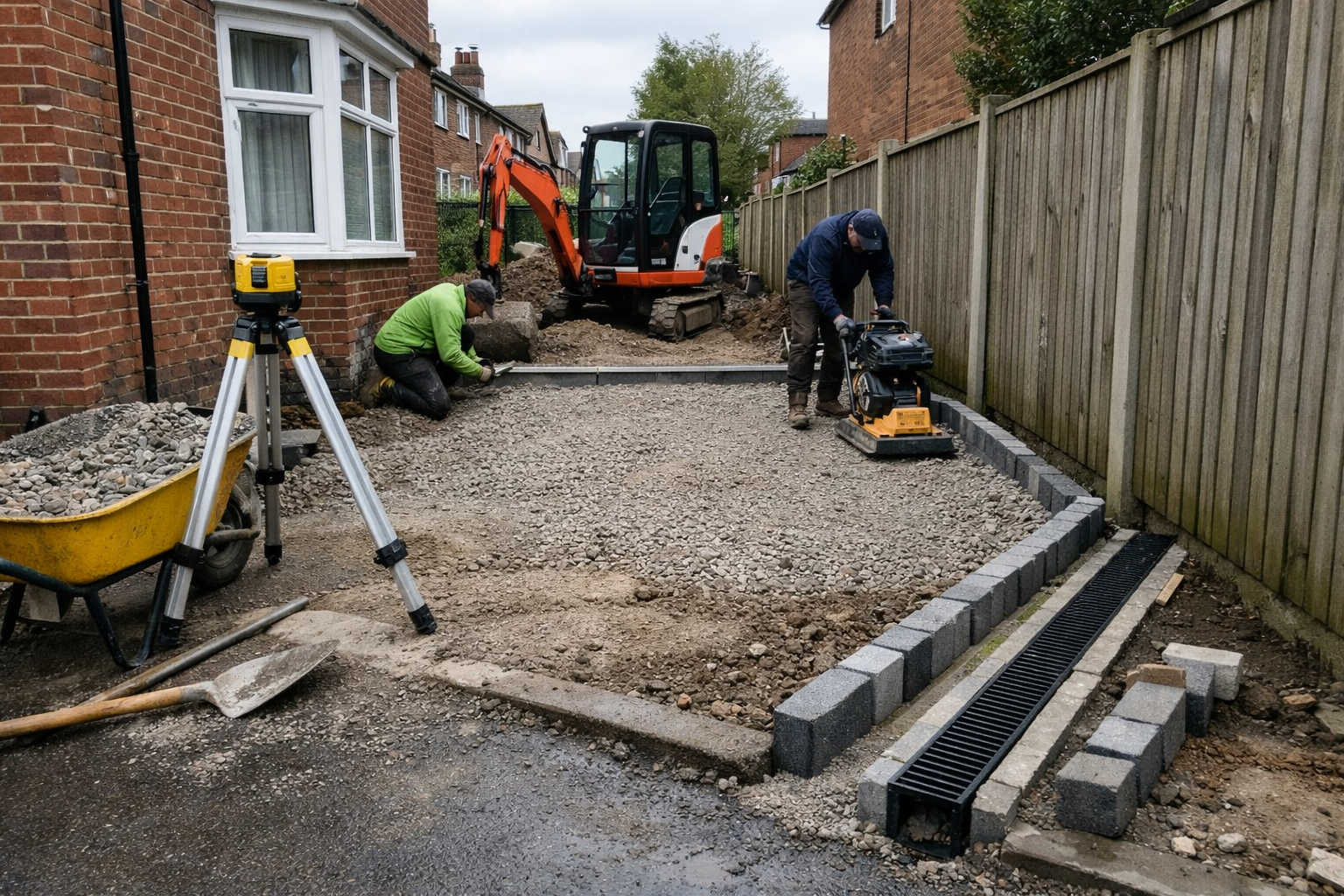
✅ Step-by-step installation checklist
Survey and design
- Measure widths, levels, thresholds and access.
- Confirm vehicle needs and pedestrian routes.
Material and drainage specification
- Choose the surface after confirming falls.
- Plan permeable layers, channels or soakaways.
Excavation
- Remove unsuitable material.
- Protect walls, services, roots and thresholds.
Sub-base installation
- Install suitable aggregate layers.
- Compact in stages, not just at the end.
Edge restraint
- Set strong edges before the final surface.
- Narrow drives rely heavily on edges.
Surface installation
- Lay tarmac, resin, blocks, gravel grids or concrete to specification.
- Keep levels consistent and clean.
Final checks
- Test water flow.
- Check door clearance.
- Clean the site and explain aftercare.
🧱 Little-known installer tip
On narrow driveways, the edge detail often decides how long the surface looks good. A drive may fail from the side before the centre shows any issue, especially where tyres repeatedly track close to the boundary.
A short site story
On one compact terrace project near Bath, the homeowner wanted block paving right up to the wall. It looked good on paper, but the car door would have opened straight into stonework.
The better answer was a slightly narrower paved strip with a flush gravel margin beside the wall. The car still parked safely, the door opened more comfortably, and the frontage looked softer.
That’s narrow design in practice. Small adjustment, big daily benefit.
Actionable takeaway
Ask your installer to explain the build-up beneath the visible finish. If the answer is vague, pause the project.
How do you future-proof a narrow driveway for EVs, deliveries and resale?
Future-proofing a narrow driveway means planning cable routes, safe walking lines, lighting, drainage capacity and flexible parking before the surface is installed. It is far cheaper to add ducts and layout allowances during construction than to cut into a finished driveway later.
Compact homes need future planning more than large homes.
There is less spare room for retrofits. A poorly placed EV charger can create a trip hazard. A delivery route across a parked car bay can damage planting. A narrow drive that works for one small car may struggle when the household changes vehicle.
🔌 EV charging on narrow drives
Plan these details early:
- Charger position
- Cable route
- Ducting under the driveway
- Trip-free pedestrian path
- Lighting near the charging point
- Drainage around the wall and cable entry
Our smart driveway EV charging guide explains how to plan charging without spoiling the design.
📦 Deliveries, bins and daily life
A narrow driveway should not force every delivery driver onto your lawn. It should also leave a simple route for bins.
Think about:
- Parcel drop-off position
- Bin storage and collection route
- Pushchair access
- Mobility needs
- Guest parking
- Visibility when reversing
Resale value
A well-designed compact driveway can make a property feel easier to live with. Buyers may not know the technical details, but they notice clean parking, safe drainage and a smart entrance.
Tony Flook’s advice is simple:
“Don’t design only for the car you own today. Design for the next owner, the next vehicle and the next ten winters.”
Tony Flook, Managing Director, Driveways Plus
Actionable takeaway
Install ducts for future EV charging even if you don’t own an electric vehicle yet. The cost during construction is usually far lower than cutting through a new surface later.
Related reading
If you’re planning a compact driveway, these guides will help you compare the main decisions:
- Best driveway material comparison for UK homes
- Driveway installation costs in 2026
- SUDS compliant driveway drainage rules
- Smart driveway EV charging design
- Gravel driveways with hidden grids
FAQs
What is the best surface for a very narrow driveway?
The best surface for a very narrow driveway is often resin-bound surfacing, herringbone block paving or stabilised gravel. Resin gives a clean modern look, block paving gives strength and pattern, and gravel grids give a softer permeable finish.
Can I make my narrow driveway wider without moving walls?
You can often make a narrow driveway feel wider without moving walls by using a single surface colour, slim edging, low planting and better bin storage. Physical widening may need boundary changes or planning checks, but visual widening is often simpler.
Is block paving good for narrow driveways?
Block paving is good for narrow driveways when it is laid on a proper sub-base with strong edge restraints. Herringbone patterns are especially useful where vehicles turn or brake on a compact area.
Are ribbon driveways practical in the UK?
Ribbon driveways can be practical in the UK when the wheel tracks match regular parking positions and the centre strip is well drained. They work best for homes where the driveway is used in a predictable way.
Do narrow driveways need drainage channels?
Many narrow driveways need drainage channels, permeable construction or another planned water route. The correct option depends on levels, surface type, soil conditions and where rainwater currently flows.
How long does a narrow driveway installation take?
A narrow driveway installation can take a few days to over a week, depending on excavation, drainage, material choice and access. Tight sites may take longer per square metre because machinery access and waste removal are harder.
Can I add EV charging to a narrow driveway?
Yes, EV charging can be added to a narrow driveway, but the cable route must not create a trip hazard. The best time to install ducting is before the new driveway surface is laid.
What is the biggest mistake in Narrow Driveway Design?
The biggest mistake in Narrow Driveway Design is designing only for the parked car and ignoring door opening, walking routes and drainage. A car may fit on paper but still be awkward every day.
Conclusion
A narrow frontage doesn’t have to limit your home’s kerb appeal. With the right Narrow Driveway Design, a compact space can park well, drain properly, look premium and support daily life without feeling squeezed.
Start with the practical questions: What vehicle needs to fit? Where do people walk? Where does water go? What will change in five years?
Then choose the surface.
If you want a smart, long-lasting driveway for a compact property, book a proper survey and ask for a design that covers layout, drainage, edging, material and future use. Driveways Plus installs premium tarmac, resin, block paving, concrete and gravel driveways across Bristol, Bath, the South West, South Wales and the Thames Valley.
For friendly, expert advice, call 01761 202 012 or request a free driveway quote.
References
[1] Watch – https://www.youtube.com/watch?v=HFJr4P_eGRM
[2] 9 Driveway Ideas To Transform Your Entrance In 2026 – https://blog.techo-bloc.com/9-driveway-ideas-to-transform-your-entrance-in-2026
[3] Driveway Ideas And Designs Phbr1 Bpt 728a 13 13787 – https://www.houzz.com/photos/driveway-ideas-and-designs-phbr1-bp~t_728~a_13-13787
[4] Driveway Ideas For 2026 That Replace Plain Asphalt With Designs That Actually Frame The House – https://www.homedit.com/driveway-ideas-for-2026-that-replace-plain-asphalt-with-designs-that-actually-frame-the-house/
[5] Small Driveway Ideas –
[6] Small Driveway Design Ideas – https://www.truegridpaver.com/small-driveway-design-ideas/
[7] Driveway Ideas –