Last updated: 1 August 2026
Quick answer
The driveway designs that work in 2026 are the ones that take their cue from the house. A contrasting border, a considered threshold, and a surface colour matched to the brick or stone will do more for a frontage than an expensive material chosen in isolation. Below are ten ideas we actually build across Bristol, Bath, and Somerset, what each one suits, and what it asks of you in return.
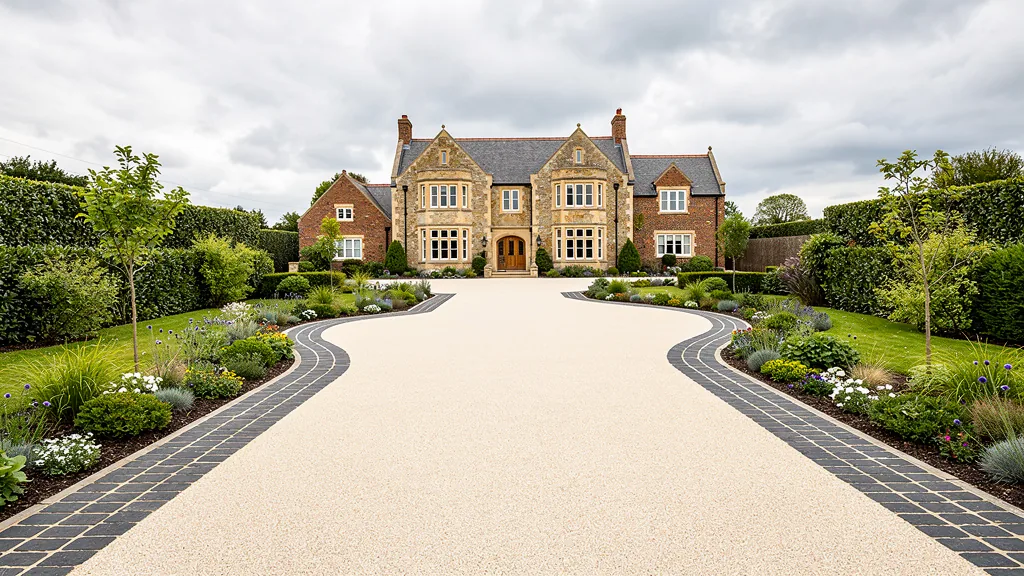
Key takeaways
- A border is the highest-return detail on any driveway, and the cheapest
- Match the surface colour to the house in daylight, wet and dry, before ordering
- Mixing two surfaces works when one leads and the other supports
- Permeable surfaces remove the planning question rather than answering it
- Run lighting and EV ducting while the drive is open, even if you fit later
What makes a driveway design work in 2026
Design trends in driveways move slowly, because the constraints do not move at all. The frontage is the first thing anyone sees of a house, the surface has to carry two tonnes of car every day, and British weather gets a vote. What has changed is drainage. Since front garden rules tightened, permeable surfaces have gone from a niche choice to the default, and that has quietly pushed resin-bound and permeable block paving to the front of most design conversations.
The other change is expectation. Homeowners increasingly want the drive to read as part of the garden rather than a slab of surfacing bolted to the front of the house. That is a design problem before it is a material one, and it is why the ideas below are mostly about edges, thresholds, and proportion rather than about which product to buy.
Ten driveway design ideas that work on UK homes
1. A contrasting soldier course border
The single cheapest way to make a driveway look designed rather than surfaced. A row of blocks laid end to end around the perimeter, in a colour that contrasts with the main surface, gives the drive a defined edge and a deliberate shape.
It works on every surface we lay. Around tarmac it does structural work as well as visual, holding the outer edge that would otherwise break away first. Around resin it draws a clean line against a lawn or border. Charcoal against buff is the safest pairing; brindle against a red brick house picks the brick up without matching it exactly.
2. The ribbon drive, with a planted centre
Two parallel strips where the wheels run, with gravel, planting, or grass between them. It is an old idea that has come back because it halves the hard surface without halving the usable drive.
Best on longer approaches, and on plots where a full-width drive would swallow the whole front garden. It also helps with front garden drainage rules, because most of the area stays soft. It is not the answer where cars have to turn or park across the width, and it needs the strips setting out accurately to a real vehicle, not a guess.
3. Resin in a blend matched to the house
Resin-bound is mixed on site, so the aggregate can be chosen against the stone or brick of the building rather than picked from a chart. That is the whole trick, and most people miss it.
On Bath limestone a warm buff or honey blend reads as though it has always been there. Against Bristol red brick a mid-grey or a flecked blend stops the drive competing with the frontage. Against white render, silver grey looks contemporary and hides tyre marks better than pale gold does. We hold samples against the actual wall, in daylight, before anything is ordered.
4. Tarmac with a block paved apron
Tarmac across the body of the drive, block paving at the threshold where it meets the road and again at the parking bay. You get the cost per square metre of tarmac with the detail of block paving where the eye actually lands.
This is the best value design on the list, and it is what we would suggest on most longer or sloping drives. The apron also takes the hardest wear, where cars turn in off the road, and block copes with that better than a tarmac edge does.
5. A circle or fan in the turning area
A radial pattern set into the middle of a wider drive or a turning head. It breaks up a large expanse and gives a formal frontage something to sit around.
It suits substantial detached houses with room to carry it, and it looks wrong squeezed onto a small frontage. Circles are cutting-intensive, so they cost labour rather than materials. If the budget is tight, a simple change of laying direction achieves some of the same effect for none of the cutting.
6. Banding to break up a long drive
Transverse bands of a contrasting block laid across the drive at intervals, like rungs. On a long approach it stops the surface reading as a runway.
Bands also give you somewhere honest to change level or introduce a drainage channel without it looking like an afterthought. Space them by eye on site rather than to a measurement, because the right rhythm depends on the length and the fall.
7. Gravel with a bound threshold strip
Loose gravel across the drive, with the first two metres at the road in a bound surface. It keeps the country-house look while stopping stone migrating onto the pavement.
This is the fix for the single most common complaint about gravel. The bound strip takes the braking and turning at the entrance, which is where stone gets thrown. Behind it, the gravel behaves, especially with proper edge restraint and the right angular stone.
8. A level threshold with a linear channel
The drive finishing flush with the door or the garage, with a slim drainage channel taking the water instead of a step taking the level.
It is the detail that makes a frontage feel considered, and it is genuinely useful for prams, bins, and wheelchairs. It has to be designed rather than improvised: the finished surface has to stay clear of the damp proof course, and the channel has to go somewhere.
9. Lighting set into the surface
Low-level markers along an edge, or uplights washing the house. Either changes what the driveway does after dark, which in a British winter is most of the time you see it.
The important part is timing. Cabling costs almost nothing while the drive is open and a great deal once it is finished. Decide at survey stage even if you fit the lights later, and run the ducting now.
10. Planting pockets and a soft edge
Leaving deliberate gaps for planting along the boundary, or running a gravel margin between the hard surface and a wall.
It softens the transition between drive and garden, and it stops a full-width drive feeling like a car park. On period frontages it does more for the look than any pattern will. It also gives surface water somewhere to go, which keeps the drainage question simple.
Choosing a surface to carry the design
Every idea above can be built in more than one material, so pick the design first and the surface second. As a rough guide: resin-bound gives you a seamless finish and colour matching, tarmac gives you the most drive per pound and copes best with length and gradient, block paving gives you pattern and the only surface you can repair one unit at a time, and gravel gives you a period-correct look and natural drainage for a fraction of the cost over a large area.
If you want the same treatment behind the house, the same resin system works on patios and terraces. Our driveway material guide compares all four on cost, lifespan, and upkeep, and the free driveway visualiser puts each one on a photo of your own house.
Design details that lift any driveway
- Edge restraint: haunched properly on both sides, or the surface fails from the outside in
- Falls: water leaving the frontage, never running back at the brickwork
- Threshold: finished height kept clear of the damp proof course
- Ducting: EV charging and lighting cable run while the ground is open
- Transitions: a deliberate join between drive, path, and garden rather than an accidental one
Planning, drainage, and what you can actually do
Most driveway designs need no permission at all. The trigger is a non-permeable surface over five square metres that sheds water onto the highway. Choose a permeable surface, or direct the water into a border, lawn, or soakaway, and permitted development covers you. Creating a brand new access across the footway is different: that needs a dropped kerb, applied for separately through your council, and it runs on its own timescale.
Conservation areas and listed buildings add a layer, and around Bath in particular it is worth checking before you commit to a colour. We flag it at the survey where it applies. Full detail is on the Planning Portal.
Driveway design ideas: your questions
What is the most popular driveway design in the UK right now?
Block paving with a contrasting border remains the most requested, because it gives the most visible design for the money. Resin-bound has taken a large share of the premium end on the strength of being seamless and permeable.
Which driveway design adds the most value to a house?
The one that suits the house. A design that fights the frontage subtracts value however well it is built. In practice, a well-detailed drive in a surface appropriate to the property’s age does more than an expensive surface applied without thought.
Do I need planning permission for a new driveway design?
Usually not. Permission becomes a question when the surface is non-permeable, the area is over five square metres, and water would run off to the road. Resin-bound, gravel, and permeable block paving all deal with their own water, which removes the issue. A new access across the pavement needs a dropped kerb, which is a separate application.
What is the cheapest way to make a driveway look better?
A border. A soldier course or a contrasting edge costs a fraction of the total and changes how the whole surface reads. After that, cleaning and re-sanding an existing block drive will do more than most people expect.
Can I mix two surfaces on one driveway?
Yes, and the best designs usually do. Tarmac with a block apron, gravel with a bound threshold, resin with a block border. The rule is that one surface leads and the other supports it. Two surfaces competing for attention looks indecisive.
How do I choose a driveway colour?
Against the house, not against a brochure. Take the sample outside, hold it against the actual brick or stone in daylight, and look at it wet as well as dry. Most surfaces darken when wet, and in this country that matters.
Designing yours
We design and install driveways across Bristol, Bath, Thornbury, Portishead, and Weston-super-Mare, from our base in Paulton. The survey is free, it commits you to nothing, and you will get a layout and an honest recommendation out of it either way. Get in touch and we will come and look.

Your Premium Driveway & Paving Specialists
Quality Meets Kerb Appeal.
Not just our tagline...it’s our promise.
- No obligation
- Transparent pricing
- Local references available