Last updated: 1 August 2026
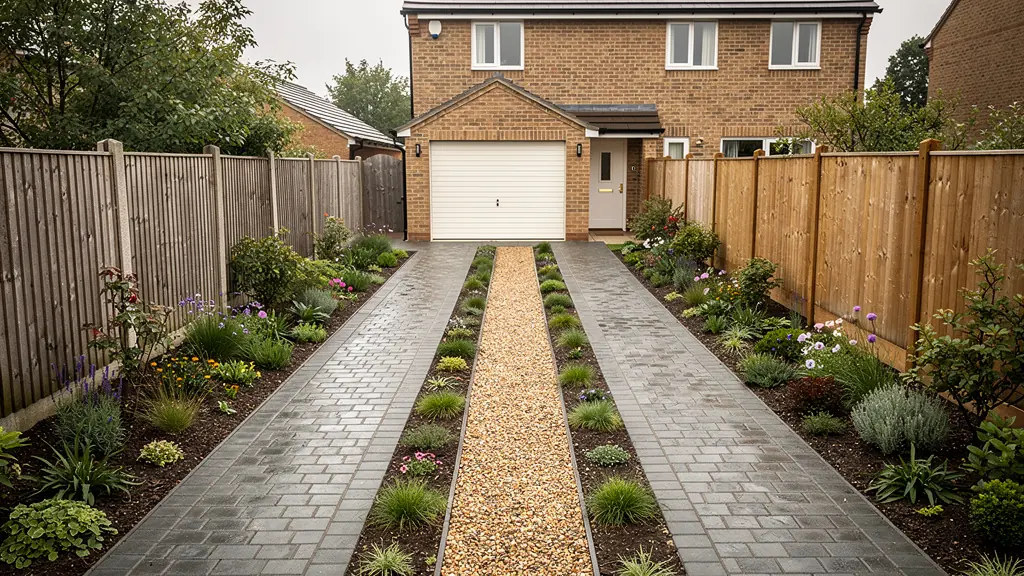
Quick answer: Geometric patterns, ribbon driveways and long parallel bands are design-led solutions that make narrow or awkward plots feel wider, longer, and more premium without expanding the physical footprint. By using bold line direction, contrasting materials, and strategic visual rhythm, these approaches solve the problems that trip up standard driveway layouts on tight or irregular sites.
Key takeaways
- 🎯 Ribbon driveways use two parallel paved strips separated by grass or gravel, reducing hard-surface coverage by roughly 40% compared to a full slab
- 📐 Long parallel bands running toward the house create a sense of depth on narrow plots; bands running across the width make a short plot feel broader
- 💷 Ribbon driveway installation typically costs less than a full-width pour, with savings reinvested in premium edging or planting
- 🌿 Permeable centre strips in ribbon designs support sustainable drainage (SuDS) compliance under current UK planning guidance
- 🔧 Minimum usable ribbon strip width is 600–750 mm per track; total driveway width of at least 2.4 m is recommended for a standard car
- ⚠️ The most common mistake is choosing the wrong band direction, which can make a narrow plot feel even more confined
- 🏡 Well-executed geometric driveway designs can add measurable kerb appeal and contribute to property value
- 🧱 Best materials include concrete, resin-bound aggregate, porcelain planks, block paving, and crushed gravel for infill strips
- 🌧️ Drainage is built into the design with ribbon layouts; a proper sub-base and edging restraints are non-negotiable

What exactly is a ribbon driveway design?
A ribbon driveway consists of two parallel strips of hard-surfaced pavement separated by a softer, often planted or gravelled centre section. Rather than paving the entire width of a plot, you pave only where the tyres actually travel.
Also known as Hollywood driveways, this style dates back to the 1920s and 1940s, when period homes used them as a practical and aesthetically considered approach to front access. The look is clean, structured, and surprisingly contemporary when executed with modern materials.
The centre strip can be:
- 🌱 Lawn or low-growing ground cover (classic look, suits period homes)
- 🪨 Crushed gravel or slate (low maintenance, good drainage)
- 🌾 Ornamental grasses or creeping thyme (adds texture and fragrance)
- ⬛ Contrasting resin-bound aggregate (modern, seamless appearance)
Ben Sperring, Surfacing Manager (25+ years): “Ribbon driveways are one of the most underrated solutions for tight plots. The key is getting the sub-base right under each strip so they don’t sink independently over time. We always install them as a unified structure with a continuous compacted base, even though the surface looks separated.”
How wide do ribbon driveways need to be?
Each paved track should be a minimum of 600 mm wide, though 700–750 mm is more comfortable and allows for slight steering variation. For a standard family car, the two tracks together with a centre strip should total at least 2.4 m in overall width.
For larger vehicles or SUVs, aim for:
Vehicle type |
Recommended track width |
Total driveway width |
|---|---|---|
Small/medium car |
650 mm per track |
2.4–2.7 m |
SUV/4×4 |
700–750 mm per track |
2.8–3.0 m |
Van or commercial |
800 mm per track |
3.2 m+ |
The centre infill strip typically runs 300–600 mm wide. Wider centres look more generous but require more maintenance if planted.
Quick rule: If you’re unsure, measure your car’s track width (axle to axle), add 150 mm either side for comfort, and work outward from there.
Pros and cons of ribbon driveways compared to traditional driveways
Ribbon driveways suit many plots, but they’re not right for every situation.
Advantages:
- ✅ Use approximately 40% less hard material than a full-width slab
- ✅ Lower installation cost in most cases
- ✅ Permeable centre strip supports SuDS drainage compliance; see our SuDS compliant driveway guide for full details
- ✅ Visually lighter; suits period, cottage, and contemporary homes
- ✅ Easier to adapt to curves and slight changes in direction
- ✅ Reduces urban heat island effect compared to solid concrete
Disadvantages:
- ❌ Planted centres need regular maintenance (mowing, weeding)
- ❌ Not ideal where very wide vehicles need to manoeuvre frequently
- ❌ Can look unkempt if the centre strip is neglected
- ❌ Requires careful edging to prevent track migration over time
Tony Flook, Managing Director (30+ years): “From a property investment perspective, a well-maintained ribbon driveway with a clipped grass centre and quality concrete or resin tracks reads as considered, premium design. It signals that the homeowner has thought about the space. That’s the kind of detail buyers notice.”
How much does a ribbon driveway cost to install?
Ribbon driveway costs vary by material, plot length, and ground conditions, but they’re generally more economical than full-width paving. As a rough guide for 2026 UK pricing:
- Concrete ribbon strips: £60–£90 per linear metre (both tracks combined)
- Block paving tracks: £80–£120 per linear metre
- Resin-bound tracks: £100–£150 per linear metre
- Gravel centre infill: £15–£30 per linear metre (additional)
A typical 10-metre ribbon driveway in concrete might cost £700–£1,000 installed, compared to £1,500–£2,500 for a full-width concrete slab of the same length.
For a full breakdown of all driveway surface costs, our driveway installation costs 2026 guide covers every material in detail.
Tommy Clancy, Pre-Construction Consultant: “Always factor in edging restraints and a proper sub-base when budgeting. Skimping on those is the number one reason ribbon tracks sink or spread at the edges within a couple of years. It’s a small addition to the budget that protects the whole investment.”
Can ribbon driveways work on really steep slopes?
Yes, but they need additional engineering. On gradients above roughly 1:10 (10%), each track requires a textured or profiled surface to maintain traction, and the sub-base must be compacted in layers to prevent washout.
Practical steps for steep ribbon driveways:
- Use a textured finish (exposed aggregate, brushed concrete, or resin-bound with larger aggregate)
- Install cross-falls on each track to direct water away from the centre
- Consider a channel drain at the base of the slope
- Use a deeper sub-base (150 mm+ compacted MOT Type 1) to resist movement
Our steep driveway solutions guide covers traction options for tarmac, resin, and block paving in wet UK conditions. Very steep plots (above 1:6) may need a professional structural assessment before work begins.
Best materials for building ribbon driveways and long parallel bands
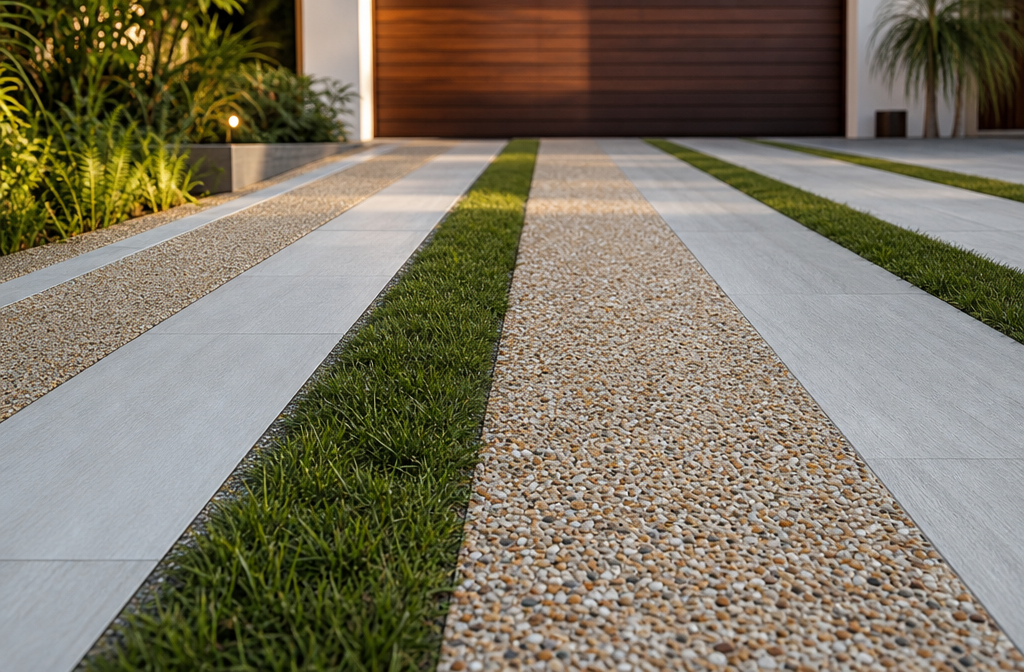
The right material depends on your budget, maintenance appetite, and the visual effect you want. Geometric patterns, ribbon driveways and long parallel bands for narrow or awkward plots work across a wide range of surfaces.
Concrete is the classic choice: durable, cost-effective, and easy to form into precise strips. Brushed or exposed aggregate finishes add grip and visual interest.
Resin-bound aggregate gives a seamless, contemporary look. It’s fully permeable, UV-stable, and available in dozens of colours. Explore our resin driveway options for current colour ranges.
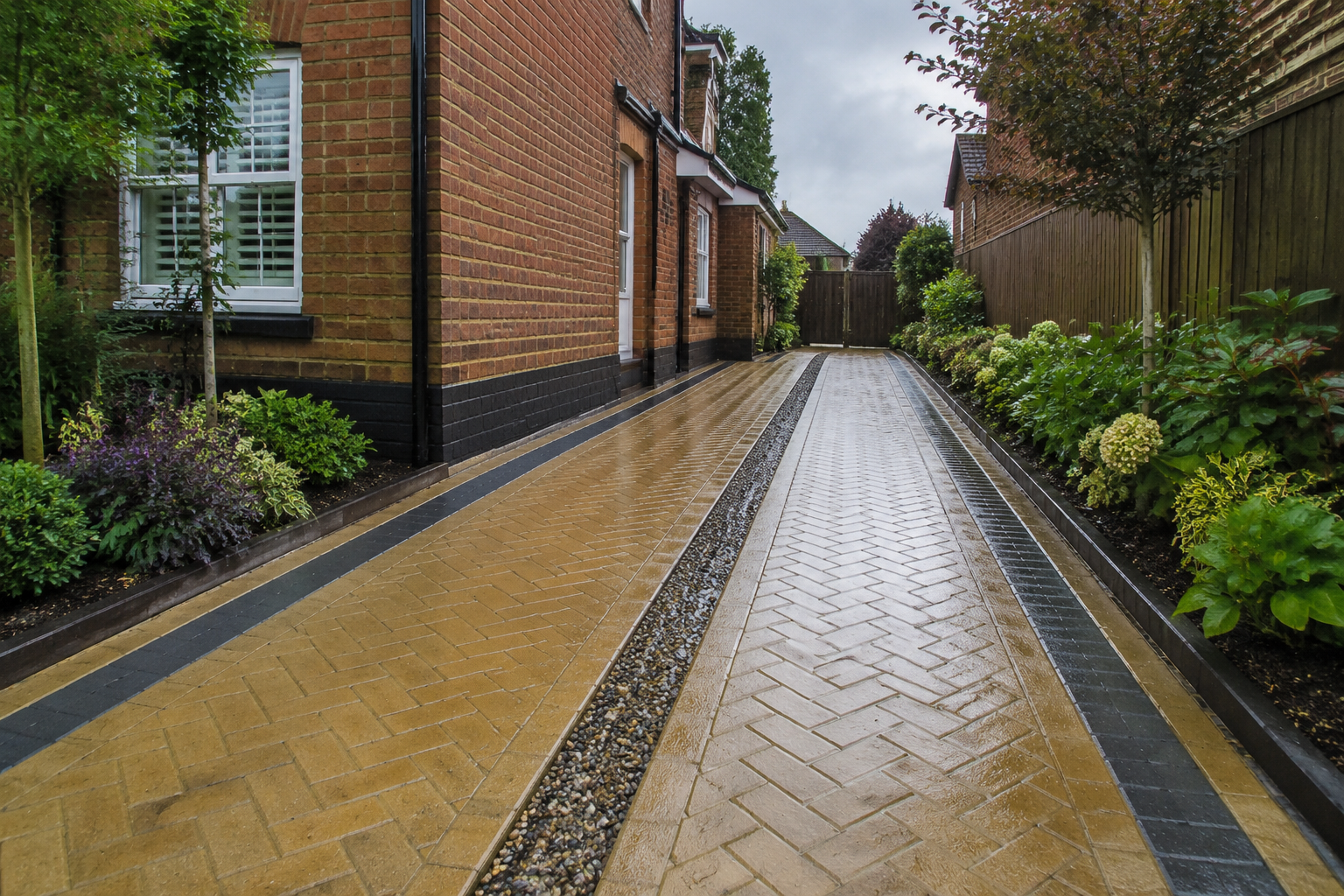
Block paving allows for herringbone or running-bond patterns within each track, adding a layer of geometric detail. The herringbone pattern distributes load in multiple directions, making it highly resistant to shifting under vehicle weight. See our block paving driveway page for layout options.
Porcelain planks create long, linear bands with a clean architectural finish. They suit contemporary homes and pair well with gravel infill strips.
Tarmac is the most economical option for the tracks themselves. It’s fast to install and very durable. Our tarmac driveways page covers specification options.
For centre infill strips:
- 🪨 10 mm pea gravel (classic, good drainage)
- 🌿 Sedum or creeping thyme (low-maintenance planting)
- ⬛ Resin-bound gravel (no loose stone, permeable)
- 🌱 Fine lawn grass (traditional, requires mowing)
How geometric patterns and long parallel bands work on narrow or awkward plots
This is where design thinking earns its keep. Geometric patterns, ribbon driveways and long parallel bands for narrow or awkward plots use optical principles to reshape how a space is perceived.
Direction matters most. Bands running parallel to the length of a narrow plot draw the eye forward, creating a sense of depth and purpose. Bands running across the width make a short, wide plot feel more balanced.
The running bond pattern, for example, can be oriented lengthwise to elongate a short plot or crosswise to widen a narrow one. It’s a simple decision that changes the entire feel of the space.
Breaking up the “hallway effect.” Long, narrow driveways can feel like a corridor. Introducing a visual interruption every 15–25 feet, such as a change in material, a planted threshold, or a contrasting band, resets the eye and makes the space feel more considered.
Zoning with bands. On longer plots, dividing the driveway into distinct visual zones, such as an arrival zone near the road, a transition zone mid-way, and a parking zone near the house, adds structure without adding width.
Ben Sperring, Surfacing Manager: “On a narrow side-access plot, I’ll often suggest running a dark resin track with a pale gravel centre. The contrast draws the eye along the length rather than across it. It’s a simple trick, but it makes a 2.5-metre-wide drive feel much more spacious than it actually is.”
Use the Driveways Plus driveway visualiser to test band directions and material combinations on your own plot before committing.
Are ribbon driveways good for small urban lots?
Absolutely. Small urban plots are where ribbon driveways and geometric band layouts deliver the most value. They reduce the hard-surface footprint (important for planning compliance), keep the design feeling open, and allow planting that softens the streetscape.
In many UK local authority areas, planning permission is required if more than 5 square metres of new impermeable surface is added to a front garden. Ribbon designs with permeable centres often fall below this threshold or qualify as permeable paving, avoiding the need for a planning application entirely. Always check with your local authority before starting work.
For more ideas on making the most of a compact space, our narrow driveway design solutions guide covers layouts, materials, and planning considerations in depth.
Are ribbon driveways eco-friendly compared to solid concrete driveways?
Yes, meaningfully so. Ribbon driveways reduce impermeable surface area by roughly 40%, which directly reduces surface water runoff. This matters for urban drainage systems and is increasingly relevant under UK SuDS requirements.
Key environmental benefits:
- 🌧️ Permeable centre strips allow rainwater to infiltrate naturally
- 🌡️ Less hard surface means reduced urban heat island effect
- 🌿 Planted centres support biodiversity and pollinators
- ♻️ Less material used means a lower embodied carbon footprint
Choosing a resin-bound surface for the tracks adds another layer of permeability. Full-width solid concrete is the least permeable option and the most likely to require drainage mitigation.
What kind of drainage solutions work with ribbon driveway designs?
Drainage is built into the ribbon concept, but it still needs to be designed properly. The permeable centre strip handles the majority of surface water, but the tracks themselves need cross-falls (a slight slope of 1:40 to 1:60) to direct water away from the house.
Drainage options by scenario:
Scenario |
Recommended solution |
|---|---|
Flat plot, permeable soil |
Permeable centre infill, no additional drain needed |
Flat plot, clay soil |
Permeable centre + linear channel drain at base |
Sloped plot |
Cross-fall on tracks + channel drain at low end |
Steep slope |
Stepped sub-base + channel drain + soakaway |
For complex drainage situations, a SuDS compliant driveway approach ensures you meet current UK planning requirements and protect your property from water ingress.
Do ribbon driveways increase or decrease property value?
A well-designed ribbon driveway with quality materials and a maintained centre strip adds to kerb appeal and, by extension, to perceived property value. A neglected one, with overgrown or patchy grass centres and cracked tracks, can do the opposite.
The key factors are:
- Material quality: Resin-bound or quality block paving tracks read as premium
- Maintenance: A clipped grass or tidy gravel centre signals care
- Proportion: Tracks that are too narrow look mean; well-proportioned ones look considered
- Context: Ribbon driveways suit period, cottage, and contemporary homes well; they’re less suited to very formal or grand frontages
For more on how driveway choices affect property value, our premium new drive page covers the investment case in detail.
Which landscaping styles work best with geometric ribbon driveway patterns?
Geometric band and ribbon layouts are versatile, but they pair best with:
- 🏡 Cottage and Arts & Crafts homes: Grass centre with brick or cobble tracks
- 🏢 Contemporary and minimalist: Resin-bound tracks with slate or gravel infill
- 🌿 Naturalistic/wildlife gardens: Planted centre with exposed aggregate tracks
- 🧱 Traditional period homes: Concrete tracks with clipped lawn centre
The principle from landscape design is consistent: introduce visual interruptions every 15–25 feet to prevent the “hallway effect” on long, narrow plots. Structural planting at the sides, a change in infill material mid-way, or a simple border of contrasting stone all achieve this.
Common mistakes people make when designing ribbon driveways
Getting the concept right is only half the job. These are the errors that cause problems after installation:
- ❌ Wrong band direction: Running bands parallel to a narrow width makes it feel narrower, not wider
- ❌ Tracks too narrow: Less than 600 mm per track makes parking stressful and looks mean
- ❌ No edging restraints: Without proper kerbing, tracks migrate outward over time
- ❌ Inadequate sub-base: Each track needs a unified, compacted base; treating them as independent structures causes differential settlement
- ❌ Planted centre with no maintenance plan: Overgrown centres undermine the whole aesthetic
- ❌ Ignoring drainage: Even permeable centres need a plan for heavy rainfall events
- ❌ Mismatched materials: Tracks and infill that clash visually look unplanned
Tommy Clancy, Pre-Construction Consultant: “The conversation I have most often is about track width. Homeowners see ribbon driveways online and think they look narrow, so they go even narrower to save money. Then they can’t open the car door properly. We always model the actual car dimensions on site before finalising the layout.”
How to maintain ribbon driveways in different weather conditions
Ribbon driveways are low-maintenance compared to full-width paving, but they do need some seasonal attention.
Spring/Summer:
- Trim or mow grass centre strips every 2–3 weeks
- Check edging restraints for movement after winter frost
- Weed gravel centres (or apply a pre-emergent weed membrane top-dressing)
Autumn/Winter:
- Clear leaf debris from tracks to prevent slip hazards
- Check drainage channels are clear before heavy rainfall
- Avoid salt on resin-bound or block paving tracks; use sharp sand for grip instead
General maintenance:
- Seal concrete or block paving tracks every 3–5 years
- Top up gravel infill as needed (typically every 2–3 years)
- Inspect sub-base edges for any signs of track movement
Our driveway maintenance guide 2026 covers cleaning, sealing, and seasonal care for all surface types.
FAQs
Can I convert an existing full-width concrete driveway to a ribbon layout? Yes, though it involves cutting and removing the central section of the existing slab. The tracks can be retained if they’re structurally sound, and the centre excavated and filled with gravel or topsoil for planting. It’s a cost-effective way to update an older driveway and improve drainage at the same time.
Do ribbon driveways need planning permission in the UK? Usually not, provided the centre infill strip is permeable (gravel, planted, or resin-bound) and the total new impermeable surface is under 5 square metres. However, rules vary by local authority and listed building status, so always check before starting work.
How long do ribbon driveways last? With a proper sub-base and quality surfacing, concrete or block paving tracks should last 20–30 years. Resin-bound surfaces typically carry a 10–15 year performance expectation. The centre infill will need refreshing more frequently, especially if planted.
Can I use ribbon driveway principles for a shared or communal access? Yes, though shared access driveways need wider tracks (typically 900 mm per track minimum) to accommodate the range of vehicles using them. A structural engineer’s input is advisable for communal surfaces with high traffic.
What’s the difference between a ribbon driveway and a track driveway? The terms are often used interchangeably. “Track driveway” sometimes refers to a more rural, informal layout using compacted gravel or stone, while “ribbon driveway” typically implies a more designed, urban or suburban approach with defined hard-surfaced tracks and a deliberate infill treatment.
Are geometric band patterns suitable for driveways with a curve? Absolutely. Parallel bands can follow gentle curves very effectively, especially with resin-bound or loose gravel infill in the centre. Sharp curves are more challenging with rigid materials like block paving or porcelain planks, but a skilled installer can cut and mitre to accommodate most layouts.
Conclusion
Geometric patterns, ribbon driveways and long parallel bands for narrow or awkward plots aren’t a compromise. They’re a considered design choice that solves real problems: too little width, awkward proportions, drainage challenges, and the need to make a modest frontage feel premium.
The principles are straightforward. Use band direction to guide the eye. Choose materials that contrast just enough to create definition without clashing. Build in drainage from the start. And get the track width right for the vehicles that will actually use the space.
Your next steps:
- Measure your plot width and your car’s track width before making any design decisions
- Use the Driveways Plus driveway visualiser to test layouts and materials
- Review our narrow driveway design solutions guide for plot-specific ideas
- Request a free quote from the Driveways Plus team, who bring 25+ years of commercial-grade expertise to every residential project
The right layout is out there for your plot. It just needs the right eye to find it. Ready to set one out? Our block paving and resin pages cover how we build the bands, and the driveway design ideas guide has nine more looks worth borrowing.