Last updated: May 5, 2026
Quick answer
Permeable Resin-Bound Driveways are leading the premium driveway market in 2026 because they solve three homeowner problems at once: water drainage, kerb appeal and upkeep. A resin-bound surface mixes natural aggregate with UV-stable resin, then trowels that blend onto a prepared base so rain can pass through the surface rather than sit on top [1][2].
For homeowners, prestige property owners and small developers, that means fewer puddles, a smooth modern finish and a driveway that needs simple cleaning rather than constant repair. Done properly, it’s a smart long-term choice for homes where appearance, access and reliability matter.
Key takeaways
- Permeable Resin-Bound Driveways let water drain through the surface, which helps reduce puddling and surface runoff when the base is correctly designed [1][2].
- Resin-bound is not the same as resin-bonded. Resin-bound mixes stone and resin before laying; resin-bonded scatters stone onto resin and is generally not permeable [1][2].
- Low maintenance is a major reason for growth in 2026. Most care involves sweeping, occasional washing and prompt stain removal [3].
- UV-stable resin matters. It helps protect lighter colours from yellowing and keeps the finish looking sharper for longer [1].
- Installation quality decides lifespan. Base preparation, drainage design, edging, mixing and curing matter more than the surface colour.
- Costs vary by site conditions. A simple overlay costs less than a full dig-out with new sub-base, drainage and edging.
- A resin-bound driveway suits many UK homes, but steep, shaded, tree-heavy or poorly drained sites need careful design.
- For SuDS compliance, the whole build-up must drain. A permeable surface over a sealed base is not a true permeable system.
- Choose a contractor who talks about the base first. That’s usually a good sign.
- Ask for material specifications, depth, aggregate size, resin type and aftercare guidance before you sign.
What are permeable Resin-Bound Driveways and how do they work?
Permeable Resin-Bound Driveways are smooth stone surfaces made by mixing dried natural aggregate with specialist resin, then hand-trowelling the blend onto a prepared base. The small gaps between the stones create connected voids, so rainwater can pass through the surface instead of running straight to the road [1][2].
That’s the simple answer.
The technical bit is just as important: the surface is only as good as what sits below it. A true permeable resin-bound driveway usually needs a suitable open-textured base, planned falls and a drainage strategy that manages water beneath the surface.
🔍 Resin-bound vs resin-bonded
These two terms sound similar, but they perform very differently.
Feature |
Resin-bound |
Resin-bonded |
|---|---|---|
How it’s made |
Aggregate mixed with resin before laying |
Resin spread first, stone scattered on top |
Surface feel |
Smooth, even, stone-rich |
More textured, loose-stone feel |
Permeability |
Permeable when installed over the right base |
Usually not permeable |
Typical use |
Premium driveways, paths, patios |
Decorative surfacing, lower traffic areas |
Maintenance |
Low, with regular sweeping and washing |
Can shed loose stone over time |
A homeowner once told us they’d had “a resin drive” quoted at two very different prices. One was resin-bound. One was resin-bonded. Same word, very different build.
That one detail can change drainage, lifespan and planning requirements.
Tony Flook, Managing Director: “When you’re investing in your home, don’t just ask for resin. Ask what system is being installed, what base it’s going on and how water will be managed. That’s where quality shows.”
✅ Quick decision rule
Choose a resin-bound system if you want a smooth, premium driveway with permeability and low maintenance. Be cautious with resin-bonded surfacing if your main goal is drainage, long-term finish quality or SuDS-friendly design.
For more detail on resin options, see our resin-bound driveway advice.
Why are permeable Resin-Bound Driveways so popular in 2026?
Permeable Resin-Bound Driveways are popular in 2026 because homeowners want driveways that look smart, deal with heavier rainfall and don’t demand constant weekend maintenance. Resin-bound also gives a premium, clean finish that suits both modern homes and traditional properties [1][3].
The rise makes sense.
A driveway is no longer just a place to park. It’s part of your home’s first impression. It affects water movement, daily access, safety, cleaning time and resale appeal.
🏡 What homeowners are asking for now
From our conversations with homeowners, the brief has changed. People still want kerb appeal, but they also want confidence.
Common requests include:
- 🌧️ Better rainwater handling after repeated local downpours
- 🧹 Less cleaning and weeding than block paving joints
- 🚗 A smooth surface for cars, bins, bikes, prams and mobility needs
- 🎨 Colour choice that suits stone, brick and render
- 🏘️ A finish that looks high-end without looking flashy
- 🔧 Reliable installation from a contractor who explains the process clearly
Sources covering 2026 resin driveway trends also point to growing demand for durability, appearance and long-term reliability [1].
💬 A short site story
On one Bath-area project, the homeowner had lived with old concrete for years. The drive looked tired, but the bigger issue was water sitting near the garage after rain.
The surface wasn’t failing in a dramatic way. It was just annoying them every week.
The design conversation changed when we stopped talking about “a new driveway” and started talking about the daily outcome: clean shoes, dry access, fewer puddles and a front entrance that looked cared for.
That’s why resin-bound is winning.
Mike Clancy, Non-Executive Director: “A good driveway should quietly do its job every day. The right surface protects access, protects appearance and protects value without asking the homeowner to keep fixing it.”
⚠️ Common mistake
Don’t choose resin-bound only from a sample tray. A colour sample tells you how the surface may look, but it doesn’t tell you whether the installation will drain, bond or last.
If colour is your next decision, our guide to the top resin driveway colours for Bath and Bristol homes will help you narrow the options.
Are permeable Resin-Bound Driveways really low maintenance?
Yes, permeable Resin-Bound Driveways are low maintenance when installed correctly and cleaned sensibly. The sealed stone matrix helps resist loose gravel movement, open joints and regular weed growth, while routine care usually means sweeping and occasional washing [3].
Low maintenance doesn’t mean no maintenance.
It means the work is simple, predictable and light compared with many traditional surfaces.
🧽 What maintenance usually involves
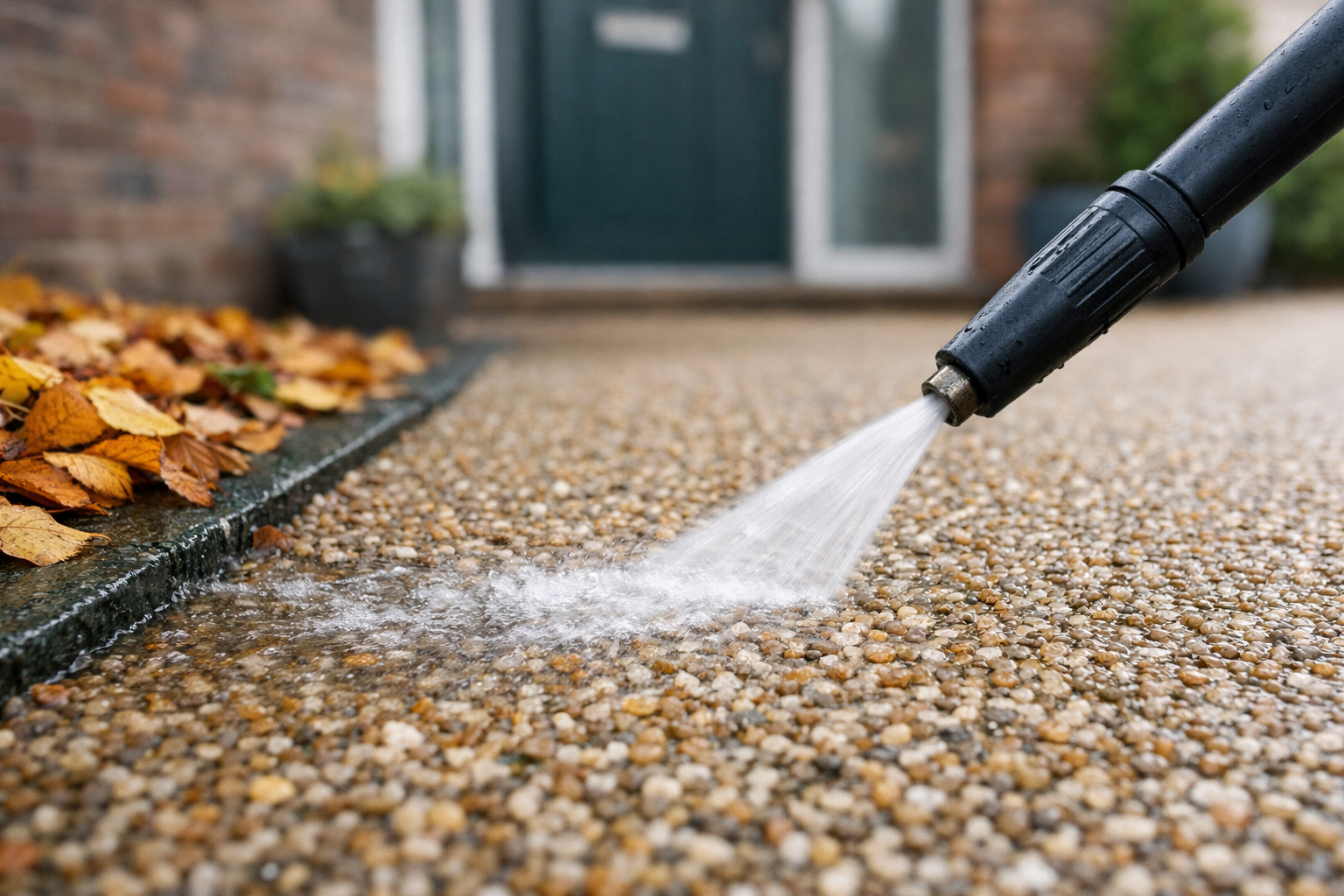
A sensible care routine looks like this:
- Sweep leaves and grit monthly, especially in autumn.
- Wash with clean water when the surface looks dusty.
- Use a mild detergent for general grime.
- Pressure wash carefully, using a fan jet and sensible distance.
- Treat oil marks quickly, before they settle.
- Keep heavy skips and sharp metal objects off the surface unless protection boards are used.
Modern resin-bound formulations are often described as resistant to oil staining and general surface marking, but prompt cleaning still gives the best result [1][3].
🌿 What about weeds?
A resin-bound surface has no open sand-filled joints, so weeds have fewer places to establish than they do in block paving. House Digest notes that the seamless surface helps resist weeds without regular chemical treatment [3].
However, wind-blown seeds can still land on top. If dirt builds up in a shaded corner, small surface weeds may appear.
They’re usually easy to remove.
🧊 What about winter?
Because water can drain through a properly built permeable resin-bound surface, there is less standing water to freeze into slippery patches [3]. That can be useful on shaded entrances, sloping drives and homes where safe access matters.
Still, no driveway is magically ice-proof. In cold snaps, sensible gritting may still be needed.
Ben Sperring, Surfacing Manager: “The best maintenance starts on installation day. If the levels, base and edges are right, the homeowner’s job becomes simple: keep it clean and don’t let debris block the surface.”
✅ Quick decision rule
Choose resin-bound if you want a tidy surface that avoids loose gravel spread and reduces joint weeds. If your home sits under heavy trees, plan for more leaf clearing to keep the pores open.
For a full care routine, read our 2026 driveway maintenance guide.
How does permeability help with drainage and SuDS compliance?
Permeability helps because rainwater can pass through the resin-bound surface into a suitable base, reducing surface water runoff and puddling. In the UK, this can support SuDS principles when the entire driveway build-up is designed to store, slow or drain water correctly.
The key phrase is entire build-up.
A permeable top layer over an impermeable concrete slab may look the part, but water still needs somewhere to go. If the base traps water, the surface can suffer and the driveway may not meet the drainage goal.
🌧️ What makes a resin-bound driveway truly permeable?
A proper drainage design may include:
- An open-textured asphalt or permeable concrete base
- A suitable Type 3 sub-base where infiltration is planned
- Correct excavation depth
- Geotextile membrane where needed
- Edge restraints that hold the surface securely
- Falls away from the house
- Soakaway or attenuation design if soil infiltration is poor
- Drainage channels only where the design needs them
Permeable driveway guides describe resin-bound surfaces as having interconnected voids that allow water to drain through, reducing standing water and strain on stormwater systems [2][3].
🏛️ SuDS and planning in plain English
SuDS means Sustainable Drainage Systems. For homeowners, it’s about managing rainwater where it lands rather than pushing it straight into overloaded drains.
In many UK front garden driveway projects, planning rules can become relevant if you create a non-permeable surface that drains onto the highway or public sewer. A permeable driveway, correctly designed, can help avoid that problem.
For a deeper UK-specific explanation, read our guide to SuDS compliant driveways and permeable paving.
⚠️ Edge case: clay soil
Clay soil drains slowly. A permeable resin-bound surface can still work on clay sites, but the design may need storage, drainage outlets or a different sub-base strategy.
This is where a proper survey earns its keep.
✅ Quick decision rule
Choose a fully permeable resin-bound build-up if rainwater needs to soak away on site. If the existing base is sealed, cracked or badly laid, ask whether overlaying is safe or whether a dig-out is the better long-term decision.
What does a quality resin-bound installation involve?
A quality resin-bound installation starts with the base, not the decorative surface. The best contractors assess levels, drainage, load, edging and moisture before mixing any resin.
That’s the part homeowners rarely see in glossy photos.
But it’s the part that decides whether the driveway stays tight, smooth and attractive.
🛠️ Step-by-step installation checklist
A professional installation typically follows this sequence:
Site survey
- Check access, drainage, levels, existing surface and vehicle use.
Design and specification
- Choose build-up, edging, aggregate colour, depth and drainage approach.
Excavation or base preparation
- Remove failed surfaces or prepare a suitable existing base.
Sub-base installation
- Build stable support with correct compaction.
Base course
- Lay open-textured asphalt or another suitable base where permeability is required.
Edging and details
- Fix restraints around borders, manholes, thresholds and planting.
Mixing
- Use correct ratios of dried aggregate and UV-stable resin.
Trowelling
- Lay evenly at the specified depth with smooth, consistent compaction.
Curing
- Protect the surface from traffic, rain and contamination while it cures.
Handover
- Explain aftercare, curing times and cleaning guidance.
🔎 Tools and checks we expect on site
On well-run resin-bound projects, you should expect to see proper kit. That may include a forced-action mixer, moisture checks, clean trowels, resin-safe gloves, edging tools, compaction equipment and protection materials.
Small things matter.
Wet aggregate can cause foaming or poor bonding. Bad timing can create trowel marks. Weak edging can let the surface break at the sides.
Ben Sperring, Surfacing Manager: “Most resin-bound problems are built in before the customer ever parks on it. Get the base dry, stable and suitable, then the surface has a fair chance of doing its job for years.”
⚠️ Common mistake
Be wary of installers who say, “We can lay over anything.” Some existing concrete, asphalt or paving can be overlaid, but only after checking condition, movement, levels and drainage.
Some newer reinforcement systems are promoted for overlaying existing concrete, asphalt or pavers while bridging cracks and movement [6]. That can be useful in the right setting, but it’s not a magic fix for a failed base.
For examples of finished projects, browse our resin driveway installation service.
How much do permeable Resin-Bound Driveways cost in 2026?
Permeable Resin-Bound Driveways cost more than basic gravel or tarmac in many cases, but they can offer better drainage, appearance and lower day-to-day maintenance. The final price depends on size, access, base condition, edging, drainage and whether the existing surface can be reused.
A US permeable driveway guide quotes resin-bound surface costs at $15 to $35 per square foot, with professional labour adding $5 to $15 per square foot [2]. UK pricing is different, so treat those figures as an international reference, not a UK quote.
For UK homeowners, the most honest answer is: survey first, price second.
💷 What affects the price?
The biggest cost drivers are:
- Driveway size, because resin and aggregate are measured by area and depth
- Excavation needs, especially if the old driveway has failed
- Sub-base depth, which changes with ground conditions and vehicle load
- Drainage design, including soakaways, channels or attenuation
- Edging choice, such as block, stone, metal or kerb restraints
- Access, including narrow lanes, steps or limited storage
- Detail work, such as manhole covers, curves, thresholds and planting borders
- Colour blend, because some aggregates cost more than others
🏘️ Mini example
A small townhouse front drive with a sound open-textured base may need a simpler overlay-style specification. A larger prestige property with poor levels, clay soil, electric gates and multiple parking bays may need a full dig-out, reinforced edging and a planned drainage system.
Those are not the same project.
They shouldn’t have the same price.
Tony Flook, Managing Director: “A cheap driveway can become expensive if water, levels or the base are ignored. The right quote protects your home first, then gives you the finish you want.”
✅ Quick decision rule
Choose the lowest quote only if the specification is genuinely the same. If one contractor includes excavation, drainage and edging while another only lists “resin driveway”, you’re not comparing like with like.
For budgeting, compare materials in our 2026 driveway installation costs guide.
How do resin-bound driveways compare with tarmac, block paving and gravel?
Resin-bound driveways sit between practical surfaces and premium finishes. They usually offer a smarter look than tarmac, less joint maintenance than block paving and a smoother, more stable finish than loose gravel.
There isn’t one best driveway for every home.
There is a best fit for your site, budget and priorities.
Material |
Best for |
Watch-outs |
|---|---|---|
Resin-bound |
Premium look, permeability, low maintenance |
Needs skilled installation and correct base |
Tarmac |
Speed, cost control, simple access roads |
Less decorative, may need sealing over time |
Block paving |
Pattern choice, traditional look, repairable sections |
Weeds and movement in joints if poorly maintained |
Gravel |
Rural look, lower material cost, drainage potential |
Migration, ruts and accessibility issues without grids |
Concrete |
Strength, clean modern design |
Drainage and cracking need careful design |
🚗 Choose resin-bound if…
- You want a neat, modern finish.
- You dislike loose stones.
- You want permeability.
- You need easy access for bins, bikes, pushchairs or mobility aids.
- You care about kerb appeal and long-term presentation.
🛣️ Choose tarmac if…
- Budget and speed matter most.
- The area is large and functional.
- You prefer a simple blacktop finish.
Our guide to tarmac versus modern driveway alternatives explains when blacktop still makes sense.
🧱 Choose block paving if…
- You want patterns or a more traditional look.
- You value easy small-area repairs.
- You’re happy to manage joints and cleaning.
🌿 Choose gravel if…
- You want a softer rural look.
- You have a long drive or country property.
- You use stabilisation grids to reduce movement.
If gravel is on your shortlist, compare it with resin in our guide to gravel driveways with hidden grids.
✅ Quick decision rule
Choose resin-bound when you want the best balance of smart appearance, permeability and low maintenance. Choose tarmac when budget leads. Choose gravel when a natural rural feel matters more than a smooth surface.
For a wider view, see our best driveway material comparison.
Who should choose permeable Resin-Bound Driveways, and who should think twice?
Permeable Resin-Bound Driveways are best for homeowners and developers who want a premium, tidy, drainage-conscious surface with low routine maintenance. They are less suitable where the base cannot be corrected, where heavy industrial traffic is expected, or where the site is constantly contaminated by mud, oil or construction debris.
The right driveway should fit the real use of the property.
Not just the brochure photo.

🏠 Best-fit homes and sites
Resin-bound is often a strong choice for:
- Prestige homes where the front approach matters
- Townhouses with limited parking space
- Family homes needing clean, safe access
- Properties with drainage concerns
- Small residential developments
- Boutique commercial premises
- Homes preparing for sale or upgrade
- EV-ready driveways where neat cable routes and clean access matter
For future-ready design ideas, see our guide to smart driveway EV charging in the UK.
⚠️ Think twice if…
Resin-bound may need extra thought if:
- The drive is very steep
- The area is heavily shaded and tree-covered
- The existing base is cracked, moving or holding water
- Heavy vans or turning loads are frequent
- The budget only allows for a cosmetic overlay
- Drainage has no viable outlet or infiltration option
Steep drives can still work with resin-bound, but grip, falls and water movement need careful design. Our guide to steep driveway solutions for wet UK weather covers those decisions in more detail.
✅ Quick decision rule
Choose resin-bound if you want a premium daily-use driveway and you’re prepared to invest in the base. Think twice if the quote avoids drainage, ignores existing cracks or promises a quick surface-only fix on a failing driveway.
What mistakes should you avoid before installing a resin-bound driveway?
The biggest mistake is treating resin-bound as a thin decorative coating rather than a full driveway system. A lasting resin-bound driveway needs the right base, drainage, edging, materials, weather conditions and aftercare.
Most bad outcomes come from rushed decisions.
A good driveway starts with better questions.
🚩 Red flags in a quote
Be careful if a quote:
- Doesn’t specify resin type
- Doesn’t mention UV stability
- Doesn’t explain the base
- Doesn’t include drainage details
- Doesn’t state surface depth
- Doesn’t describe edging
- Offers no curing guidance
- Avoids warranty terms
- Pushes for a same-day decision
- Has no local examples or references
🧪 Questions to ask before you agree
Ask your contractor:
- Is the system resin-bound or resin-bonded?
- Will the driveway be permeable through the full build-up?
- What base will be used?
- How will water be managed?
- What aggregate size and colour blend do you recommend?
- Is the resin UV-stable?
- What depth will the surface be laid at?
- How will edges and thresholds be finished?
- When can we walk and drive on it?
- What maintenance do you recommend?
If the answers are clear, you’re in safer hands.
If the answers are vague, pause.
Mike Clancy, Non-Executive Director: “Proper installation is worth paying for because you only see the surface. The strength, drainage and preparation are hidden, but they carry the whole investment.”
✅ Quick decision rule
Pick the contractor who explains the boring parts well. Base preparation, water management and curing times matter more than a polished sales pitch.
Related reading
- Resin-bound driveway advice
- Driveway maintenance guide 2026
- SuDS compliant driveway UK guide
- Driveway installation costs 2026
- Best driveway material comparison
FAQs
Are permeable Resin-Bound Driveways suitable for UK weather?
Yes, permeable Resin-Bound Driveways suit UK weather when installed over the right base with correct drainage. The surface lets rain pass through, which helps reduce puddles and standing water [1][2].
Do resin-bound driveways need planning permission?
A resin-bound driveway may avoid planning issues if it is genuinely permeable and drains within your property. If water runs onto the road or into public drains, you may need extra drainage design or permission, so check local requirements.
How long before I can park on a new resin-bound driveway?
Many resin-bound driveways need around 24 to 48 hours before vehicle use, depending on resin type, temperature and site conditions. Your installer should give a clear curing time before handover.
Can resin-bound be laid over old concrete?
Resin-bound can sometimes be laid over existing concrete if the concrete is stable, clean, dry and properly prepared. If the concrete is cracked, moving or holding water, a full repair or replacement base may be needed.
Is resin-bound slippery when wet?
A well-installed resin-bound driveway should provide good everyday grip, but surface texture, aggregate choice and slope affect slip resistance. Steep drives need extra care in specification and layout.
Will oil damage a resin-bound driveway?
Modern resin-bound systems are often resistant to oil staining, but oil should still be cleaned quickly [1][3]. Prompt action helps protect the surface appearance.
Can weeds grow through resin-bound surfaces?
Weeds are less likely because resin-bound surfaces don’t have open joints like block paving [3]. Surface weeds can still grow from wind-blown seeds if dirt and leaves are left to build up.
What colours are best for premium homes?
Silver, buff, bronze and natural granite blends are popular because they suit stone, brick and render. The best colour depends on your house, edging, roof tone and surrounding landscaping.
Conclusion
Permeable Resin-Bound Driveways are dominating in 2026 because they match what homeowners now expect from a premium driveway: smart looks, better rainwater handling and low routine upkeep. The surface is attractive, practical and comfortable to live with, but only when the full system is designed properly.
If you’re comparing options, start with three questions:
- Where will the water go?
- What base will support the surface?
- Who is accountable for the installation quality?
Get those right, and the colour choice becomes the enjoyable part.
If you’re planning a new driveway, review your drainage, compare materials and ask for a clear written specification before you commit. For friendly, expert guidance, you can request a free driveway quote from Driveways Plus.
References
[1] The Ultimate Guide To Resin Driveways In 2026 –
[2] Permeable Driveway Guide – https://terrazzo-usa.com/de/permeable-driveway-guide/
[3] Permeable Driveway Material Resin Bound Pros – https://www.housedigest.com/2094907/permeable-driveway-material-resin-bound-pros/
[4] Geobondx Permeable Resin Bound Pavement –
[6] aceresin.us –