Last updated: July 4, 2026
Around two-thirds of front gardens in England are now paved over, according to the Royal Horticultural Society, and that quiet transformation has real consequences: more flash flooding, hotter streets, and fewer places for bees, birds and hedgehogs to feed. Your driveway doesn’t have to add to that problem. In fact, with the right choices it can help reverse it.
Quick answer
Eco-Friendly Driveway Solutions: Sustainable Materials and ‘Habitat-Friendly’ Front-Garden Design means pairing permeable surfaces (resin-bound gravel, permeable block paving, gravel with hidden grids, or recycled aggregates) with planted borders of native, pollinator-friendly species. Done properly, you keep every inch of parking space, meet SuDS drainage rules, cut surface runoff, and give wildlife a genuine foothold in your front garden.
Key takeaways
- 🌧️ Permeable surfaces let rainwater soak into the ground, easing pressure on drains and reducing local flood risk.
- 🐝 A 30-60cm planted border along the edge of a driveway can support pollinators without losing a parking space.
- ♻️ Recycled aggregates, recycled-plastic grids and reclaimed setts cut embodied carbon compared with virgin materials.
- 🇬🇧 Under UK planning rules, driveways over 5m² must be permeable or drain to a planted area, or you’ll need planning permission.
- 🌱 Native species like hawthorn, lavender, foxglove and wild marjoram thrive with minimal watering once established.
- 💷 Expect £90-£180 per m² for quality permeable installations in 2026, compared with £60-£100 per m² for standard tarmac.
- 🦔 Small design tweaks (hedgehog gaps, log piles, shallow water dishes) turn a driveway garden into a proper habitat.
What are eco-friendly driveway materials?
Eco-friendly driveway materials are surfaces designed to let water pass through, use recycled or low-impact content, and last long enough to avoid frequent replacement. The main options in the UK are resin-bound gravel over a permeable base, permeable block paving, loose gravel with hidden stabilising grids, recycled asphalt, and grass or gravel-filled cellular pavers.
Here’s how the common choices stack up:
Material |
Permeable? |
Recycled content |
Typical lifespan |
|---|---|---|---|
Resin-bound gravel (on permeable base) |
Yes |
Aggregate can be recycled |
15-25 years |
Permeable block paving |
Yes |
Some ranges use recycled concrete |
20-30 years |
Gravel with hidden grid |
Yes |
Grids often 100% recycled plastic |
15-25 years |
Recycled asphalt (RAP) |
Partial |
30-100% reclaimed |
15-20 years |
Traditional tarmac |
No |
Low |
15-20 years |
For a fuller breakdown, our best driveway material comparison guide covers cost, look and durability side by side.
Decision rule: if your priorities are drainage compliance, low carbon and kerb appeal, start with resin-bound gravel or permeable block paving. If budget is tight, gravel with a hidden grid is often the best value.
Permeable pavement vs traditional asphalt: cost, drainage and lifespan
Permeable pavement costs roughly 30-60% more upfront than traditional asphalt, but it removes the need for separate drainage systems and helps you meet UK planning rules without extra hassle. Over 20 years, the total cost often lands close to level.
Ballpark UK figures for 2026:
- 🛣️ Traditional tarmac: £60-£100 per m² installed
- 💧 Permeable block paving: £95-£160 per m² installed
- 🧱 Resin-bound gravel (permeable): £110-£180 per m² installed
- 🪨 Gravel with hidden grid: £70-£120 per m² installed
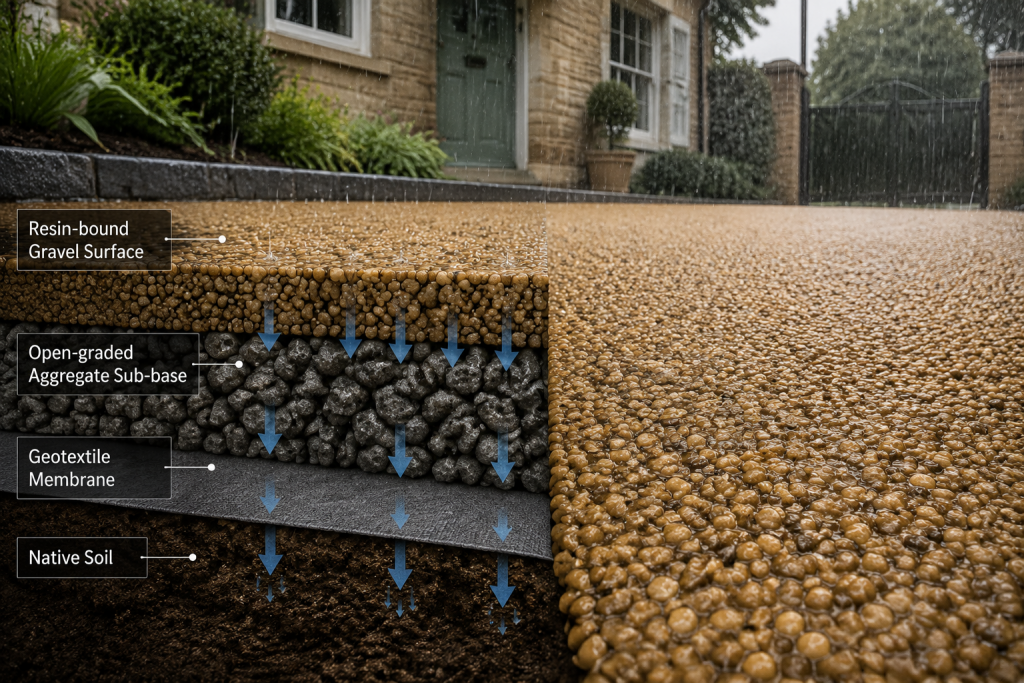
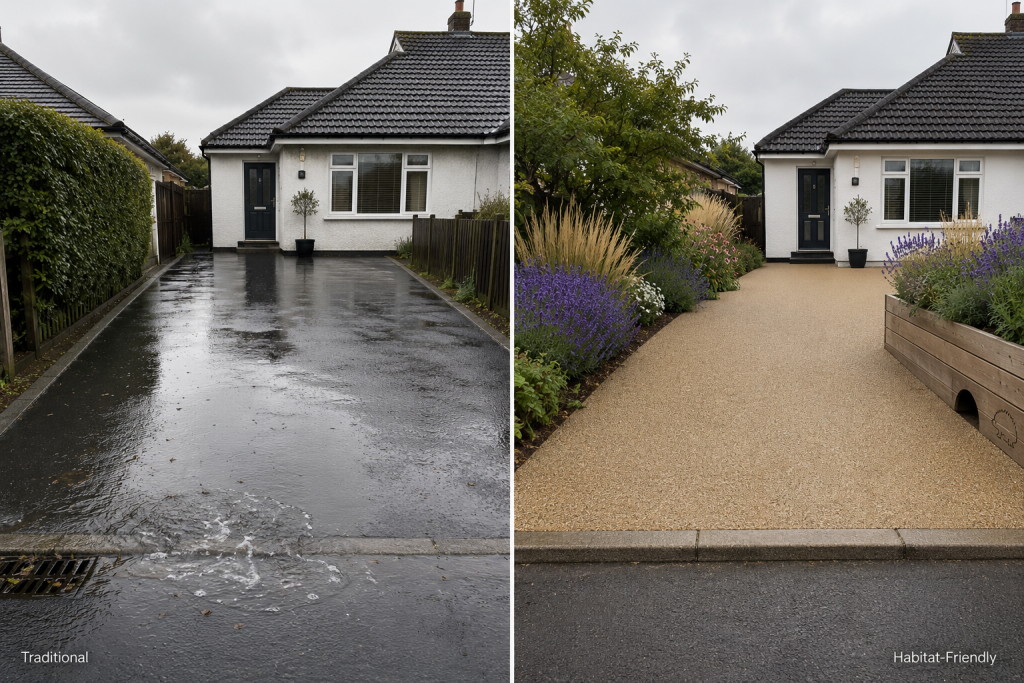
Traditional asphalt sheds water. On a wet Somerset day, that water hits the road, overwhelms gullies, and can flood neighbours downhill. Permeable pavement holds water in an open-graded sub-base and releases it slowly into the soil [8]. That’s why local authorities increasingly favour it.
“The single biggest mistake I see is homeowners spending on a lovely permeable surface, then skimping on the sub-base. Get the layered build right and it’ll drain for decades.” – Ben Sperring, Surfacing Manager
For a deep dive on the regulations, see our SuDS-compliant driveway guide.
Do permeable driveways really reduce flooding?
Yes. Permeable driveways cut surface runoff dramatically compared with sealed surfaces, holding rainwater in the sub-base and releasing it into the ground rather than the storm drain [6][8]. On a typical 40m² driveway, that can mean thousands of litres a year kept out of the sewer network.
The impact is biggest on:
- 🌧️ Sloped sites where runoff picks up speed
- 🏘️ Terraced streets where multiple driveways drain to one gully
- 🌊 Areas with clay soils and high water tables (though these need careful sub-base design)
Permeable systems aren’t magic. If the sub-base is thin, poorly compacted, or clogged with fine silt, drainage performance drops fast. That’s why installation quality matters at least as much as material choice.
How to design a wildlife-friendly front garden alongside a driveway
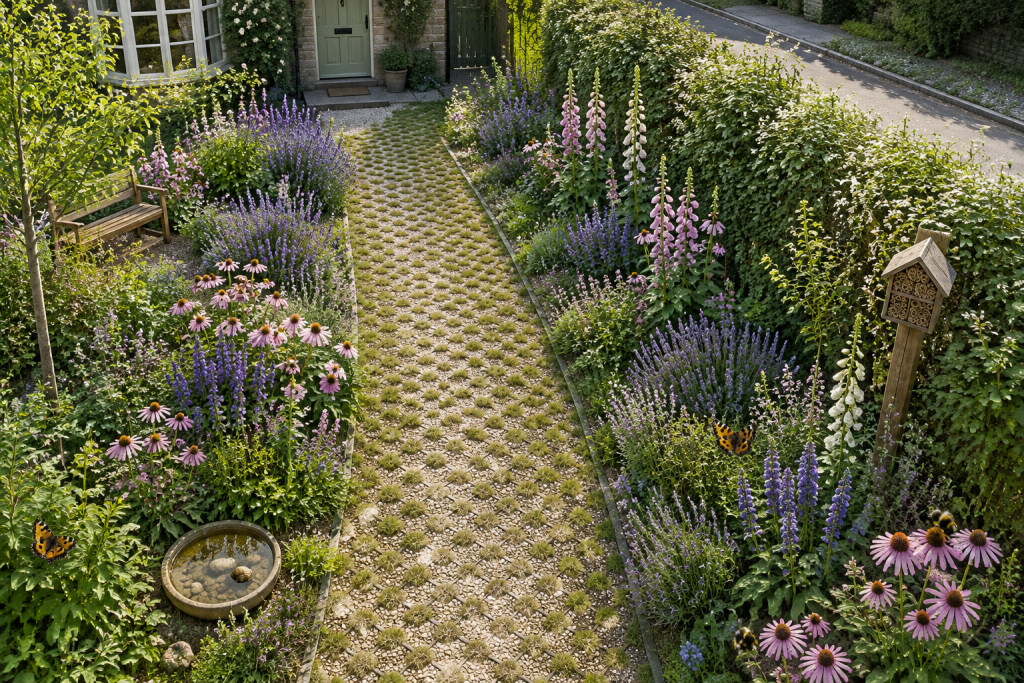
Start by keeping (or adding) a planted strip of at least 30cm along one or both edges of the drive, use native or pollinator-friendly plants, and avoid paving right up to the boundary. Even a narrow border of lavender, salvia and wild marjoram will pull in bees within weeks [4][7].
A simple habitat-friendly front garden layout:
- 🚗 Central driveway in permeable surfacing, sized to your vehicle plus 30cm each side for door swing.
- 🌿 Pollinator borders either side, planted with a mix of spring, summer and autumn flowering species.
- 🌳 Small tree or large shrub (rowan, crab apple, amelanchier) for structure, shade and berries.
- 🦔 A hedgehog gap (13cm x 13cm) in any solid boundary fence.
- 💧 A shallow water dish at ground level, topped up weekly in dry spells.
- 🪵 A discreet log pile or leaf corner tucked behind planting for insects and amphibians.
The Royal Horticultural Society’s guide to greening a grey front garden is a brilliant starting point [10].
Can you mix native plants with a driveway garden in small spaces?
Absolutely. Even a 2m-wide front garden can carry a productive pollinator strip, climbers up the house wall, and a tree in a large planter. The trick is layering: ground cover, mid-height perennials, and something vertical.
Best low-maintenance natives and near-natives for UK driveway borders:
- 🌸 Lavender (Lavandula angustifolia) – drought-tolerant, bee magnet
- 🌼 Wild marjoram (Origanum vulgare) – butterflies love it
- 💜 Foxglove (Digitalis purpurea) – bumblebee favourite
- 🌾 Feather grass (Stipa tenuissima) – movement and texture
- 🌺 Hardy geranium – fills gaps, flowers for months
- 🫐 Hawthorn – excellent boundary hedge, berries for birds
If you’re working with a compact frontage, our narrow driveway design solutions guide shows how to balance parking with planting.
What’s the difference between permeable and porous pavement?
Permeable pavement lets water pass through gaps between the units (like the joints in block paving or spaces in a gravel grid). Porous pavement lets water pass through the material itself (like porous asphalt or resin-bound gravel). Both drain vertically; the mechanism differs.
For most UK homes, permeable block paving and resin-bound gravel are the two most popular routes. Resin-bound is porous (water moves through the resin-and-aggregate matrix), while block paving is permeable (water flows through wider joints filled with clean grit).
Quick example: a resin-bound surface looks smooth and seamless, ideal for wheelchair access, prams and heels. Permeable block paving has visible joints, easier to lift and repair if you ever need to reach a service pipe.
Gravel vs recycled asphalt for green driveways
Gravel wins on permeability and carbon footprint; recycled asphalt wins on smoothness and low maintenance. Choose gravel with a hidden grid for the greenest overall result, or recycled asphalt if you need a fast, hard-wearing surface with meaningful recycled content.
Gravel (with cellular grid):
- ✅ Fully permeable, supports light plant growth in joints
- ✅ Grids often made from 100% recycled plastic [9]
- ✅ Easy to top up or repair
- ⚠️ Needs occasional raking; not ideal for wheelchairs
Recycled asphalt (RAP):
- ✅ Up to 100% reclaimed material in some mixes
- ✅ Smooth, quiet, good for cycling and prams
- ⚠️ Not permeable in standard form
- ⚠️ Still has embodied carbon from binder and heating
Our gravel driveways with hidden grids guide covers grid systems in detail.
Are recycled plastic driveways worth it?
Yes, particularly for gravel stabilising grids and cellular pavers. Recycled-plastic grid systems divert waste from landfill, weigh a fraction of concrete alternatives (cutting transport emissions), and deliver 15-25 years of service when installed on a proper sub-base [9].
Where they shine:
- 🚙 Domestic driveways with light-to-medium traffic
- 🌱 Overflow parking on lawns that need reinforcement
- ♿ Wheelchair-accessible gravel (the grid holds stones flat)
Where they struggle: heavy commercial traffic, poorly drained clay sites without adequate sub-base, and installations that skip the geotextile membrane.
“For a family home, a recycled-plastic grid filled with local aggregate is one of the lowest-carbon, best-value driveways you can build. It’s what I’d choose for my own place.” – Tony Flook, Managing Director
What are the best sustainable driveway options for the UK climate?
For the UK’s wet, mild climate, the strongest sustainable options are resin-bound gravel over an open-graded permeable base, permeable block paving with clean-grit joints, and gravel over recycled-plastic grids. All three handle heavy rain, resist frost damage, and meet SuDS drainage requirements.
Match the material to your site:
- 🌧️ High-rainfall or sloped site: resin-bound gravel with a deep permeable sub-base; consider our steep driveway solutions guide for grip specifics.
- 🏛️ Period property: permeable block paving in traditional clay or reclaimed setts.
- 💷 Tight budget: stabilised gravel with a recycled-plastic grid.
- ⚡ EV owner: any permeable surface works; plan cable routing early with our smart driveway EV charging guide.
How long do sustainable driveway materials last?
Well-installed sustainable driveways last 15-30 years, depending on material and use. Permeable block paving is the longest-lived (20-30 years), followed by resin-bound gravel (15-25 years) and gravel-with-grid systems (15-25 years). Recycled asphalt sits around 15-20 years.
Longevity comes down to three things: sub-base depth, edge restraint, and maintenance. Skip any of them and you’ll shave years off the surface. Our driveway maintenance guide walks through the annual jobs that keep permeable surfaces draining freely.
What’s the real cost of eco-friendly driveway installation in 2026?
For a typical UK driveway of 40m², expect £3,600-£7,200 for permeable installation in 2026, depending on material, sub-base depth and access. Add £400-£1,200 for planted borders and habitat features.
Rough 2026 pricing (installed, per m²):
- Gravel with hidden grid: £70-£120
- Permeable block paving: £95-£160
- Resin-bound gravel: £110-£180
- Habitat border (soil prep, plants, mulch): £60-£120 per linear metre
For a fuller picture, see our driveway installation costs guide for 2026.
Hidden savings people forget: no separate drainage engineering, no planning application fee, and lower long-term repair costs because permeable systems flex slightly with ground movement.
Common mistakes when installing green driveways
The five mistakes we see most often on eco-friendly builds:
- 🚫 Thin sub-base. A permeable surface over compacted clay isn’t permeable. You need 150-300mm of open-graded aggregate underneath.
- 🚫 No geotextile membrane. Fines migrate up, drainage capacity collapses within a few years.
- 🚫 Sealing the edges. A concrete kerb on a permeable driveway can trap water. Use permeable edge restraints.
- 🚫 Paving right to the boundary. You lose your planting strip and the habitat value with it.
- 🚫 Wrong plants. Bedding annuals need constant watering. Natives and drought-tolerant perennials thrive on neglect.
“I’ve seen beautiful resin driveways installed over solid concrete. That’s a waterproof driveway with a permeable surface, no drainage benefit at all. The sub-base is where the eco credentials live.” – Tommy Clancy, Pre-Construction Consultant
How to maintain a habitat-friendly front garden
Maintenance is genuinely light, that’s part of the appeal. Sweep the driveway surface twice a year, top up gravel as needed, and cut back perennials in late winter rather than autumn to leave seed heads and shelter for insects.
Yearly habitat-friendly maintenance calendar:
- 🌸 Spring: cut back last year’s perennials, top up mulch, check hedgehog gaps.
- ☀️ Summer: deadhead lavender after first flush, refill water dish weekly.
- 🍂 Autumn: leave leaf litter in borders, plant spring bulbs for early pollinators.
- ❄️ Winter: brush permeable surface joints, check drainage after heavy rain.
Avoid pressure washing permeable surfaces at maximum settings, it drives fines into the joints and reduces drainage. A stiff broom and occasional low-pressure rinse is enough.
FAQ
Do I need planning permission for a permeable driveway? No, permeable driveways over 5m² are permitted development in England, provided they drain to a permeable surface or planted area. Impermeable surfaces over 5m² do need planning permission.
Can I convert my existing tarmac driveway to permeable? Yes, but it usually means excavating the existing surface and sub-base to install an open-graded aggregate layer underneath. It’s a full rebuild, not an overlay.
Will a gravel driveway work with a wheelchair or pram? Yes, if you use a stabilising grid system. Loose gravel alone is difficult; a grid holds the stones flat and creates a firm, level surface.
Do permeable driveways freeze in winter? They handle frost better than sealed surfaces because water drains away rather than pooling and freezing on top. Sub-base voids also give ice room to expand without cracking the surface.
Can I keep parking space and still add wildlife features? Yes. A 30cm border along one side of a standard driveway costs roughly 1.5m² of planting per parking bay, no parking lost, real habitat gained.
What’s the most sustainable driveway material overall? Gravel with a recycled-plastic grid, using local aggregate and a proper permeable sub-base. Low embodied carbon, fully permeable, and easy to repair or extend.
Conclusion
An eco-friendly driveway isn’t a compromise. Get the sub-base right, pick a permeable surface that suits your site, and leave room for a planted border, and you’ll end up with a front garden that parks the cars, drains the rain, and feeds the bees. Every one of those choices adds up: less runoff on your street, more pollinators in your postcode, and a home that looks looked-after for the next 20 years.
Ready to plan yours? Get in touch for a free driveway quote and we’ll walk through the material, layout and habitat options that fit your property and budget.
References
[1] What’s Replacing Traditional Garden Deck – https://www.homesandgardens.com/gardens/whats-replacing-traditional-garden-deck [2] How To Turn A Front Garden Into A Driveway – https://www.homebuilding.co.uk/advice/how-to-turn-a-front-garden-into-a-driveway [3] Hardscape – https://www.earthstewardecology.com/hardscape [4] Front Garden Designing – https://www.rhs.org.uk/garden-design/front-garden-designing [5] Wildflower Garden Front Yard – https://justarden.com/gardens/wildflower-garden-front-yard/ [6] Eco Friendly Driveway Materials – [7] Habitat Gardens – [8] Permeable Surfaces Driveways Garden Paths – https://www.theidealgarden.com/permeable-surfaces-driveways-garden-paths/ [9] Sustainable Paver Driveways In NYC Eco Friendly Solutions – [10] How To Green Your Grey Front Garden – https://www.rhs.org.uk/garden-design/how-to-green-your-grey-front-garden