Last updated: 1 August 2026
Quick answer
Resurfacing works when your driveway’s base is still solid and the damage is cosmetic – crazing, faded colour, minor cracks, worn topcoat. It typically costs 50-70% less than a full replacement and buys you another 7-10 years. Full replacement makes sense when the sub-base has failed: sunken areas, deep potholes, weeds growing through joints, or drainage problems. A proper replacement lasts 20-30+ years. In short: fix the surface if the foundations are sound; dig it up if they’re not.
Key takeaways
- Resurfacing costs roughly £20-£70 per m² depending on material; replacement runs £60-£150+ per m².
- A resurface lasts 7-10 years. A full replacement can last 30+ years.
- Tarmac and resin are the easiest surfaces to overlay. Block paving usually needs lifting and relaying rather than “resurfacing”.
- If you can see the sub-base moving, weeds pushing through, or standing water, resurfacing is a waste of money.
- Winter installations are possible for block paving, but tarmac and resin need dry conditions above 5°C.
- Getting the diagnosis wrong is the single biggest budget mistake homeowners make.
What’s the difference between resurfacing and replacing a driveway?
Resurfacing means laying a new wearing course (usually 20-40mm thick) directly on top of your existing driveway. Replacement means excavating everything – surface, binder, sub-base – and rebuilding from the ground up.
Think of it like a roof. Resurfacing is re-tiling. Replacement is stripping back to the joists and starting again. Both fix the way things look, but only one fixes what’s underneath.
Resurfacing typically involves:
- Cleaning and prepping the existing surface
- Filling cracks and levelling defects
- Applying a bonding coat
- Laying a fresh wearing course (tarmac, resin, or micro-asphalt)
Replacement typically involves:
- Full excavation (usually 150-250mm deep)
- New Type 1 MOT sub-base, compacted in layers
- New edge restraints and drainage
- New binder course and wearing surface
“Homeowners often ask us to ‘just skim over the top’. Sometimes that’s the right call. But if the base has gone, you’re spending good money on a surface that’ll fail within eighteen months.” – Ben Sperring, Surfacing Manager
How much does driveway resurfacing cost compared to replacement in 2026?
Resurfacing costs roughly £20-£70 per square metre depending on material. Full replacement typically runs £60-£150+ per square metre. On a standard 40m² driveway, that’s a difference of about £2,000-£3,500 up front.
Here’s how the numbers break down for typical UK projects:
Material |
Resurface (per m²) |
Replace (per m²) |
Lifespan gained |
|---|---|---|---|
Tarmac |
£20-£35 |
£60-£90 |
7-10 yrs / 20+ yrs |
Resin-bound overlay |
£40-£70 |
£90-£140 |
10-15 yrs / 20-25 yrs |
Block paving |
Lift & relay: £40-£60 |
£90-£150+ |
5-10 yrs / 25-30 yrs |
Figures are indicative for the South West UK. For a fuller breakdown, see the driveway installation costs 2026 guide.
Resurfacing can save 50-70% upfront compared to full replacement, provided the base is structurally sound. But watch the long game: two resurfaces over 20 years may cost more than one proper replacement.
When should I resurface my driveway vs replace it?
Resurface when the damage is cosmetic and the base is solid. Replace when the structure has failed. It really is that simple; the tricky bit is honest diagnosis.
Choose resurfacing if you have:
- 🔸 Surface crazing, oxidation, or faded colour
- 🔸 Cracks less than 6mm wide with no vertical movement
- 🔸 Worn topcoat but firm underfoot
- 🔸 A driveway less than 15-20 years old with a sound base
Choose replacement if you have:
- 🔹 Sunken areas or rutting where cars park
- 🔹 Potholes or “alligator” cracking across large sections
- 🔹 Weeds coming through the middle (not just the edges)
- 🔹 Standing water suggesting drainage failure
- 🔹 A driveway over 25 years old with no known sub-base spec
There’s a useful three-test rule adapted from commercial concrete work: no active cracks with displacement, no hollow spots, and damage less than 6mm deep. Pass all three and resurfacing is on the table. Fail any one and you’re patching a problem, not solving it.
Can you resurface a tarmac driveway or does it need replacing?
Yes, you can resurface tarmac, and it’s one of the most common and cost-effective driveway repairs in the UK. A fresh 25-40mm wearing course bonded to a sound base gives you a driveway that looks brand new for a fraction of the replacement cost.
Tarmac resurfacing works brilliantly when:
- The existing base is stable and level
- There’s no widespread cracking or crumbling
- Drainage falls are still correct
- You’re not raising the surface above the damp-proof course
It doesn’t work when the binder course has broken up, the sub-base is contaminated, or the driveway sits lower than surrounding ground. For a deeper look at the process, see our tarmac driveway resurfacing guide.
How long does resurfaced tarmac last before needing replacement?
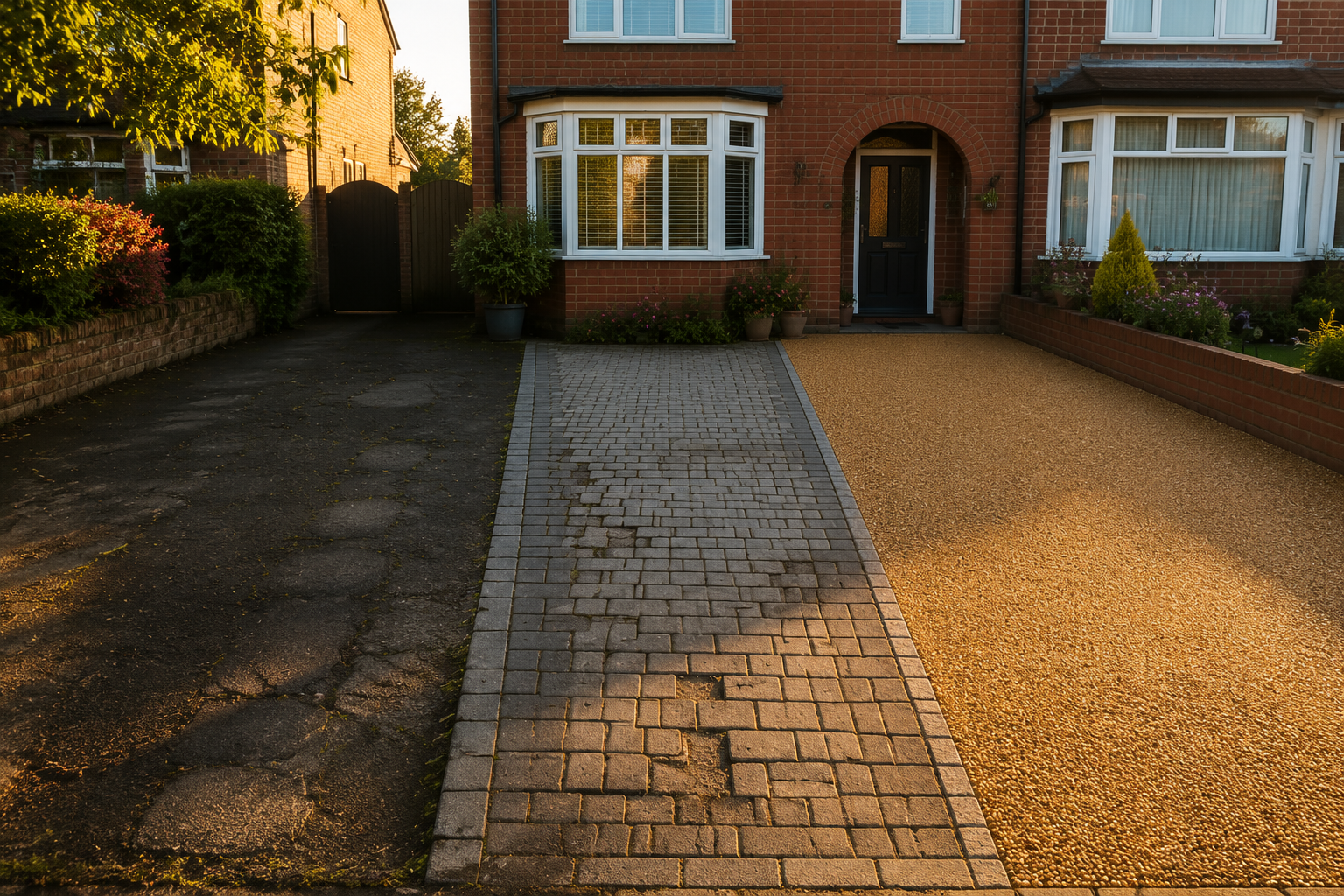
A properly resurfaced tarmac driveway lasts 7-10 years on average, sometimes up to 12-15 with good maintenance. That’s shorter than a full replacement (20-30 years) but represents excellent value if the sub-base is sound.
Lifespan depends on:
- Base condition at the time of resurfacing (biggest factor)
- Traffic loading – vans and multiple cars wear faster than one family car
- Drainage – standing water is tarmac’s worst enemy
- Sealing – a quality sealer every 3-5 years can add years
Regular driveway maintenance is the difference between a resurface that lasts 7 years and one that lasts 12.
Is resin driveway resurfacing cheaper than block paving replacement?
Usually, yes. A resin-bound overlay onto a sound tarmac or concrete base runs £40-£70 per m². A full block paving replacement typically costs £90-£150 per m². On a 50m² drive, that’s a saving of £2,500-£4,000.
But it’s not always the right comparison. Resin needs a solid, permeable-compliant base. If your existing driveway is failing, you’ll still need groundworks, which narrows the gap.
Resin overlay makes real sense when:
- You have a tarmac drive with a good base but tired appearance
- You want a modern, low-maintenance finish
- SUDS compliance matters (choose permeable spec)
- You’d rather not deal with weeds in joints
Our resin driveway colour guide covers the aesthetic side of that decision.
What are the signs my driveway needs replacing instead of resurfacing?
Look for structural failure, not just surface wear. If any of the signs below apply, resurfacing is throwing good money after bad.
- Sunken sections where cars park regularly (sub-base compaction failure)
- Deep potholes exposing the sub-base or bare ground
- “Alligator” cracking – interconnected cracks in a pattern
- Standing water that doesn’t drain within 30 minutes of rain stopping
- Weeds growing through the middle of the surface, not just the edges
- Movement underfoot when you walk across it
- Drainage running the wrong way towards the house
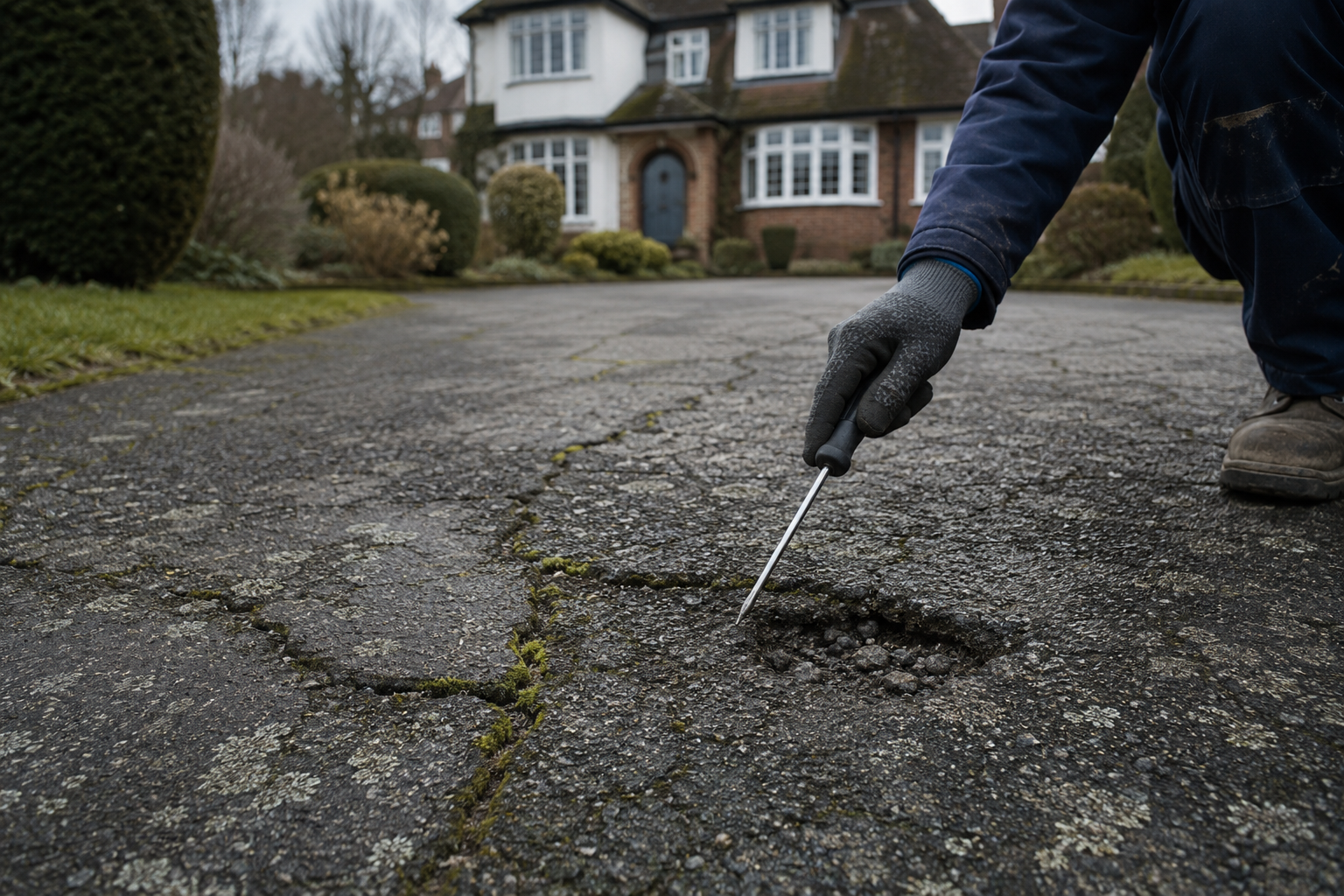
“The test I use: if you can push a screwdriver in and it disappears, or the surface flexes when a car drives on it, you’re past resurfacing.” – Tony Flook, Managing Director
For a wider look at what goes wrong, see our guide on common driveway problems and how to fix them.
Can block paving be resurfaced or do I need to replace it?
Block paving isn’t resurfaced in the traditional sense. Instead, it’s “lifted and relaid” – the blocks are taken up, the base is repaired or renewed, and the same blocks (plus any replacements) are put back down. This gives you most of the benefit of a replacement at 40-60% of the cost.
Lift and relay works well when:
- The blocks themselves are in good condition
- Sinking is localised (a strip or corner, not the whole drive)
- Kerb edges and drainage are still sound
- You have matching replacement blocks or can accept a slight mix
Full replacement is smarter when:
- Blocks are widely cracked, chipped, or discoloured beyond cleaning
- The sub-base has failed across most of the driveway
- You want to change the design or drainage layout
Our block paving driveways page covers what a quality install actually involves.
How do I know if my driveway damage is too bad to just resurface?
Do the three-minute walk test. If you can find any of these, resurfacing probably won’t hold.
- Bounce test – walk across firmly. Any movement or flex under your weight? Base failure.
- Puddle test – after rain, are puddles still there 30+ minutes later? Drainage or level failure.
- Screwdriver test – can you push a screwdriver more than 6mm into a crack? Structural failure.
- Edge test – are the edges crumbling or dropping away? Edge restraint failure.
- Weed test – are weeds coming through the middle of the surface? Base or membrane failure.
Fail one, and you might get away with heavy patching before resurfacing. Fail two or more, and you’re looking at replacement.
What mistakes do people make when choosing between resurfacing and replacement?
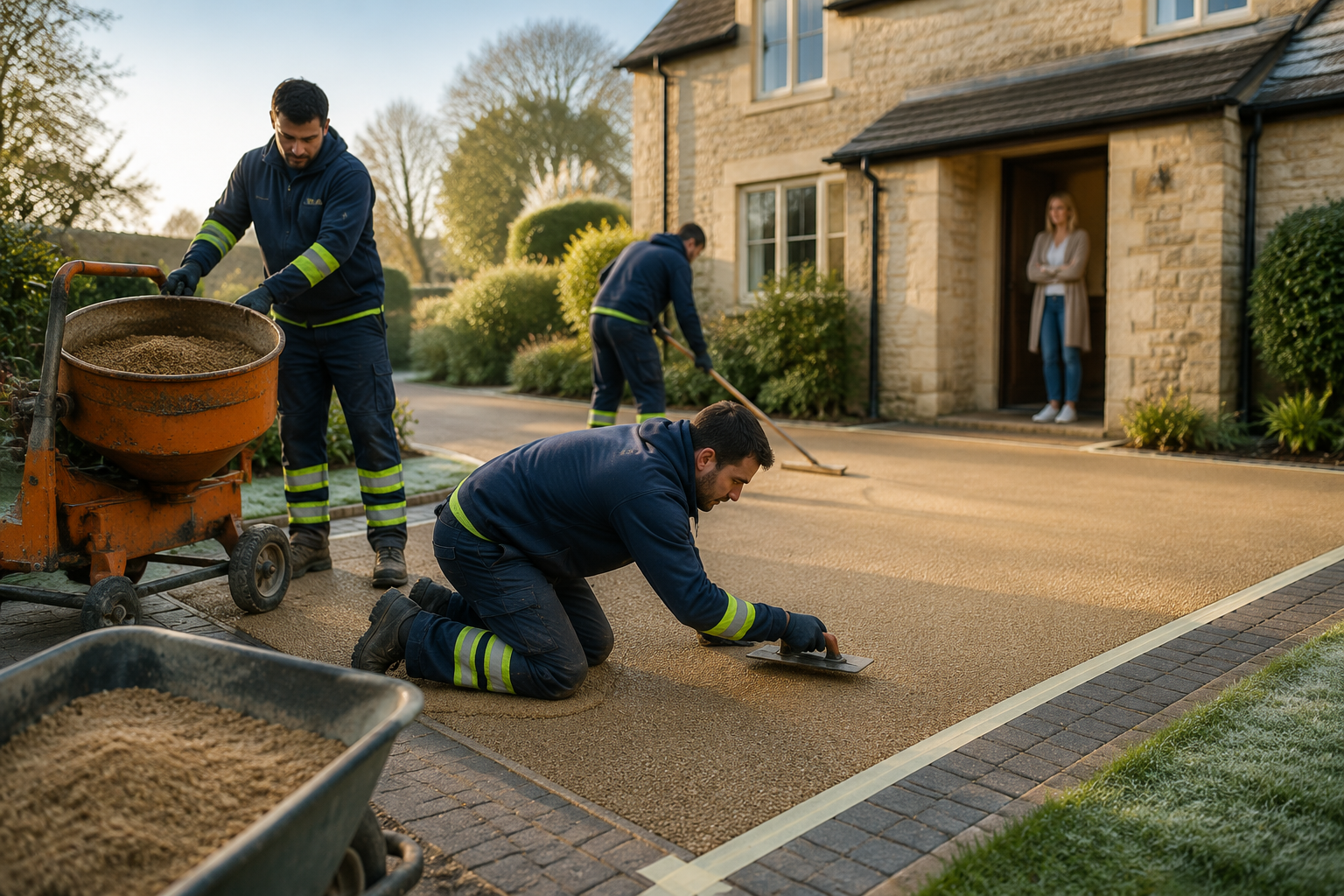
The most expensive mistake is resurfacing over a failing base. Within 12-24 months the same problems telegraph through the new surface, and you’ve paid twice.
Other common pitfalls:
- 🔸 Choosing on price alone without checking the base condition
- 🔸 Skipping drainage repairs because “it looks fine now”
- 🔸 Raising the surface level so it now sits above the damp-proof course
- 🔸 Trusting a “cheap overlay” from a doorstep trader with no written spec
- 🔸 Ignoring edge restraints – a driveway without solid edges fails from the outside in
- 🔸 Not getting a written scope covering depth, materials and warranty
“Nine times out of ten, when we’re called to fix a failed resurface, the original quote didn’t include groundworks or drainage. The cheapest option isn’t cheap if it fails twice.” – Tommy Clancy, Pre-Construction Consultant
Is driveway resurfacing worth it for old tarmac?
Yes, if the base is sound. For a 15-20 year old tarmac drive that’s cosmetically tired but structurally solid, resurfacing is one of the best value home improvements you can make. Expect to spend around 30-40% of replacement cost for a driveway that looks brand new and lasts another decade.
It’s not worth it when:
- The tarmac was laid over garden soil with no proper sub-base
- Drainage was never right in the first place
- You’re planning to sell within 2-3 years and want maximum kerb appeal (buyers see through a fresh overlay)
- You want to add EV charging that needs cable runs beneath the surface – see our smart driveway EV charging guide
Who should choose resurfacing, and who really needs full replacement?
Resurfacing suits you if: your driveway is under 20 years old, the base was properly built, the damage is cosmetic, drainage still works, and you’d rather spend £1,500-£3,000 than £4,000-£8,000.
Replacement suits you if: your driveway is old and its history is unknown, you’ve had ongoing sinkage or drainage issues, you want to change materials (tarmac to resin, or gravel to block), or you’re future-proofing for EV charging and a 25+ year lifespan.
There’s also a middle path: partial replacement plus resurfacing. Dig out and rebuild the failed zones (usually the parking bays), then resurface the whole area for a uniform finish. It’s often the smartest use of budget on driveways with localised failure.
Can you resurface a driveway in winter or bad weather?
Not really, at least not for tarmac and resin. Both need dry conditions and surface temperatures above 5°C (resin ideally 10°C+). Laying in wet or cold weather causes poor bonding, pinholing, and premature failure.
- Tarmac resurfacing: best March-October; possible in mild dry winter spells
- Resin overlay: best April-September; strict weather windows
- Block paving lift and relay: possible year-round if the ground isn’t frozen
If you’re getting quotes in November for a “special winter price” on resin, be cautious. A good contractor will tell you to wait until spring. For more on cold-weather grip, see our steep driveway solutions guide.
FAQ
Does resurfacing add value to my home? Yes, but less than a full replacement. A fresh resurface can add £1,000-£3,000 in perceived value for the cost of the works. A full new driveway typically returns more, especially with premium materials like resin or block paving.
Can I resurface a driveway myself? Small crack repairs and sealing, yes. Full resurfacing, no. It requires proper compaction equipment, hot materials, and bonding coats. DIY overlays almost always fail within 2-3 years.
Do I need planning permission to resurface or replace? Usually no, provided the new surface is permeable or drains to a permeable area. If you’re replacing with a non-permeable surface over 5m², planning permission may be needed. Check the planning portal or your local authority.
How long does resurfacing take? Most residential resurfaces take 1-2 days. A full replacement typically takes 3-5 days depending on size and drainage complexity.
Will a resurface hide all the old cracks? Cosmetic cracks, yes. Structural cracks will telegraph through within months. That’s why the base assessment matters more than the finish.
Is resin overlay slippery when wet? Not when installed correctly with the right aggregate blend. Quality resin-bound systems have excellent grip, often better than smooth tarmac.
Conclusion
The choice between resurfacing and replacement comes down to one honest question: is the foundation sound? If yes, resurfacing saves you 50-70% and buys another 7-10 years of good service. If no, replacement is the only route that won’t cost you twice.
Your next steps:
- Do the five-minute walk test on your driveway today
- Note any sinkage, drainage issues, or edge failures
- Get at least two written quotes with a clear scope and warranty
- Ask each contractor to explain their diagnosis, not just their price
If you’d like an honest assessment of your driveway with no pressure, request a free quote from our team. Twenty-five years of commercial surfacing experience, now dedicated to homes across Bath, Bristol and the wider South West. If you are weighing up a rebuild, our tarmac, resin, block paving, and gravel pages set out what each surface costs to lay properly across Bristol, Bath, and Somerset.