Last updated: 1 August 2026
Quick answer
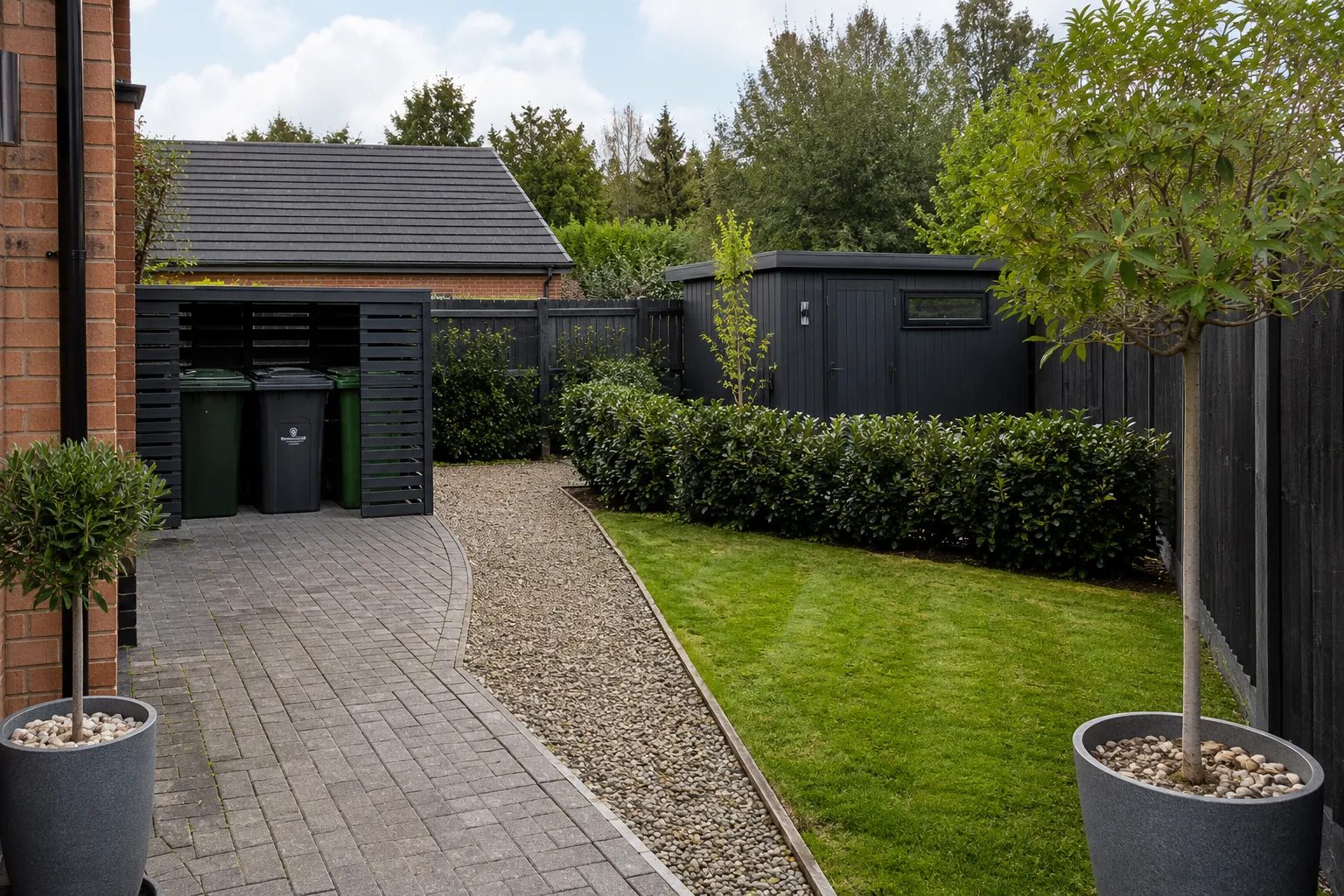
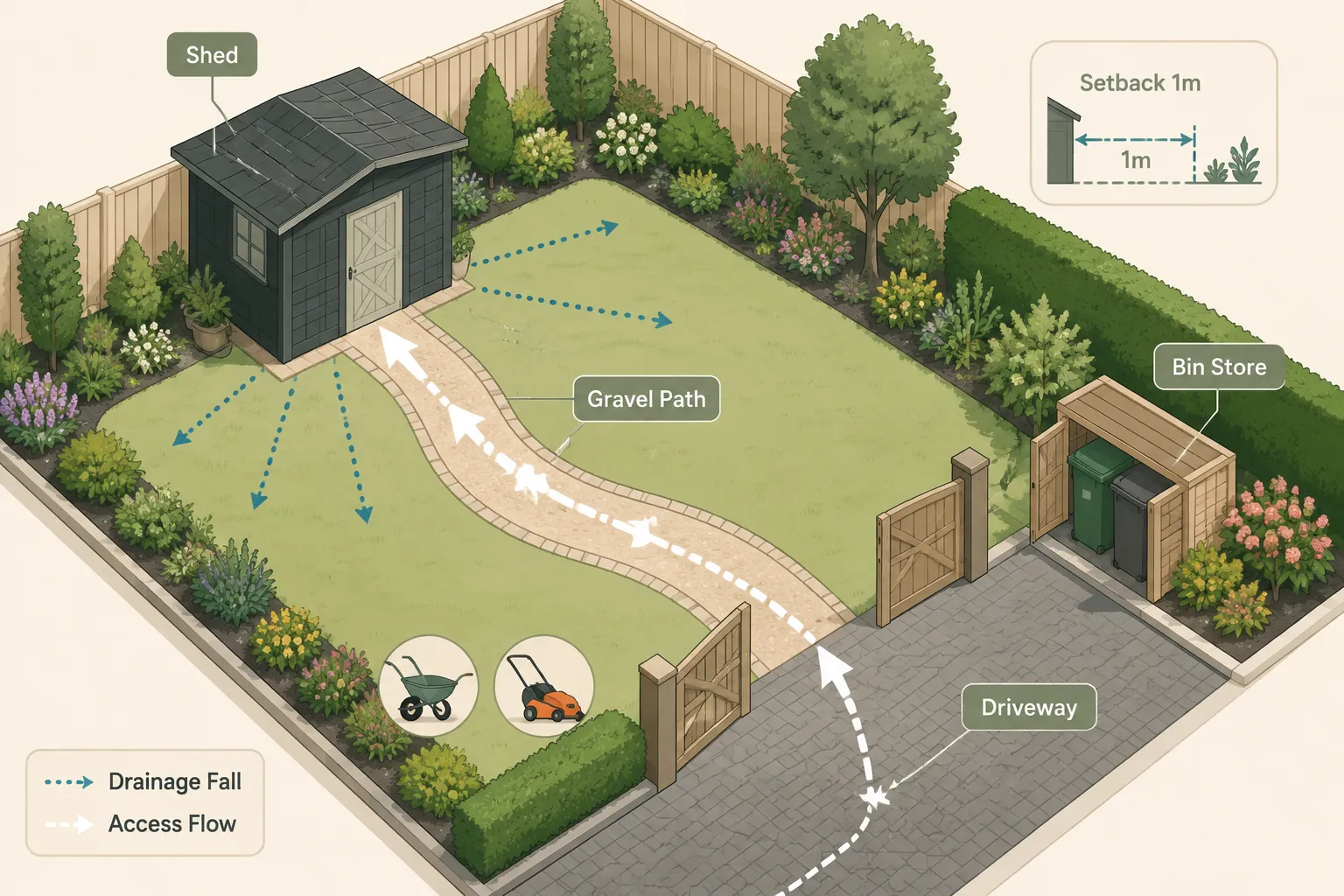
The tidiest gardens keep the shed off the main driveway sightline, connect it with a narrow gravel or resin path (36-48 inches wide) on a proper compacted base, and set the shed 3-5 feet from the house with about a 2% fall for drainage. Do that, and you get practical access, clean kerb appeal, and no muddy tracks across the lawn.
Key takeaways
- 🏡 Position the shed off the driveway sightline, but link it with a dedicated path so access stays practical.
- 📏 Keep sheds 3-5 feet from the house and 3-10 feet from boundaries, subject to local rules.
- 💧 Aim for a 2% fall (roughly 2.4 inches over 10 feet) away from shed walls to protect timber and foundations.
- 🪨 Access paths work best at 36-48 inches wide on 6-8 inches of compacted base.
- 🚗 A shed and driveway can share an access route if widths and turning space still work for the car.
- 🌿 Gravel, resin and stepping stones all screen well; match the path material to the driveway for visual flow.
- 📋 Check permitted development limits before buying a shed over 2.5m tall or 15m² floor area.
What’s the best layout for a garden shed and driveway in a small garden?
In a small garden, tuck the shed into a back or side corner, then run a narrow branch path off the driveway rather than paving the whole route. This keeps parking usable, preserves lawn, and stops the shed dominating the view from the street.
The trick is treating access as a secondary route, not a second driveway. A 900mm gravel or stepping-stone path off the main drive gives you room for a wheelbarrow or mower without eating into planting space. Align the shed door so it faces the path, not the house, and you’ll rarely notice the shed from the kitchen window.
“On tight plots, the biggest mistake is oversizing the access. A metre-wide path beats a three-metre spur every time. It looks intentional, not industrial.” – Tommy Clancy, Pre-Construction Consultant, Driveways Plus
For inspiration on making compact spaces work harder, our narrow driveway design solutions guide covers layouts that free up room for shed access without sacrificing parking.
Choose this layout if…
- 🚙 You park one or two cars and still need bin and shed access.
- 🌱 You want to keep at least half the garden as lawn or planting.
- 👀 The shed would be visible from the front door if placed elsewhere.
How far should a garden shed be from the house?
Most guidance recommends keeping a shed at least 3-5 feet from the house to reduce fire risk, allow maintenance access, and prevent damp bridging between the two buildings. Some local authorities push this further for larger sheds or those with electrics.
That gap matters more than people think. You need room to paint the shed, clean gutters, and get behind it to fix fence panels. Push the shed tight against the house and you’ll regret it the first time a pipe leaks or a rat finds the gap.
If you’re in a conservation area or listed property, check with your council before finalising placement. Permitted development rules can be stricter than the standard defaults.
Can I put a shed right next to my driveway?
Yes, but leave a buffer of at least 300-600mm between the shed wall and the driveway edge for drainage, maintenance, and door swing. Placing a shed directly on the driveway edge causes water to pool against the timber and makes future resurfacing awkward.
A slim planted strip, gravel margin, or timber sleeper edge between the two works well. It softens the transition visually and gives water somewhere to soak away rather than running under the shed floor.
Watch for these edge issues:
- 🚪 Shed door opening into the parking bay (blocks the car).
- 💧 Driveway falling towards the shed instead of away.
- 🌧 No gutter on the shed side facing the drive.
- 🚗 Wing mirrors clipping the shed as you pull in.
What are common mistakes people make with shed placement?
The biggest mistakes are ignoring drainage fall, siting the shed too close to boundaries, and forgetting how you’ll actually walk to it in winter. All three are cheap to fix on paper and expensive to fix after installation.
Here are the recurring ones our team sees:
- No slope away from the shed. Water pools, timber rots, floor sags. Aim for ~2% fall.
- Foundation skipped or undersized. 4-6 inches of compacted stone on geotextile is the minimum for a stable, level base.
- Placed under trees. Sap, leaves, and dripping branches wreck roofs and stain paths.
- Too close to the fence. You can’t paint it, and neighbours can’t repair theirs.
- Access path added as an afterthought. Muddy grass tracks appear within weeks.
- Door facing the wrong way. Facing prevailing wind or rain drives water inside every time you open it.
“We’ve lifted plenty of sheds off soggy patios where the previous owner just plonked it down. A proper base and a metre of clearance would’ve saved them a rebuild.” – Ben Sperring, Surfacing Manager, Driveways Plus
How much does it cost to install a garden shed and driveway together?
Combined costs in the UK typically range from £3,500 to £15,000+ depending on shed size, driveway material, and groundwork. A modest 8×6 timber shed with a resin-bound driveway spur sits mid-range; block paving or a large workshop-style shed pushes costs higher.
Rough 2026 ballpark figures:
Element | Typical cost (UK, 2026) |
Timber shed (8×6, installed) | £800 – £2,200 |
Shed base (concrete or paver) | £300 – £900 |
Gravel access path (10m) | £400 – £900 |
Resin-bound driveway (40m²) | £3,600 – £5,600 |
Block paving driveway (40m²) | £3,200 – £5,200 |
For a full breakdown, see our driveway installation costs guide for 2026.
What’s the difference between gravel and concrete driveways for accessing sheds?
Gravel is cheaper, drains freely and looks natural against a shed; concrete is smoother for wheeled traffic and lasts decades but costs more and needs proper drainage design. For most shed access routes, gravel or resin-bound gravel wins on cost and aesthetics.
Quick comparison:
- 🪨 Gravel – £30-£60/m², SUDS-friendly by nature, easy DIY top-ups, but migrates without proper edging and grids.
- 🧱 Concrete – £70-£110/m², smoothest surface for barrows and mowers, but cracks if the sub-base fails and looks stark.
- 🌊 Resin-bound – £80-£120/m², smooth like concrete but permeable and warmer looking; ideal when you want the driveway and shed path to visually match.
For low-maintenance stability, gravel driveways with hidden grids solve the migration issue without losing the natural look.
Do I need a permit for a garden shed in my backyard?
In the UK, most garden sheds fall under permitted development and don’t need planning permission, provided they’re under 2.5m tall (flat roof) or 4m (dual-pitch), take up less than 50% of your garden, and sit outside the front of the house. Rules tighten in conservation areas, listed buildings, and for sheds with power.
Always double-check with your local planning department before ordering. A five-minute call now saves an enforcement notice later. If you’re adding electrics, you’ll need Part P compliant work, and any driveway over 5m² draining to the highway needs SUDS-compliant permeable paving or soakaways.
How do you design access routes that don’t make your garden look cluttered?
Keep routes deliberate: one main path, one branch, matching materials, and clean edges. Cluttered gardens usually have three or four competing paths in different materials with no clear hierarchy.
Design principles that work:
- 🎯 Align the primary path with the front door sightline; branch secondary paths from there.
- 🧭 Give each route a purpose – parking, shed access, bin store, garden entry – and don’t cross them.
- 🪞 Match or complement materials across driveway and paths so the eye reads it as one system.
- 🌾 Use planting to soften edges rather than adding decorative borders that fight for attention.
- 💡 Low-voltage lighting at corners and thresholds sharpens the layout after dark without gimmicks.
“Kerb appeal isn’t about adding more; it’s about editing. One considered path always beats three decorative ones.” – Tony Flook, Managing Director, Driveways Plus
Browse real driveway and access route projects to see how coordinated materials transform a scattered garden into a coherent one.
What size driveway do I need if I have a large garden shed?
For a large shed used as a workshop or storage for bikes and machinery, allow a driveway at least 3m wide at the access spur, with a turning or unloading zone of 3m x 3m near the shed. Standard 2.4m car widths don’t leave room for opening doors and moving stock.
If you’re storing a ride-on mower, trailer, or motorbike, size the access route to the widest item plus 600mm clearance either side. Nothing spoils a tidy layout faster than dragging a mower across the lawn because the path’s too narrow.
What are the best materials for pathways between shed and house?
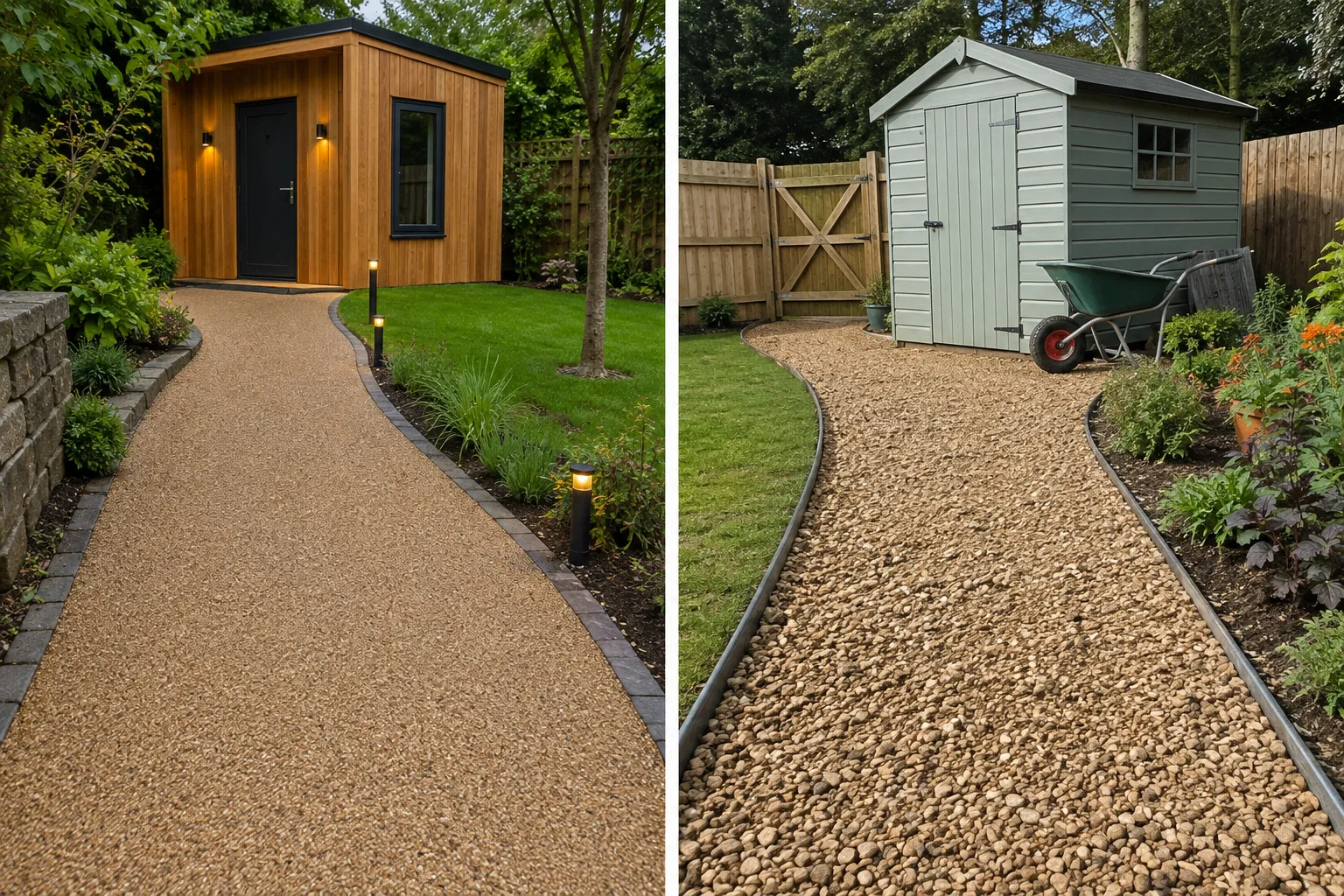
The best pathway materials are resin-bound gravel, self-binding gravel, block paving, or large-format porcelain pavers on a compacted 6-8 inch base. Each handles UK weather well and keeps edges crisp.
Quick guide:
- 🌾 Self-binding gravel – natural look, permeable, best for informal gardens.
- 🧱 Block paving – hardwearing, matches most driveways, easy to lift for repairs.
- 🪨 Porcelain pavers – premium finish, low maintenance, excellent for modern homes.
- 🌊 Resin-bound – seamless with a matching driveway, permeable, no weeds.
For matching finishes, see our best driveway material comparison.
How do you hide or screen a garden shed from the street?
Screen with a combination of evergreen hedging (laurel, yew, or photinia), timber trellis with climbers, or a strategically placed fence panel. The goal is to break the sightline from the pavement, not build a wall.
A 1.5m laurel hedge planted 600mm in front of the shed hides most of it within two seasons. If you need instant screening, a slatted timber panel with jasmine or clematis growing through it looks intentional rather than defensive. Painting the shed a muted heritage green or charcoal also helps it recede visually.
Can a shed and driveway share the same access route?
Yes, provided the shared section is wide enough for the car with doors open (minimum 3.2m) and the shed access branches off cleanly without forcing pedestrians to weave between vehicles. A shared route works well when the shed sits behind or beside the parking area.
Two rules to follow:
- Never route pedestrian shed access across the parked car’s blind spot.
- Always give the shed spur its own surface change (gravel off resin, for example) so the branch reads as a footpath, not a driving surface.
What drainage considerations matter for sheds near driveways?
Drainage is the single biggest factor in whether a shed-and-driveway layout still looks tidy in five years. You need fall away from the shed, permeable surfaces or SUDS drainage for the driveway, and no low points where the two meet.
Key targets:
- 📐 2% fall away from shed walls (roughly 2.4 inches over 10 feet).
- 🌊 Permeable driveway surface, or a linear drain at the driveway-shed junction.
- 🪵 Shed floor raised at least 100mm above surrounding ground level.
- 🍂 Gutters and downpipes on the shed, discharging to a soakaway or water butt.
Get this wrong and you’ll see rotting timber, green algae on the path, and puddles that never dry. Get it right and the whole layout stays crisp through wet UK winters. For more on managing water properly, see our tarmac driveway resurfacing and drainage guide.
FAQ
Can I build a shed on my driveway permanently?
Only if the driveway sub-base is designed to support it, and doing so doesn’t breach planning or covenants. Most driveway bases aren’t level enough or built for point loads, so you’d typically overlay a proper shed base first.
How long should a shed access path last?
A properly built path on a 6-8 inch compacted base with edge restraints should last 15-25 years with minimal maintenance. Skip the base and you’ll be relaying it within 3-5 years.
Do I need to insure a garden shed?
Most home insurance policies cover garden sheds as outbuildings, but check contents limits. Expensive tools, bikes, or ride-on mowers often exceed standard outbuilding cover and need adding specifically.
What’s the tidiest shed colour for a small garden?
Muted greens, charcoal, or dark grey recede visually and let planting take centre stage. Bright orange cedar or unpainted timber can dominate a small plot.
Can I have a shed and a bin store on the same driveway?
Yes, and it’s often the tidiest solution. Group the bin store, shed access, and any external tap into a single service zone off the driveway so the rest of the garden stays uncluttered.
How do I stop weeds growing between the driveway and shed path?
Use a woven geotextile membrane under the sub-base, keep edge restraints tight, and either pointing (for pavers) or a resin-bound top layer to seal joints. Our driveway maintenance guide covers ongoing care.
Conclusion
A tidy garden isn’t about having the biggest shed or the smoothest driveway; it’s about how the two connect. Get the setback right (3-5 feet from the house, 3-10 feet from boundaries), add a proper compacted base, keep the access path narrow and purposeful, and match materials so the layout reads as one intentional design.
Your next steps:
- Sketch your plot with existing driveway, doors, and boundaries marked.
- Test walk your proposed shed-to-driveway route with a wheelbarrow.
- Check drainage fall and permitted development limits.
- Get quotes from installers who understand groundwork, not just kit assembly.
Ready to plan a layout that actually works? Get in touch with the Driveways Plus team for a free consultation on integrating shed access with a new or existing driveway. Planning the access route at the same time as the drive saves digging it twice. Our gravel and resin pages cover the build-up a footpath needs, and the survey is free.