Last updated: June 27, 2026
Quick answer
If your home sits in or near a UK Special Protection Area (SPA), your driveway must let rainwater soak away on-site, not pour into the road or a stream. The simplest route to planning approval is a permeable surface (resin-bound, permeable block paving, porous asphalt or gridded gravel) laid over an open-graded sub-base, paired with a soakaway, drainage channels and a strip of planting. Get those four elements right and you’ll usually pass first time.
Key takeaways
- Permeable driveways let rainwater drain through the surface, mimicking how natural ground behaves before it was built on.
- SUDS (Sustainable Drainage Systems) are the UK framework councils use to judge whether your drainage plan is acceptable.
- In SPA zones, councils scrutinise nitrate and phosphate run-off, so on-site infiltration is usually essential.
- Driveways over 5m² that drain to the highway normally need planning permission; permeable ones usually don’t [10].
- Costs in 2026 range from roughly £75/m² for gridded gravel to £160/m²+ for premium resin-bound systems.
- Even clay soils can support permeable driveways when paired with a properly sized soakaway or attenuation crate.
- A blocked permeable surface can be restored, not replaced, with the right vacuum cleaning kit.

What are permeable driveway materials and how do they work?
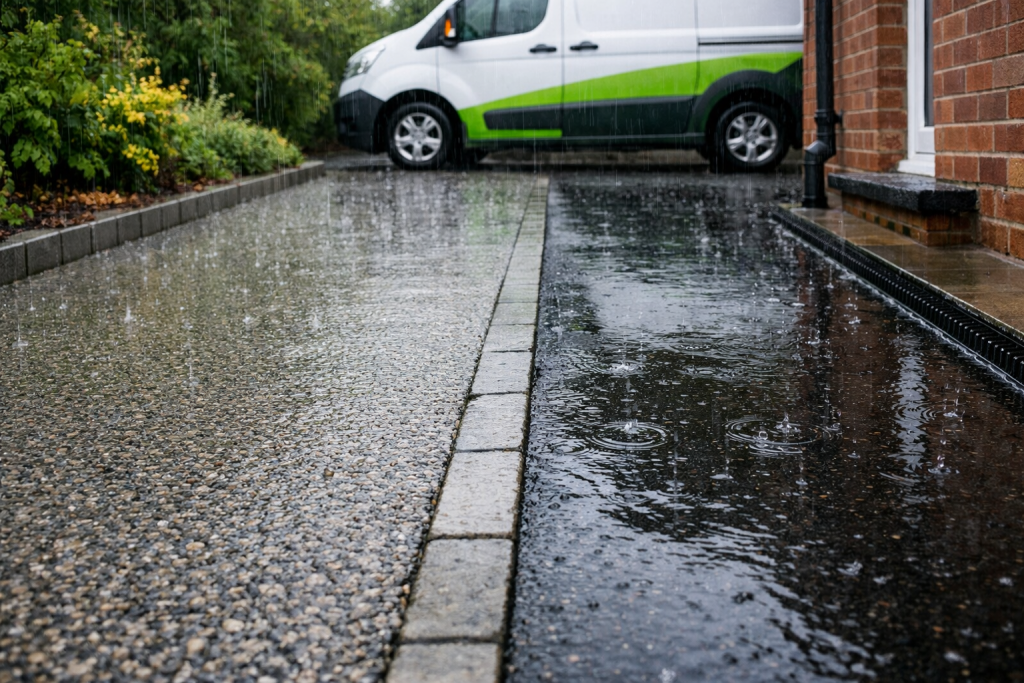
Permeable driveway materials let water pass straight through the surface into a free-draining sub-base below, where it slowly soaks into the ground or feeds a soakaway. Traditional concrete and tarmac shed water sideways. Permeable systems absorb it.
The “magic” isn’t really in the surface; it’s in the build-up beneath. A typical permeable driveway has:
- 🪨 An open-graded sub-base (usually 150-250mm of angular 4/20mm stone with no fines)
- 🧵 A geotextile membrane separating layers
- 💧 The permeable surface itself (resin, blocks, porous asphalt or gridded gravel)
- 🌱 Edge drainage (channels, rain gardens or soakaways) for overflow in heavy storms
“Most homeowners think the driveway is what they walk on. The truth is, 80% of the performance sits in what you can’t see, the sub-base.” — Ben Sperring, Surfacing Manager, Driveways Plus
For a deeper material breakdown, our driveway material comparison guide lays out the trade-offs side by side.
What is SUDS and why does it matter for UK driveways?

SUDS stands for Sustainable Drainage Systems. It’s the approach UK councils and the Environment Agency use to manage surface water so new hard surfaces don’t worsen flooding or pollute watercourses [9].
For driveways, SUDS thinking boils down to three things:
- Slow the water down
- Let it soak in where it falls
- Clean it as it filters through
Since 2008, paving more than 5m² of your front garden with an impermeable surface that drains to the highway has required planning permission [10]. A SUDS-compliant permeable driveway sidesteps that headache and protects local rivers and aquifers.
What does Special Protection Area mean for my driveway?
A Special Protection Area is a legally protected site for rare or vulnerable birds, designated under UK and retained EU law. Many SPAs also overlap with sensitive water catchments, like the Somerset Levels, the Solent or the Severn Estuary.
If you’re within or close to one, your local authority will want hard evidence that your driveway:
- Doesn’t increase surface water runoff
- Doesn’t add nitrate or phosphate pollution to nearby watercourses
- Maintains existing tree roots and habitat where possible
In practice, that means a permeable surface, an infiltration calculation, and often a small planted buffer. Skip those and your application gets bounced.
How much do permeable driveway materials cost in the UK?
Permeable driveway costs in 2026 sit roughly 15-25% higher than impermeable equivalents because of the deeper sub-base and specialist surfaces. Here’s a realistic 2026 price guide for a fully installed driveway in southern England:
Material |
Typical cost (per m²) |
Lifespan |
Best for |
|---|---|---|---|
Gridded gravel (e.g. Gravelrings) |
£75-£110 |
20-25 yrs |
Budget SPA projects, rural homes |
Permeable block paving |
£110-£150 |
25-30 yrs |
Traditional kerb appeal, heavy use |
Porous asphalt |
£90-£130 |
15-20 yrs |
Larger drives, fast install |
Resin-bound (over permeable base) |
£120-£170 |
20-25 yrs |
Premium finish, contemporary homes |
Permeable concrete (e.g. Pervia) |
£130-£180 |
25-30 yrs |
High-spec commercial-grade |
For a deeper look at budgeting, our 2026 driveway installation costs guide breaks down labour, materials and prep work.
What are the best permeable driveway materials for heavy rainfall areas?
For high-rainfall locations like the West Country, the Lake District or upland Wales, you want surfaces with the highest tested infiltration rates and the deepest attenuation potential.
The strongest performers we install:
- 💧 Trailflex flexible paving — up to 80,000 litres/m²/hour, brilliant over clay [3]
- 🧱 Marshalls Priora permeable block paving — proven SUDS performance with attenuation void [8]
- 🛣️ Breedon porous asphalt — around 20% void content for rapid drainage [4]
- 🏗️ Cemex Pervia permeable concrete — up to 1,000 litres/m²/minute infiltration [2]
- 🪨 Resin-bound over open-graded sub-base — proper SuDS compliance when specified correctly [1]
Pair any of these with an attenuation crate soakaway sized for a 1-in-100-year storm event plus 40% climate change uplift, which is what most councils now require.

Permeable driveway vs traditional concrete: which is better?
For SPA homes, permeable beats traditional concrete on every measure that matters to planners. Traditional concrete sheds water, contributes to flash flooding, and almost always requires planning permission if it drains to the road.
Quick comparison:
- ✅ Permeable: SUDS-compliant, usually permitted development, supports planting, manages storm peaks
- ❌ Traditional concrete: Impermeable, planning needed over 5m², contributes to runoff, can crack without movement joints
Choose traditional concrete only if you’re outside an SPA, well away from watercourses, and have a clear surface-water drainage route already approved. Otherwise, go permeable.
Can I install a permeable driveway myself or do I need a professional?
You can DIY a small gridded gravel area, but for anything over about 20m² (or any installation needing planning sign-off in an SPA), use a professional. The reason is simple: the sub-base depths, geotextile placement and soakaway sizing have to be right, or the whole system fails within a couple of winters.
A qualified installer will:
- 🔍 Carry out a percolation test on your soil
- 📐 Size the sub-base and soakaway for your roof and driveway area
- 📋 Provide drainage calculations for your planning application
- 🛠️ Lay edge restraints and movement joints correctly
- ✅ Issue a warranty (typically 10-15 years on workmanship)
“We’ve fixed plenty of failed DIY permeable drives. The surface looked great on day one. Then the first big storm hit, the sub-base hadn’t been compacted in the right layers, and the whole lot slumped.” — Tommy Clancy, Pre-Construction Consultant
How do you maintain and clean a permeable driveway?
Permeable driveways need light, regular maintenance to stop the surface voids clogging with silt, moss and leaf debris. Done properly, you’ll keep 90%+ of original infiltration for 20 years.
Your annual routine:
- 🍂 Sweep or leaf-blow autumn debris weekly through October-December
- 🧹 Stiff-brush the surface twice a year
- 🌀 Specialist vacuum cleaning every 2-3 years (mechanical sweepers extract trapped silt)
- 🚫 Avoid jet washing on resin-bound surfaces at high pressure; use a wide fan tip on low setting
- 🌿 Treat moss promptly before it spreads into the joints
Our driveway maintenance guide for 2026 has a full seasonal checklist worth bookmarking.
Do permeable driveways work in clay soil or poor drainage?
Yes, but they need a properly designed attenuation layer. Clay soil drains slowly, so the sub-base has to hold the storm water temporarily and release it gradually, either into the ground via a deeper soakaway, into a rain garden, or into a controlled outfall.
The recipe for clay sites:
- Deeper sub-base (250-350mm instead of the usual 150mm)
- Attenuation crates beneath the sub-base for extra void capacity
- A perforated overflow pipe to a rain garden or swale
- Native planting to absorb residual water
Trailflex and similar flexible systems work especially well on clay because they tolerate seasonal ground movement [3].
Permeable driveway planning permission requirements in SPA areas
In Special Protection Areas, even permeable driveways may need a formal planning application, not because of the paving itself, but because of nitrate/phosphate neutrality rules. Always check with your local planning authority before starting.
What planners typically want to see:
- 📄 A site plan showing existing and proposed surfaces
- 💧 A surface water drainage strategy
- 🧪 Soil percolation test results
- 🌱 A landscaping/planting plan (often required as a buffer)
- 🦅 A statement confirming no impact on SPA features
If your driveway is over 5m², uses permeable materials, and drains within your own boundary, you usually qualify as permitted development [10]. But SPA overlays can override that, so a quick call to the planning duty officer saves weeks of grief.
For more on compliant design, see our guide to a SUDS compliant driveway in the UK.
What happens if a permeable driveway gets blocked or fails?
A blocked permeable surface stops draining and starts puddling, which looks alarming but is almost always fixable without ripping the drive up. The most common cause is silt and organic matter clogging the surface voids.
The fix, in order of escalation:
- 🧹 Mechanical sweep and stiff brush
- 🌀 Specialist vacuum cleaning (restores 70-90% of original infiltration)
- 🔧 Targeted surface re-dressing for resin or gravel systems
- 🏗️ Partial lift-and-relay for block paving if joint material has compacted
Total failure (sub-base collapse) is rare and usually points to poor original installation. Our team at Driveways Plus has rescued plenty of these jobs without full replacement.
Are permeable driveways worth it for water management?
Yes, especially in SPA zones, conservation areas and flood-risk postcodes. The Local Government Association is clear: permeable surfaces materially reduce surface water flood risk and improve local water quality [9].
The wider benefits:
- 💷 Higher property valuation (kerb appeal plus future-proofing)
- 🏛️ Easier planning approval for extensions later
- 🌍 Lower carbon footprint vs traditional concrete
- 🌧️ Genuine flood resilience as UK rainfall patterns intensify
“A permeable drive isn’t a luxury anymore. With the way rainfall’s changing, it’s quietly become one of the smartest investments you can make in your home.” — Tony Flook, Managing Director, Driveways Plus
What are the alternatives to gravel and porous asphalt?
If you want something more refined than gravel but more traditional than porous asphalt, you have three excellent options.
- 🪨 Resin-bound aggregate over an open-graded base, smooth, seamless and SUDS-compliant when specified correctly [1]. See our resin driveway colour guide for inspiration.
- 🧱 Permeable block paving like Marshalls Priora, classic kerb appeal with engineered drainage joints [8]
- 🌳 No-dig grid systems (e.g. CORE TRP) that protect tree roots, ideal for SPA homes with mature trees [7]
For homeowners after the natural look without loose stones, our guide to gravel driveways with hidden grids is worth a read.

How long do permeable driveways last before replacement?
A well-installed permeable driveway lasts 20-30 years depending on the material and maintenance. Permeable block paving and Pervia concrete sit at the top end (25-30 years), while porous asphalt is typically 15-20 years.
What shortens lifespan:
- 🚛 Heavy vehicles on a residential-spec build
- 🍂 Neglected leaf and silt buildup
- ❄️ Salt-heavy de-icing on resin or asphalt
- 🌳 Tree roots without root barriers
What extends it:
- ✅ Annual sweeping and biennial vacuum cleaning
- ✅ Quality edge restraints
- ✅ Resealing where the material allows it
- ✅ Annual visual check on drainage outfalls
FAQs
Do I need a soakaway for a permeable driveway? Usually yes. Even highly permeable surfaces benefit from an attenuation layer or soakaway to handle extreme storm events. Your installer should size it based on a percolation test.
Will a permeable driveway affect my home insurance? No, in fact several insurers look favourably on SUDS-compliant drives in flood-risk postcodes because they reduce surface water risk to the property.
Can I lay a permeable driveway over an existing concrete base? Only if the existing base is broken up or drilled to allow infiltration. Otherwise water just sits on top of the impermeable layer and the system fails.
How close to mature trees can I install a permeable driveway? With a no-dig system like CORE TRP you can work right up to the root protection area without damaging the tree [7]. Conventional excavation should stay outside the canopy drip line.
Are resin-bonded and resin-bound the same thing? No. Resin-bound is permeable and SUDS-compliant; resin-bonded is a scattered surface coating and is not permeable [1]. Always confirm which one you’re being quoted for.
What’s the quickest permeable driveway to install? Porous asphalt or gridded gravel can typically be installed in 2-3 days for a standard double drive, weather permitting. Resin-bound and block paving usually take 4-7 days.
Conclusion: protect your home and your local SPA in one job
A permeable driveway in or near a Special Protection Area isn’t just a planning hurdle, it’s a chance to genuinely future-proof your home against heavier rainfall, protect the rare habitats on your doorstep, and add long-term value.
The practical next steps:
- 📞 Call your local planning duty officer to confirm SPA constraints
- 🧪 Book a soil percolation test
- 📐 Get a detailed quote that includes sub-base spec, soakaway size and drainage calculations
- ✅ Choose a contractor who can hand you a SUDS-compliant design pack for planning
When you’re ready to talk it through with someone who’s done this hundreds of times across the South West, get a free, no-obligation quote from Driveways Plus. We’ll walk you through the options on your specific site, no jargon, no pressure.
References
[1] Is A Resin Driveway Suds Compliant In 2026 UK – https://www.bestbuilders.co.uk/guides/insights/is-a-resin-driveway-suds-compliant-in-2026-uk [2] Pervia Permeable Porous Concrete Solution For SUDS – https://www.cemex.co.uk/products/readymix-concrete/pervia-permeable-porous-concrete-solution-for-suds [3] Trailflex – https://www.sudstech.co.uk/trailflex/ [4] Breedon Porous – https://www.breedongroup.com/products/products-gb/asphalt/residential-driveways/breedon-porous [5] Sudstech – https://www.sudstech.co.uk/sudstech/ [6] Gravelrings – https://beauxfort.com/landscape-systems/gravelrings/ [7] CORE TRP Driveways – https://www.coretrp.co.uk/applications/driveways/ [8] Marshalls Permeable Paving SUDS – https://www.marshalls.co.uk/landscaping/tools-and-support/permeable-paving-suds [9] Sustainable Drainage Systems – https://www.local.gov.uk/topics/severe-weather/flooding/sustainable-drainage-systems [10] Guidance on Driveways – https://www.luton.gov.uk/planning-building-control/planning/guidance-driveways