Last updated: April 29, 2026
Quick answer
A rustic gravel and Grass Driveways layout gives you a softer, more natural entrance than a solid tarmac or concrete drive, while still supporting daily vehicle use when the base is built correctly. The best results in 2026 use angular crushed stone, a proper layered sub-base, geotextile membrane, defined edging, and grass reinforcement where tyres will load the surface. If you want a driveway that feels settled into the landscape rather than imposed on it, this is one of the most attractive options.
Key takeaways
- Gravel and grass driveways work best on rural, period, prestige, and landscape-led homes where a hard urban surface would look too heavy.
- Angular crushed gravel is better than rounded pea gravel because sharp edges interlock and reduce movement under tyres [2].
- A three-layer build-up is now the smarter 2026 standard, often using larger stone below, smaller crushed stone in the middle, and a neat surface dressing above [2].
- Grass needs reinforcement in trafficked zones, especially on turning heads, parking bays, and access lanes used every day.
- Defined borders matter because they stop gravel migration, protect lawn edges, and make a casual driveway feel intentional [1].
- Permeable layouts can help manage rainwater, but site drainage, soil type, and local planning rules still need checking.
- Steep drives need extra care, with tighter-compacting material such as crusher run often performing better on slopes [2].
- Maintenance is simple but not zero, usually involving raking, weed control, topping up gravel, and checking drainage channels.
- The right design can protect kerb appeal and property value, especially where the driveway is part of the first impression.
- A contractor’s base preparation matters more than the surface you see.
“A natural-looking driveway should never mean a casual build. The hidden structure is what protects the investment.”
Tony Flook, Managing Director, Driveways Plus, 25+ years’ experience
What are gravel and Grass Driveways, and when do they make sense?
Gravel and Grass Driveways combine loose or stabilised gravel with living grass strips, reinforced turf, or planted edges to create a softer driveway that blends into the garden. They make most sense when you want a rural, informal, or estate-style entrance without losing practical vehicle access.
A classic version has two gravel wheel tracks with a grass strip down the middle. A more modern version uses reinforced grass grids, hidden gravel grids, or mixed bays where gravel handles tyres and grass softens the look.
You’ll often see this approach on:
- 🏡 Country homes and converted barns
- 🌿 Prestige properties with large gardens
- 🧱 Period homes where concrete feels too harsh
- 🚗 Low to medium-use residential drives
- 🏘 Small developments that need softer shared access
- 🏢 Boutique commercial sites, such as lodges or rural offices
The charm is obvious.
The risk is also obvious if it’s badly built. Gravel spreads. Grass ruts. Water collects. Edges crumble.
That’s why the layout must suit the land, not just the mood board.
🌱 Choose this style if…
Choose a gravel and grass driveway if your priority is natural landscape integration, drainage-friendly design, and a relaxed premium look. It’s especially strong where the property has planting, stone walls, timber gates, paddocks, or mature trees.
⚠️ Think twice if…
Avoid a basic grass-and-gravel layout if you have constant van traffic, very tight turning, poor drainage, or a steep slope without engineered support. In those cases, you may need reinforced gravel grids, a stronger apron, or a different surface. Our guide to gravel driveways with hidden grids explains how discreet stabilisation can keep the natural look while improving performance.
Quick example: A farmhouse entrance with long sight lines can carry a loose, sweeping gravel lane beautifully. A compact town driveway with three-point turns every morning needs a firmer, more contained design.
How should gravel and Grass Driveways be built so they last?
Gravel and Grass Driveways last when the installer treats the base as the main structure, not as an afterthought. In 2026, the better approach is a layered system with geotextile separation, compacted sub-base, angular stone, and reinforced grass where wheels pass regularly [2].
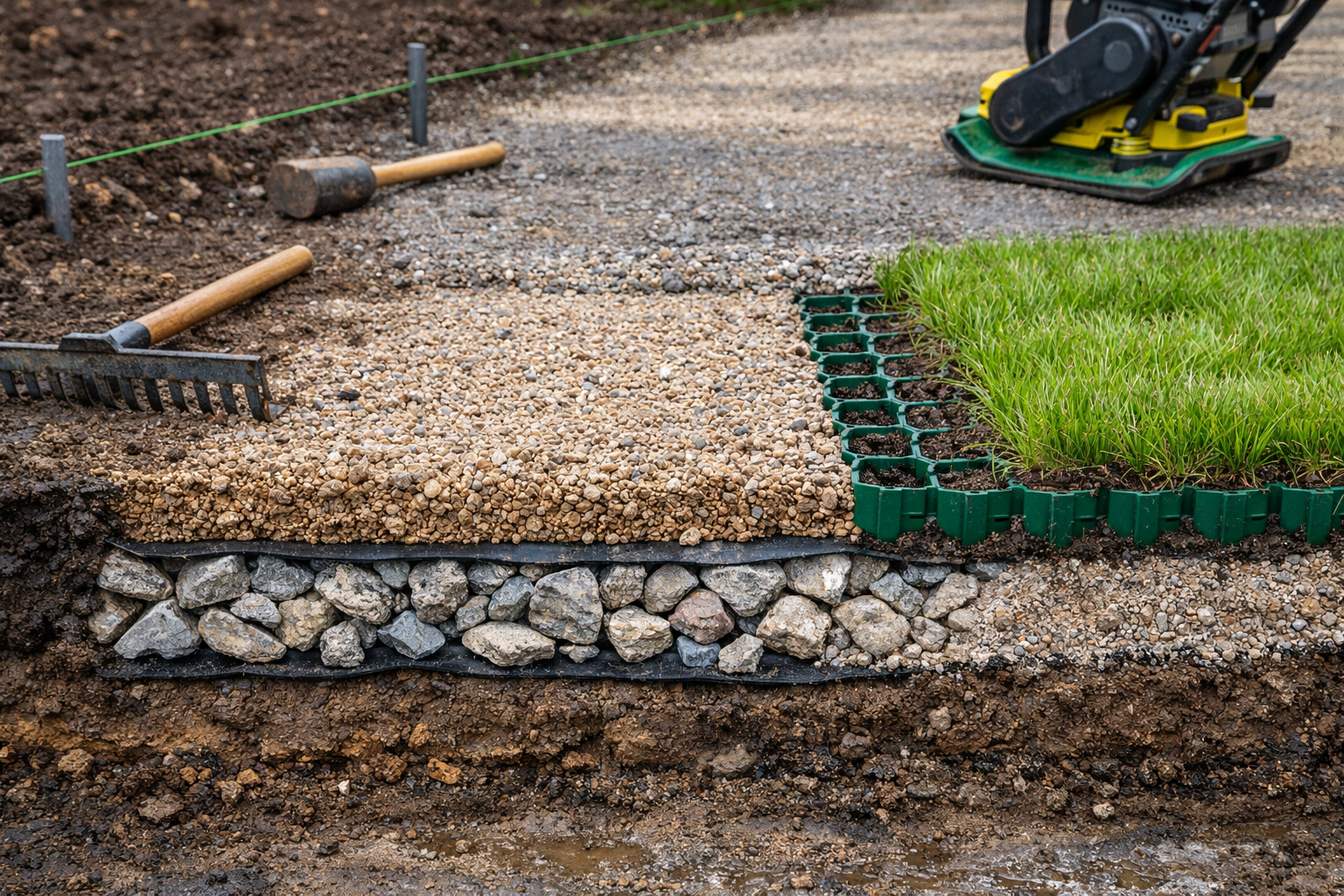
A pretty surface won’t rescue a weak foundation.
For a residential driveway, many current gravel specifications favour ¾ inch to 1 inch crushed stone, often referred to as #57 gravel, because it balances compaction, drainage, and durability [2]. Angular crushed stone is preferred over rounded stone because the edges lock together under vehicle load [2].
A commonly recommended 2026 build-up uses:
Layer |
Typical depth |
Purpose |
|---|---|---|
Large angular base stone |
4-6 inches |
Strength and drainage |
¾ inch crushed stone middle layer |
2-3 inches |
Stability and load spread |
Surface gravel or dressing |
1-2 inches |
Finish, texture, colour |
Geotextile membrane |
Site dependent |
Separates soil and stone, helps reduce weed growth |
Source guidance describes a total depth of around 6-8 inches for many driveway applications, depending on soil, traffic, and use [2]. Heavier vehicles, weak clay, and shared access routes may need more.
“Most driveway failures start below the surface. If the sub-base moves, everything above it follows.”
Ben Sperring, Surfacing Manager, Driveways Plus, 25+ years’ experience
🛠 The installation sequence that usually works best
A good contractor will normally follow a process like this:
Survey the ground
Check slope, drainage, soil type, existing levels, access, and services.Excavate to the correct depth
Remove weak topsoil and organic material. Grass cannot be built over soft ground and expected to carry vehicles.Install geotextile membrane where suitable
The membrane helps stop subsoil mixing with stone while still allowing water to pass through [2].Place and compact the sub-base in layers
Compaction should be done in controlled passes, often with a vibrating plate or roller suited to the site.Form the borders
Timber, steel, stone setts, cobbles, brick, or kerbs keep gravel and grass in their proper zones.Install reinforcement if needed
Grass grids or gravel grids spread wheel loads and reduce rutting.Dress the surface
Final gravel depth should be enough to cover the structure, but not so deep that tyres sink.Check falls and water routes
Rain should move to planted edges, soakaways, drainage channels, or permeable zones.
⚠️ Common mistake: too much loose gravel on top
A thick loose surface feels unstable. Tyres dig in, shoes scuff it aside, and pushchairs or wheelie bins become awkward.
For most homes, the answer is not “more gravel”. The answer is better compaction, better grading, and better containment.
If you’re comparing materials before committing, our best driveway material comparison gives a clear view of where gravel, tarmac, resin, concrete, and block paving each work best.
What rustic layouts work best for natural landscape integration?
The best rustic layouts follow the shape of the land, frame the house, and keep the driveway edges soft without letting the surface become messy. Gravel and Grass Driveways should look relaxed, but the geometry still needs purpose.
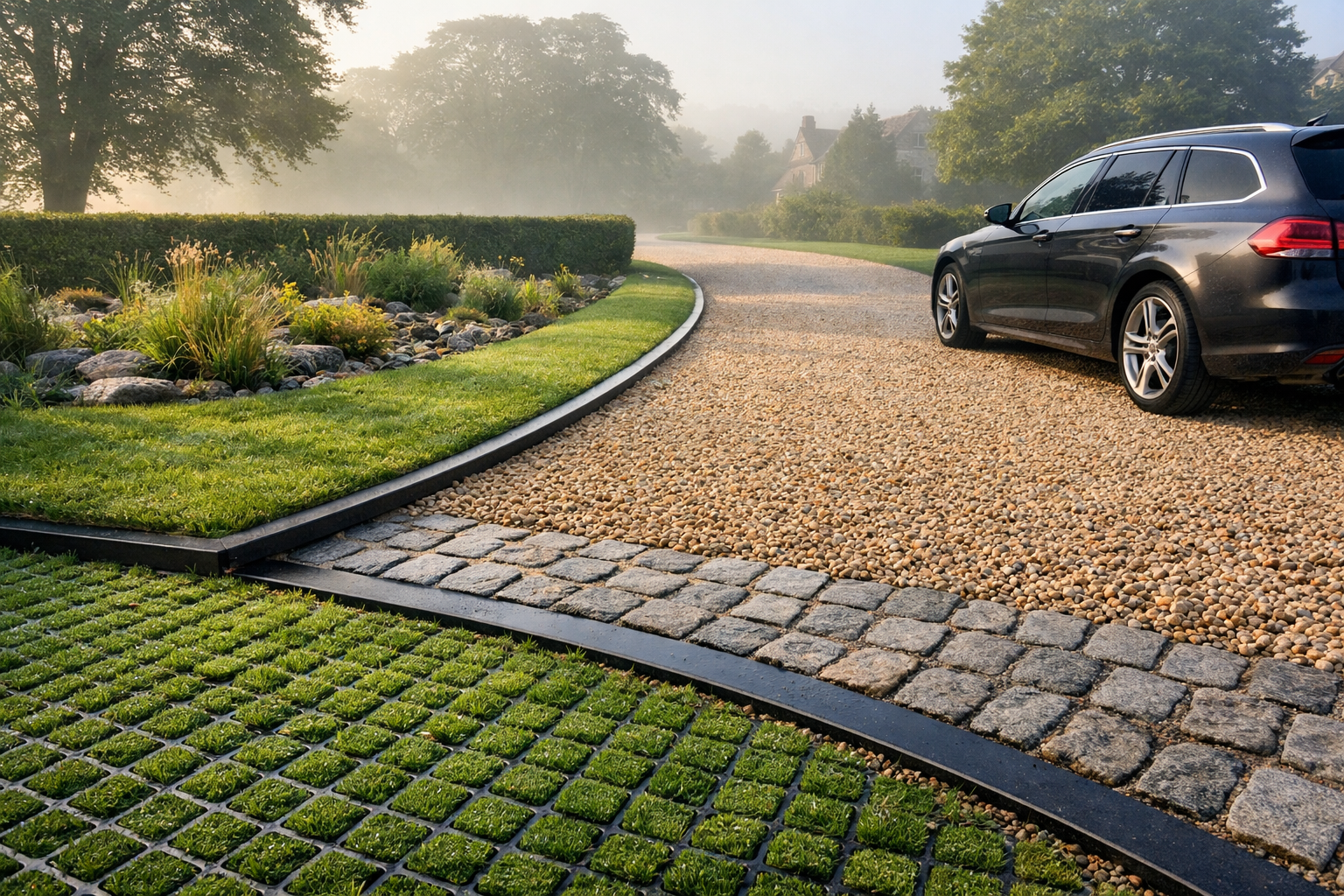
In 2026, homeowners are moving away from plain asphalt and towards mixed materials, stone, pavers, concrete panels, and driveway designs that frame the house rather than just fill a parking area [5]. Gravel and grass fits that trend well because it can feel designed and natural at the same time.
🌿 Layout 1: twin gravel tracks with a central grass strip
This is the traditional country-house look. Two gravel lanes carry the wheels, and a grass strip runs down the centre.
Best for: Long entrances, low-speed access, rural homes, barns, and cottages.
Watch point: The centre strip needs enough light, drainage, and soil depth. If vehicles regularly cross the centre, reinforce it.
🪨 Layout 2: gravel court with grass joints
A gravel court works well in front of larger homes. Grass joints, planted islands, or softened edges stop the area feeling like a car park.
Best for: Prestige homes, guest parking, turning circles, and wide entrances.
Watch point: Turning areas need a stronger base because tyres scrub the surface sideways.
🚗 Layout 3: reinforced grass parking bays with gravel access
Here, gravel forms the route in and out, while reinforced grass creates occasional parking. This keeps the frontage green.
Best for: Homes that need overflow parking without making the garden feel paved.
Watch point: Reinforced grass still needs maintenance. Shade, poor drainage, and constant parking can weaken turf.
🧱 Layout 4: stone apron with gravel and grass beyond
A firmer entrance apron in stone setts, block paving, or bound material protects the area where cars brake, turn, and enter from the road. Gravel and grass then take over deeper into the plot.
Best for: Homes on busier roads, sloped entrances, or properties needing a more formal threshold.
Watch point: The transition between materials must be well restrained to stop movement.
🌾 Layout 5: meadow-edge gravel drive
This layout uses gravel with unforced, planted edges. Native grasses, bulbs, hedging, and low planting help the drive disappear into the wider landscape.
Best for: Large gardens, rural estates, eco-led designs, and naturalistic planting schemes.
Watch point: Without a hidden edge, gravel can creep into planting beds. A discreet steel or stone restraint often solves this.
“The best rustic driveway still has discipline. Clean edges, correct falls, and the right stone make the difference between charming and untidy.”
Mike Clancy, Non-Executive Director, Driveways Plus, 30+ years’ industry experience
For visual planning, it can help to test shapes before work starts. Our driveway visualiser is useful when you’re deciding between gravel colour, border style, and layout form.
What materials should you choose for gravel and Grass Driveways?
Choose angular crushed stone for the trafficked gravel areas, reinforced grass systems for loaded turf zones, and strong edging for all boundaries. The best material mix depends on slope, traffic, soil, house style, and how formal you want the finish to feel.
The most common mistake is choosing gravel by colour alone.
Colour matters, of course. A warm buff gravel may suit limestone walls. A grey granite chip may suit a sharper modern home. A darker basalt can look smart with black timber, steel edging, and contemporary planting.
But performance comes first.
🪨 Gravel choices
For driveway use, angular crushed stone is usually the sensible choice because it interlocks under pressure [2]. Rounded pea gravel may look soft, but it tends to roll and migrate more.
Good options include:
- #57-style crushed gravel: Often recommended for residential driveways due to drainage and stability [2].
- Crusher run: Useful where tighter compaction is needed, especially on slopes [2].
- Granite chippings: Durable and crisp, often suited to premium contemporary-rustic homes.
- Limestone chippings: Warm and traditional, though local suitability and dust content should be checked.
- Self-binding gravel: Attractive for paths and lighter-use areas, but needs proper specification for driveways.
🌱 Grass options
Natural turf alone can work in very light-use centre strips, but tyres quickly damage weak grass. For most driveways, use reinforcement.
Options include:
- Plastic grass reinforcement grids
- Concrete grass pavers
- Hybrid turf systems
- Grass seeded into reinforced cellular grids
- Gravel grids for areas where grass is not suitable
Permeable pavers and biophilic design are also appearing as luxury 2026 upgrades, especially where homeowners want kerb appeal with a greener feel [7].
🧱 Edging options
Bold, intentional borders are a defining 2026 gravel trend because they reduce wash-out, stop migration, and create cleaner separation lines [1].
Popular edging choices include:
- Reclaimed stone setts
- Granite kerbs
- Corten or galvanised steel edging
- Treated timber sleepers
- Clay pavers
- Concrete pin kerbs
- Brick details to match the house
Decision rule: Choose steel edging if you want a discreet modern line. Choose setts if you want a heritage look and stronger visual framing.
For more material detail, see our premium gravel driveway installation guide and our wider expert gravel driveway advice.
Are gravel and Grass Driveways suitable for slopes, drainage, and wet UK weather?
Gravel and Grass Driveways can work in wet UK weather, but slope and drainage must be designed from the start. On steeper drives, standard loose gravel may wash, so tighter-compacting materials, grids, drainage channels, and firm edging become much more important.
A permeable-looking driveway is not automatically a drainage solution.
Water still needs somewhere to go. Clay soils, compacted ground, high water tables, and steep falls can all change the design.
🌧 Drainage checks before you build
Ask these questions before choosing the final layout:
- Where does rainwater currently flow?
- Does water sit near the house, garage, or road?
- Is the soil free-draining or heavy clay?
- Will the driveway fall towards a public pavement or highway?
- Is there enough space for planted drainage, a soakaway, or a rain garden?
- Will gravel migrate during heavy rain?
In England, planning rules often favour permeable front garden surfaces or controlled drainage within the property boundary. For practical homeowner guidance, our SUDS compliant driveway guide explains the key points in plain English.
⛰ What about sloped gravel and grass drives?
For slopes, crusher run gravel can perform better than single-size gravel because it compacts more tightly and resists washing [2]. Angular stones create mechanical interlock, which helps the surface stay put [2].
That said, steep drives need careful judgement.
You may need:
- A stronger sub-base
- Gravel grids
- Cross-drainage channels
- Stone setts at the entrance
- A textured hard-surface strip
- Reinforced grass pavers
- Regular check dams or edge restraints on long falls
If your driveway is steep or shaded, read our steep driveway safety, grip and drainage advice before settling on a rustic layout.
Edge case: A steep gravel drive under trees can become slippery with leaf mulch. The design may need a firmer wheel track, better drainage, and a maintenance plan that includes autumn clearance.
How much maintenance do rustic gravel and grass driveways need?
Rustic gravel and grass driveways need light, regular maintenance rather than heavy annual repair. Expect to rake migrated gravel, control weeds, mow or trim grass strips, clear leaves, and top up surface stone when levels drop.
Maintenance is easiest when the driveway was built with good edging and the correct gravel depth.
🧹 Simple maintenance checklist
Use this as a seasonal guide:
- Monthly in active seasons: Rake high spots and fill shallow tyre marks.
- Spring: Check weed growth, edge definition, and grass health.
- Summer: Avoid cutting grass strips too short during dry spells.
- Autumn: Clear leaves before they break down into slippery organic matter.
- Winter: Watch for puddling, soft spots, and gravel wash after storms.
- Every few years: Top up dressing gravel where the surface has thinned.
A well-built gravel surface should not need constant rescue. If you’re raking every week, something is wrong with the specification, edging, slope, or traffic pattern.
⚠️ Common problems and likely causes
Problem |
Likely cause |
Practical fix |
|---|---|---|
Gravel spreads onto lawn |
Weak or missing edge restraint |
Add steel, timber, stone, or kerb edging |
Grass ruts under tyres |
No reinforcement or weak base |
Install grass grids or redesign wheel paths |
Puddles form |
Poor falls or compacted subsoil |
Improve levels and drainage routes |
Weeds appear |
Windblown seeds or thin surface |
Remove early, maintain depth, consider membrane below |
Gravel washes downhill |
Slope too steep for loose finish |
Use crusher run, grids, setts, or drainage breaks |
For broader care advice, our driveway maintenance guide for cleaning and longevity covers practical upkeep across gravel, resin, block paving, and tarmac.
“A driveway should be easy to live with. If the design creates weekly chores, the design needs improving before the first digger arrives.”
Ben Sperring, Surfacing Manager
How do gravel and grass compare with tarmac, resin, block paving, and concrete?
Gravel and grass driveways are best for natural appearance, permeability, and informal charm, but they are not the lowest-maintenance or strongest option for every home. Tarmac, resin, block paving, and concrete can be better where traffic is heavy, turning is tight, or a crisp urban finish is preferred.
Here’s the plain-English comparison.
Surface |
Best for |
Strengths |
Watch points |
|---|---|---|---|
Gravel and grass |
Rural, informal, prestige landscape-led homes |
Natural look, drainage-friendly, flexible design |
Needs edging, raking, grass care |
Tarmac |
Fast, practical, cost-conscious access |
Strong, smooth, efficient installation |
Less natural look, heat and oil marks possible |
Resin-bound |
Smart modern homes and neat frontages |
Smooth, decorative, permeable when built correctly |
Needs specialist installation and suitable base |
Block paving |
Pattern, detail, repairable areas |
Formal finish, design choice, easy local repairs |
Weeds in joints if neglected |
Concrete |
Heavy-use drives and bold design |
Strong, long-lasting, many finishes |
Can feel hard in rural settings |
Plain asphalt is less dominant in 2026 design discussions, with more homeowners exploring pavers, concrete panels, stone, and mixed materials to frame the home [5]. That doesn’t mean tarmac is poor. It means homeowners are asking more from the front of the property.
Decision rule: Choose gravel and grass if the driveway should feel part of the garden. Choose tarmac or concrete if daily strength and low fuss matter most. Choose resin or block paving if you want a cleaner decorative finish.
If budget is part of the decision, our 2026 driveway installation cost guide explains the main cost drivers for gravel, resin, tarmac, and block paving.
What should homeowners ask before hiring a driveway contractor?
Ask your contractor about excavation depth, sub-base type, compaction method, drainage plan, edging specification, grass reinforcement, and aftercare. A reliable contractor should explain the build-up clearly and adapt the design to your site, not sell one standard package.
The best question is simple:
“What stops this driveway moving in five years?”
A good contractor will talk about ground conditions, loading, water, edge restraint, and maintenance. A weak contractor will mostly talk about surface colour.
🔍 Contractor questions worth asking
Before you approve a quote, ask:
- What depth will you excavate to, and why?
- What sub-base material will you use?
- Will the base be compacted in layers?
- Is geotextile membrane included where needed?
- What gravel size and type do you recommend?
- How will the edges be restrained?
- How will rainwater be managed?
- Where will grass be reinforced?
- How will the driveway handle turning vehicles?
- What maintenance should I expect?
🧾 What a clear quote should include
A proper quote should set out:
- Site preparation
- Excavation and waste removal
- Membrane specification if used
- Sub-base depth and material
- Edging type
- Gravel type, size, and colour
- Grass reinforcement system if included
- Drainage details
- Timescale
- Aftercare guidance
Common mistake: Choosing the cheapest quote when the base specification is vague. The visible finish may look similar on day one, but the weaker build often shows itself after the first wet winter.
Tony’s view is direct.
“For homeowners, the risk isn’t just a poor driveway. It’s disruption, repeat costs, and a front entrance that lets the property down. Good specification protects all three.”
Tony Flook, Managing Director
If you’re planning a new entrance or replacing a tired surface, our new driveway service page explains how a properly specified installation can improve daily access and kerb appeal.
How can developers and property managers use gravel and grass layouts well?
Developers and property managers can use gravel and grass layouts to soften access roads, visitor parking, shared courtyards, and low-speed residential entrances. The key is to separate light-use visual areas from heavy-use vehicle zones.
For small developments, the rustic look can add real sales appeal. Buyers notice when the entrance feels calm, green, and considered.
But shared spaces take more punishment than a private driveway.
🏘 Practical design rules for small developments
Use these rules early in the design process:
- Put reinforced gravel or hard surfacing where delivery vans turn.
- Use grass reinforcement for overflow parking, not constant loading.
- Add clear edging so maintenance teams can manage boundaries.
- Keep drainage visible and accessible for inspection.
- Avoid loose gravel where it may spill onto public footpaths.
- Consider wheelie bin routes, pushchairs, bikes, and accessibility.
- Specify a maintenance responsibility before handover.
🌿 Mini case example
A small rural courtyard of three homes may not need a fully hard-paved shared space. A mixed design could use a firm stone entrance apron, compacted gravel access, reinforced grass visitor bays, and planted rain gardens.
That gives residents a practical surface while keeping the development visually settled into the site.
Decision rule: If the area is adopted highway, high-speed, heavily trafficked, or used by refuse lorries, a casual gravel and grass finish may not be suitable without stronger engineering input.
FAQs about rustic gravel and Grass Driveways
Are gravel and Grass Driveways good for everyday parking?
Yes, gravel and Grass Driveways can handle everyday parking when the trafficked areas have a compacted sub-base and reinforced grass or gravel grids. Unreinforced grass will usually rut if cars park on it daily.
What is the best gravel size for a grass and gravel driveway?
A ¾ inch to 1 inch angular crushed stone is commonly recommended for residential driveway use because it drains well and locks together better than rounded gravel [2]. The exact size should suit the base, slope, and finish you want.
Can I install a gravel and grass driveway over an existing lawn?
You should not install a vehicle driveway directly over an existing lawn. Topsoil is usually too soft and organic, so the area needs excavation, a suitable sub-base, compaction, and reinforcement where vehicles pass.
Do gravel and grass driveways need planning permission?
In many UK front gardens, permeable surfaces or drainage within the property boundary may avoid planning issues, but site details matter. Always check local rules, especially if water could run onto the pavement or highway.
How do I stop gravel moving into the grass?
Use proper edge restraints, avoid excessive loose gravel depth, and choose angular crushed stone rather than rounded gravel. Hidden gravel grids can also reduce movement while keeping the surface natural.
Is grass reinforcement visible after installation?
Grass reinforcement is often discreet once turf or seed has established, especially when the grid is filled and maintained correctly. In high-wear areas, some grid pattern may remain visible, but it is usually less intrusive than a fully hard surface.
Are gravel and grass driveways suitable for electric vehicles?
Yes, but the parking and charging zone should be firm, level, and easy to walk on in wet weather. If you plan to charge at home, consider cable routes, lighting, and future ducting before the driveway is installed.
What colour gravel suits a rustic driveway?
Warm buff gravel suits stone cottages and rural homes, while grey granite suits modern country properties. The best colour usually picks up tones from the house, boundary walls, roof, or local stone.
Conclusion
A rustic gravel and grass driveway works beautifully when it’s designed as part of the landscape and built with proper structure below the surface. The winning formula is simple: angular stone, layered base preparation, geotextile where needed, reinforced grass in loaded areas, strong edging, and a drainage plan that suits your ground.
Start with how you use the driveway each day.
Then choose the layout.
If you want a soft country entrance, twin gravel tracks with a grass centre may be ideal. If you need parking and turning, a reinforced gravel court with grass joints or planted edges will usually perform better. If the drive slopes, don’t guess. Get the structure right before you choose the colour.
For homeowners, prestige properties, and small developments, gravel and Grass Driveways can offer that rare mix of practicality and natural charm. Built well, they feel like they’ve always belonged.
Your next step? Walk the site after rain, note where water travels, mark how vehicles turn, and speak to a contractor who can explain the base as clearly as the finish.
References
[1] 2026 Trends In Stone Gravel Uses Around The Home – https://www.landscapebarn.com/blogs/2026-trends-in-stone-gravel-uses-around-the-home
[2] Best Gravel For Driveways 2026 Complete Guide To Types That Wont Move – https://hellogravel.com/best-gravel-for-driveways-2026-complete-guide-to-types-that-wont-move/
[5] Driveway Ideas For 2026 That Replace Plain Asphalt With Designs That Actually Frame The House – https://www.homedit.com/driveway-ideas-for-2026-that-replace-plain-asphalt-with-designs-that-actually-frame-the-house
[7] Watch – https://www.youtube.com/watch?v=HFJr4P_eGRM