Last updated: June 13, 2026
Quick answer
Block paving driveways with steel edging combine traditional clay or concrete blocks with thin, hidden galvanised or powder-coated steel strips that lock the borders into a knife-sharp line. The result is a driveway that suits period homes beautifully, holds its shape under car wheels for 20+ years, and stops the gradual sideways “creep” that ruins so many older block drives. Expect to pay £12-18 per linear metre for the edging itself in 2026, on top of standard block paving costs.
Key takeaways
- Steel edging gives you a crisper, more elegant border than concrete haunching, particularly on curves and around heritage properties.
- Galvanised steel edging typically lasts 15-20 years; aluminium can exceed 25 years with zero maintenance [2].
- Strips usually range from 1.2mm to 3.0mm thick with integral hidden stakes [3].
- Installation cost for the edging alone runs £12-18 per linear metre in 2026 [2].
- Works brilliantly with herringbone, basketweave, and tumbled stretcher patterns.
- Reduces weed growth at the perimeter and prevents block migration into borders.
- Best suited to professional installation if the driveway carries vehicles daily.
What exactly is block paving with steel edging?
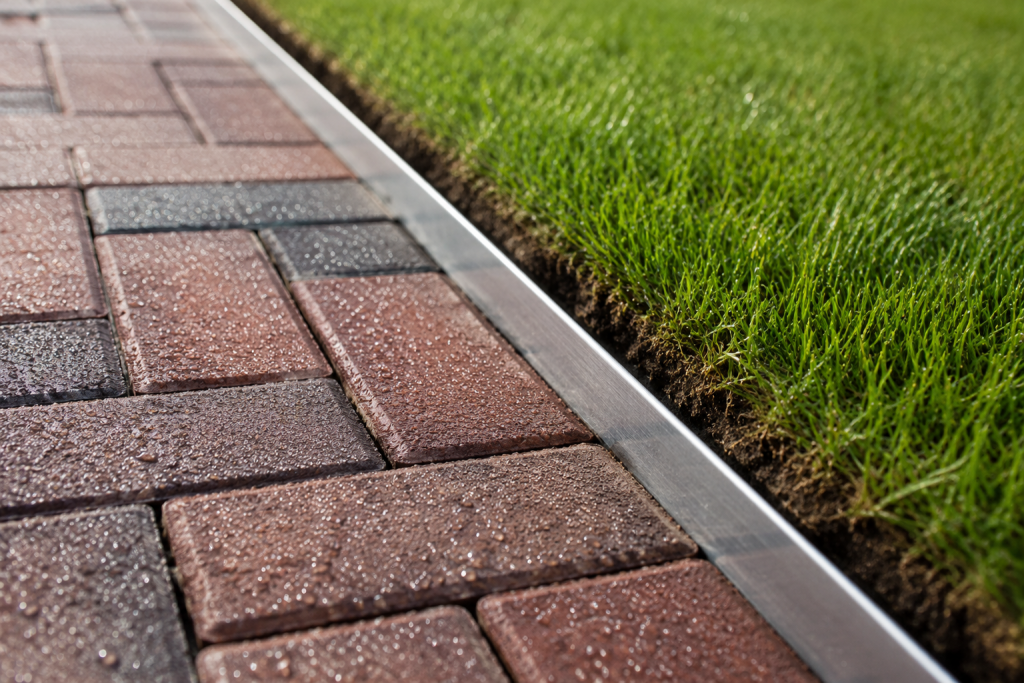
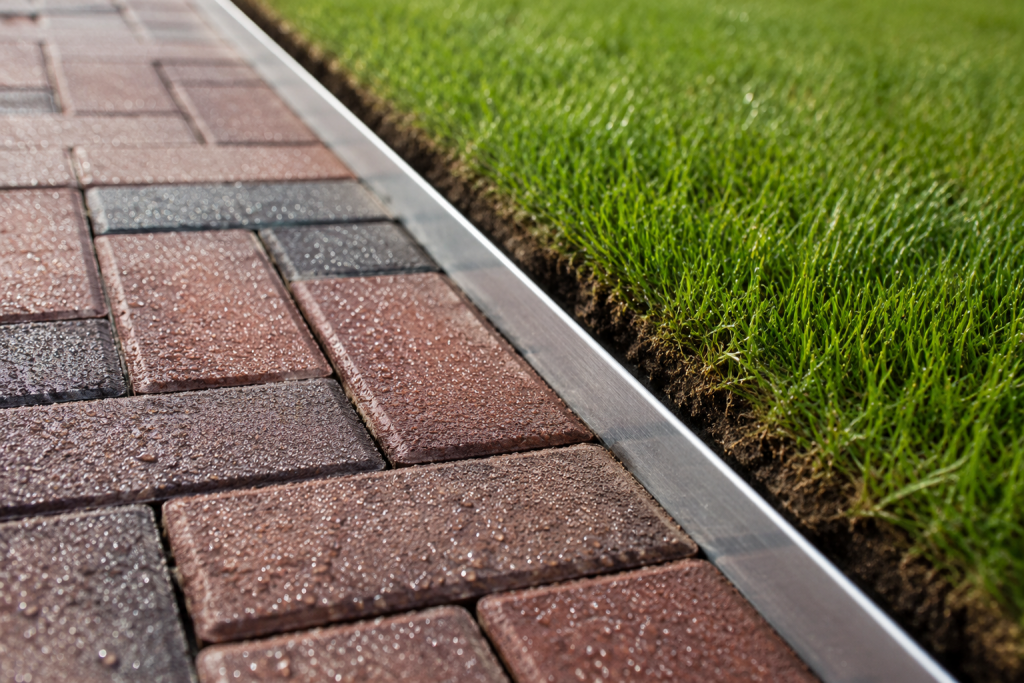
Block paving with steel edging is a driveway system where clay or concrete paving blocks are laid on a sand bed over a compacted sub-base, then locked in place along the borders by thin vertical strips of steel. The steel sits flush (or very slightly proud) with the top of the blocks, creating a clean visual line where the driveway meets a lawn, gravel border, or flowerbed.
Unlike traditional concrete haunching, which is a bulky wedge of mortar buried at the edge, steel edging is barely visible once installed. Strips are usually 1.2-3.0mm thick with hidden support stakes that drive into the sub-base [3]. They flex around curves, hold straight lines true, and don’t crack like concrete does when the ground shifts.
“Steel edging changed how we finish heritage driveways. You get the historic look of clay pavers without the bulky concrete trim that always looked wrong against Georgian or Victorian brickwork.” — Ben Sperring, Surfacing Manager, Driveways Plus
For a wider view of block paving as a surface choice, our guide to 5-star block paving driveways is a useful companion read.
How much does a steel edged block paving driveway cost in 2026?
A fully installed block paving driveway with steel edging in 2026 typically costs between £95 and £160 per square metre, depending on block choice, pattern complexity, and site conditions. The steel edging element adds £12-18 per linear metre on top of the paving cost [2].
Here’s a rough breakdown for a standard 50m² driveway with 30 linear metres of edged border:
Element |
Cost range (2026) |
|---|---|
Excavation and sub-base |
£25-40 per m² |
Block paving (supply and lay) |
£55-110 per m² |
Steel edging (materials) |
£7-13 per linear m |
Steel edging (labour) |
£5-8 per linear m |
Kiln-dried sand and finishing |
£3-5 per m² |
Typical total (50m²) |
£5,200-£9,500 |
Aluminium edging sits at the higher end (£10-13/m for materials) but eliminates the small rust risk that galvanised steel can develop in wet UK climates [2]. For a fuller cost picture across surfaces, see our 2026 driveway installation costs guide.
Pros and cons of steel edging vs concrete edging for driveways
Steel edging wins on appearance and curves. Concrete haunching wins on raw strength under heavy loads. Your choice depends on traffic, aesthetics, and budget.
Steel edging – pros
- Crisp, almost invisible border line
- Flexes smoothly around curves and arcs
- Faster to install than wet concrete
- Doesn’t crack with ground movement
- Pairs beautifully with both modern and heritage properties
Steel edging – cons
- Higher upfront cost than concrete haunching [3]
- Galvanised steel can rust in very wet areas after 15+ years
- Less robust under repeated heavy vehicle loads (think delivery lorries riding the edge)
Concrete haunching – pros
- Cheaper materials
- Extremely strong under vehicle loads
- Familiar to every block paver
Concrete haunching – cons
- Visually clunky, especially against period brick
- Cracks over time as soil shifts
- Difficult to repair neatly
Decision rule: Choose steel if you value the look and the driveway carries normal family vehicles. Choose concrete (or a granite kerb) if it’s a commercial entrance or you regularly host heavy delivery vehicles.
Can I install block paving with steel edging myself, or do I need professionals?
Technically yes, you can DIY it. Realistically, for anything beyond a small footpath or a courtyard, you’ll want a professional crew. The hidden work, the sub-base, falls, drainage, and edge restraint depth, is where amateur driveways fail within two or three winters.
The edging itself isn’t the hard part. Driving the integral stakes into a properly compacted Type 1 sub-base, making sure the steel sits at the exact right height to match the finished block surface, and getting clean mitred joints on corners, that’s where experience shows.
“I’ve seen homeowners spend two weekends laying blocks, then the first heavy rain washes the bedding sand out at the edges because the steel was set 5mm too low. Tiny detail. Massive consequence.” — Tommy Clancy, Pre-Construction Consultant
If you do tackle it yourself, our how-to driveway guides cover the fundamentals. For anything driveway-sized, get a free quote from a trusted installer first.
Best block paving patterns that work with steel edge borders
The cleanest steel borders deserve patterns that complement rather than compete. The four that consistently look best are:
- 🧱 45-degree herringbone — the strongest pattern for driveways under car loads, and the angles play beautifully off the straight steel line.
- 🧱 90-degree herringbone — a more traditional, slightly softer look that suits cottages and farmhouses.
- 🧱 Basketweave — period-correct for Victorian and Edwardian properties, framed neatly by a single soldier course just inside the steel edge.
- 🧱 Stretcher bond with tumbled blocks — the antique, weathered finish next to a sleek steel border creates that lovely old-meets-new tension heritage owners adore.
A soldier course (blocks laid end-to-end along the perimeter, parallel to the steel) acts as a transition between the main pattern and the edge [5]. It frames the driveway and hides any small cutting tolerances.
For more design inspiration, browse our top 5 block paving designs that boost home value.
How long does a steel edged block paving driveway last?
A properly installed steel-edged block paving driveway lasts 25-40 years for the blocks themselves, with the steel edging holding shape for 15-20 years (galvanised) or 25+ years (aluminium) [2].
What actually shortens lifespan? Three things, almost always:
- Poor sub-base (under 150mm of compacted Type 1)
- Wrong joint sand or no sealing
- Edge restraints set too shallow or skipped entirely
Get those right and the driveway will outlast most cars parked on it. Tony Flook puts it well:
“A driveway is a 30-year investment. The steel edge is the bit that protects the other 29 years of paving from slowly falling apart at the seams. Don’t skimp on it.” — Tony Flook, Managing Director, Driveways Plus
Common mistakes people make when installing block paving with steel edges
The same handful of errors come up on almost every failed driveway we’re called out to repair:
- ❌ Setting the steel too low — joint sand washes out, blocks rock loose.
- ❌ Skipping the haunch behind the steel — yes, you still need a small concrete heel buried behind the edging for vehicle loads.
- ❌ Using too-thin steel (under 1.5mm) on vehicle drives — it bows under tyre pressure.
- ❌ Forgetting expansion gaps on long runs — heat causes thermal movement; without a gap, the steel can buckle.
- ❌ No drainage planning — water has to go somewhere. Edge-trapped puddles destroy the bedding layer.
- ❌ Cutting blocks too small at the perimeter — anything under 1/3 of a full block will work loose. Plan the layout from the edges inward.
Which types of homes or properties look best with this driveway style?
Steel-edged block paving suits a remarkably wide range of properties, but it really sings on:
- 🏛️ Georgian and Regency townhouses — the geometric precision of the steel mirrors the symmetry of the architecture.
- 🏡 Victorian and Edwardian semis and terraces — tumbled clay blocks with thin black steel borders look properly period-correct.
- 🏰 Cotswold and country stone houses — buff-coloured blocks with a dark steel edge against gravel borders is a classic combination.
- 🏘️ Modern new-builds and barn conversions — clean charcoal blocks with brushed steel gives a contemporary minimalist look.
Where it works less well? Pure modernist white-rendered properties sometimes look better with a single colour resin or large-format porcelain. Have a play with our driveway visualiser to see how different combinations look on your own home.
Maintenance tips for keeping steel edged block paving looking new
Steel-edged block paving is low-maintenance, not no-maintenance. Spend a couple of hours twice a year and it’ll look excellent for decades.
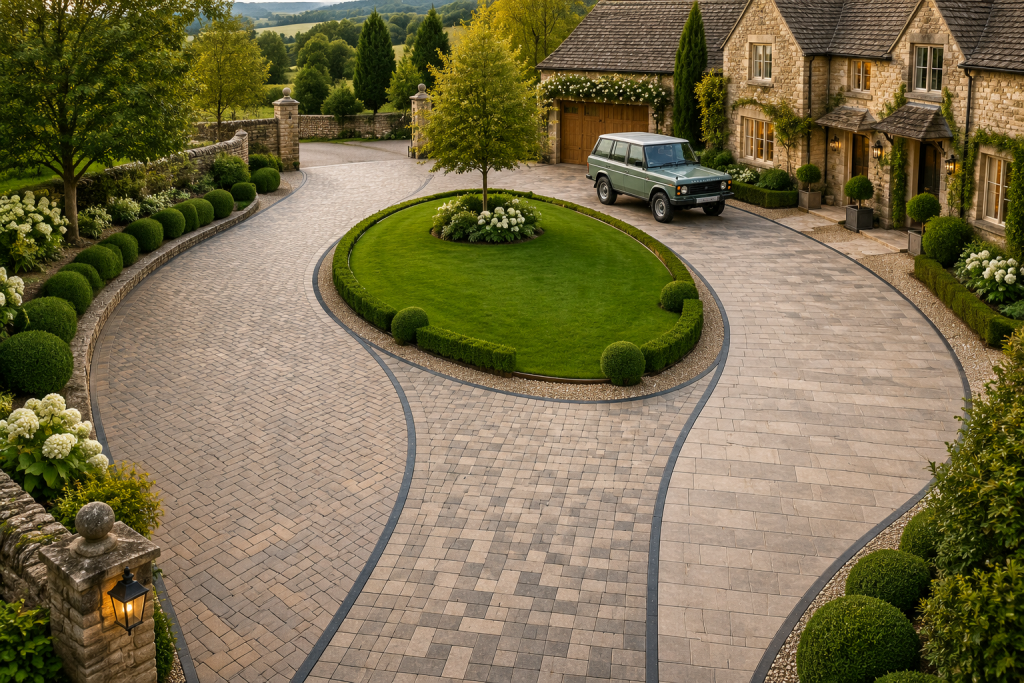
Annual maintenance routine:
- 🧹 Spring sweep and inspect — clear winter debris, check the steel for any rust spots or distortion [2].
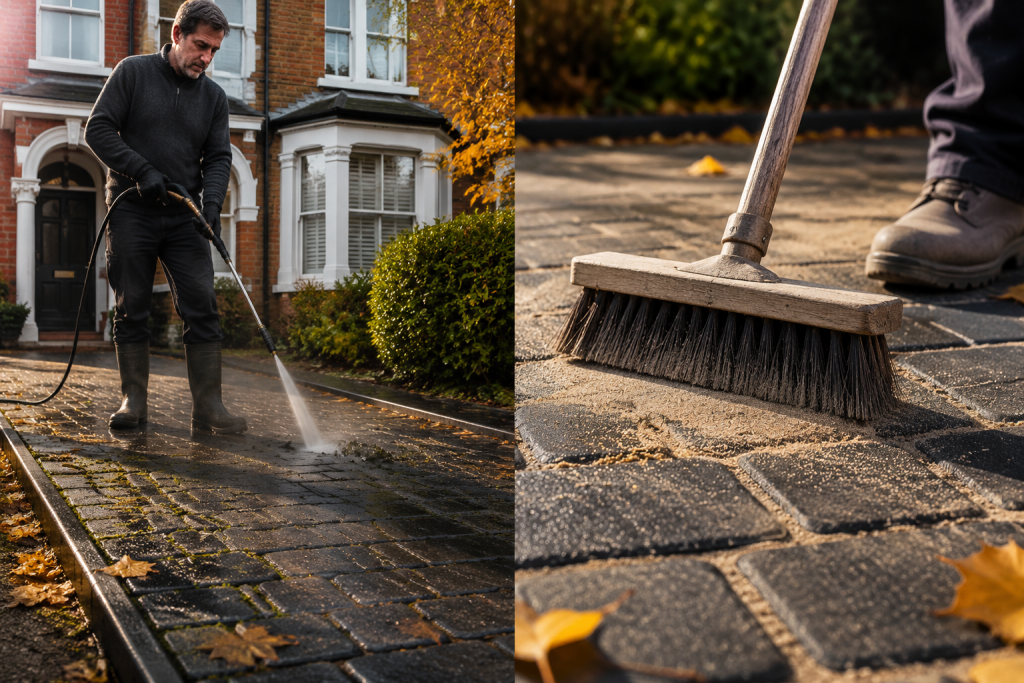
- 💦 Gentle pressure wash — keep the lance at least 300mm from the blocks; aggressive blasting strips the joint sand.
- 🏖️ Re-sand the joints — brush kiln-dried sand into any joints that have dropped.
- 🛡️ Reseal every 3-5 years — a quality block paving sealer locks in the sand, repels oil, and brightens colours.
- 🔍 Touch up the steel — if you spot any rust on galvanised edging, wire-brush and apply a zinc-rich primer.
For the deep-dive version, our driveway maintenance guide for 2026 walks through products and timings in detail. And if you ever get oil drips from the car, here’s how to remove oil stains properly.
How does steel edging prevent weed growth between paving blocks?
Steel edging stops weeds in two ways: it physically blocks rhizome creep from neighbouring soil, and it locks the joint sand tightly in place so airborne weed seeds have less to germinate in.
The biggest source of driveway weeds isn’t seeds landing on top of the paving, it’s grass and roots invading from the lawn or flowerbed at the edges. A solid steel barrier going 75-100mm deep into the soil is a brutal wall against that invasion.
Combine the steel edge with polymeric jointing sand (which sets semi-firm when wet) and you’ll get years of essentially weed-free joints.
Are steel edged block paving driveways good for wet or sloped areas?
Yes, with caveats. Block paving handles slopes up to about 1:10 (10%) comfortably, and steel edging is particularly useful on sloped drives because it stops blocks from gradually sliding downhill.
On wet sites, two things matter:
- Use aluminium edging or thicker galvanised steel (2.5-3mm) to extend rust-free life.
- Plan drainage carefully — linear drains at the base of the slope, permeable jointing where required by SUDS rules.
Sloped block driveways need extra grip too. Our steep driveway solutions guide covers traction options, and SUDS-compliant driveway design explains the drainage rules every new driveway needs to follow.
Alternatives to steel edging for block paving borders
If steel edging doesn’t suit your project, you’ve got solid alternatives:
Edging type |
Best for |
Approx cost per linear m |
|---|---|---|
Aluminium edging |
Wet sites, longest life |
£15-21 |
Concrete haunching |
Heavy loads, tight budget |
£6-10 |
Granite setts / Belgian block |
Heritage, character properties [4] |
£35-60 |
PCC kerbs |
Commercial / shared drives |
£12-18 |
Timber gravel boards |
Temporary or rustic |
£8-12 |
Belgian block (small granite setts laid as a border) is the traditional alternative for very high-end heritage homes [4]. It costs more but gives a texture and patina that steel can’t replicate.
FAQ
Will steel edging rust on my driveway? Galvanised steel can develop surface rust after 15+ years in wet UK conditions, particularly in coastal areas [2]. Aluminium edging avoids the issue entirely. Powder-coated steel sits between the two for longevity.
How deep does steel edging need to be installed? The edging itself should sit flush with the top of the blocks, with the integral stakes driven 100-150mm into a compacted sub-base. Total profile depth is usually 75-100mm below the block surface.
Can steel edging take a car driving over it? Yes, when correctly installed with a concrete haunch behind it. What it doesn’t love is heavy goods vehicles repeatedly riding the very edge. For domestic driveways with normal cars, it’s absolutely fine.
Does steel edging work on curved driveways? Yes, this is where steel really shines. Strips 1.2-2mm thick bend easily around quite tight radii, holding a true curve that concrete haunching never quite manages [3].
What’s the difference between EverEdge and standard steel edging? Premium brands like EverEdge offer features such as rolled top edges for safety and added rigidity, useful where the edging sits proud of the surface [1]. Standard strip edging is fine for most flush driveway installations.
Will steel edging affect resale value? A well-finished block paving driveway with crisp edging is one of the strongest kerb-appeal upgrades you can make. Estate agents consistently cite driveway condition as a top three first-impression factor.
Conclusion
Block paving with steel edging is the sweet spot between heritage charm and modern engineering. You get the warm, period-correct texture of clay or concrete blocks, framed by an almost invisible line that holds everything true for decades.
Three practical next steps:
- Decide on your pattern and block type first — herringbone for vehicle-heavy drives, basketweave or stretcher for Victorian and Edwardian properties.
- Specify steel thickness honestly — 2-3mm galvanised or aluminium for any drive carrying cars daily.
- Get at least two professional quotes — and ask specifically about edge restraint depth and sub-base specification. Those answers tell you everything about whether the installer knows their craft.
Ready to get specific numbers for your home? Request a free quote from Driveways Plus and we’ll talk through patterns, edging options, and what’ll work best for your property.
References
[1] Everedge Titan Steel Landscape Edging – https://landscapeandamenity.com/articles/2021-12-21/everedge-titan-steel-landscape-edging- [2] Driveway Edging Options Edinburgh – [3] Block Paving Edging – https://www.pavingexpert.com/blockedg [4] Belgian Block Driveway Edging – [5] Edgings and Kerbs Your Choices –