Last updated: April 29, 2026
Quick answer
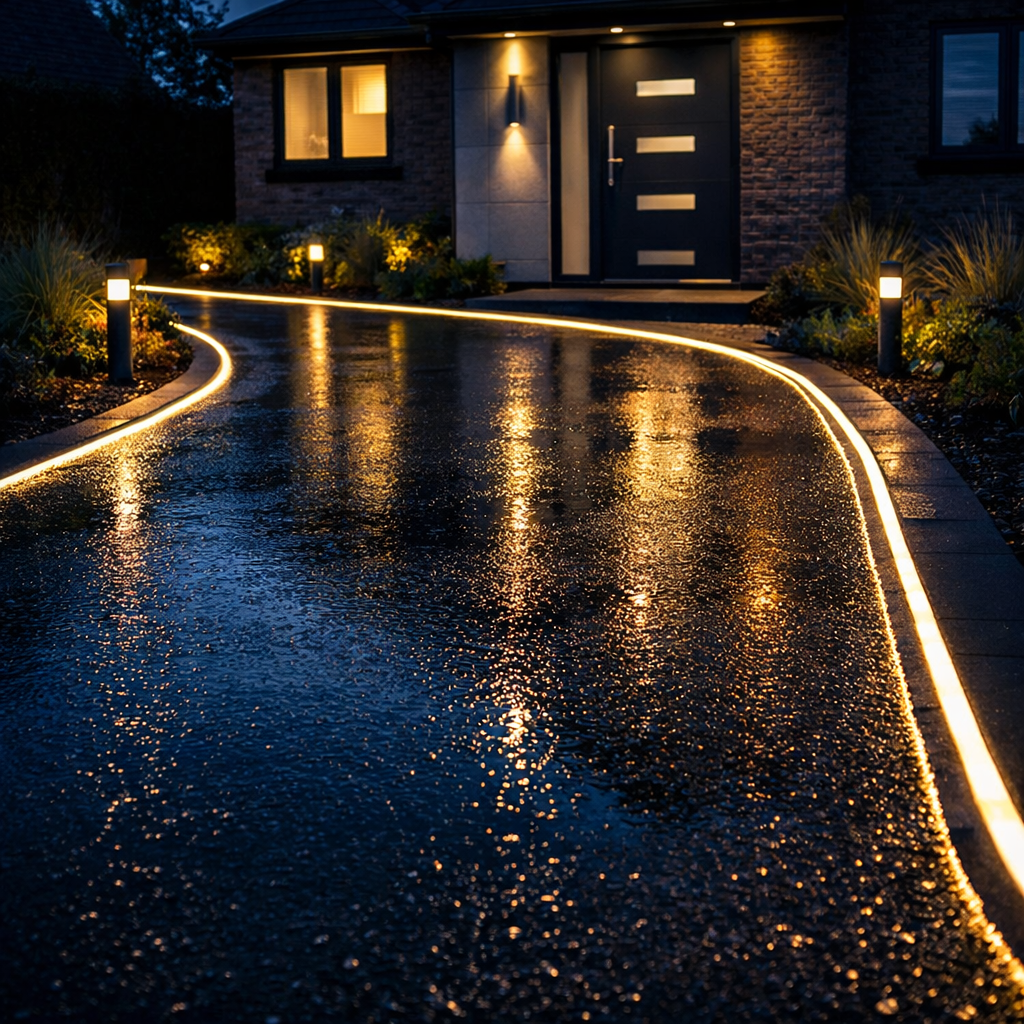
LED Lighting for Driveways is one of the simplest ways to make a home feel safer, smarter and more valuable after dark. In 2026, the best results usually come from two approaches: embedded LED strips for a premium architectural finish, and solar driveway fixtures for lower-disruption lighting where wiring is difficult.
For most UK homes, choose warm white, low-glare lighting, keep fittings protected from water and vehicle loads, and plan the lighting before the driveway surface is laid. That way, your driveway looks intentional, not like an afterthought.
Key takeaways
- LED Lighting for Driveways improves safety and kerb appeal by defining edges, entrances, steps, parking bays and turning areas.
- Embedded LED strips suit premium new driveways because cables, channels and drainage can be built into the surface from the start.
- Solar fixtures suit quick upgrades where you want less digging, no mains cabling and lower disruption.
- Warm white light, often around 2700K to 3000K, usually looks best for homes because it feels softer than cool blue-white light.
- Spacing matters. Solar driveway lights are commonly placed around 6 to 8 feet apart, depending on brightness and the driveway layout [3].
- Do not chase brightness alone. Glare can make a driveway less comfortable and less safe.
- Plan lighting with drainage, edging and surface choice. Resin, block paving, tarmac and gravel all need different fixing details.
- Use a qualified electrician for mains-powered outdoor lighting. Outdoor circuits should be designed and installed properly.
- Solar lights need sunlight. Place panels where they receive direct sun for most of the day [3].
- Lighting is part of the whole driveway investment. It should support the surface, planting, entrance, EV charging and long-term maintenance plan.
Is LED Lighting for Driveways worth it in 2026?
Yes, LED Lighting for Driveways is worth considering in 2026 if you want better night-time safety, a stronger first impression and a more complete driveway design. It works best when lighting is planned before the driveway is installed, not added as a rushed extra later.
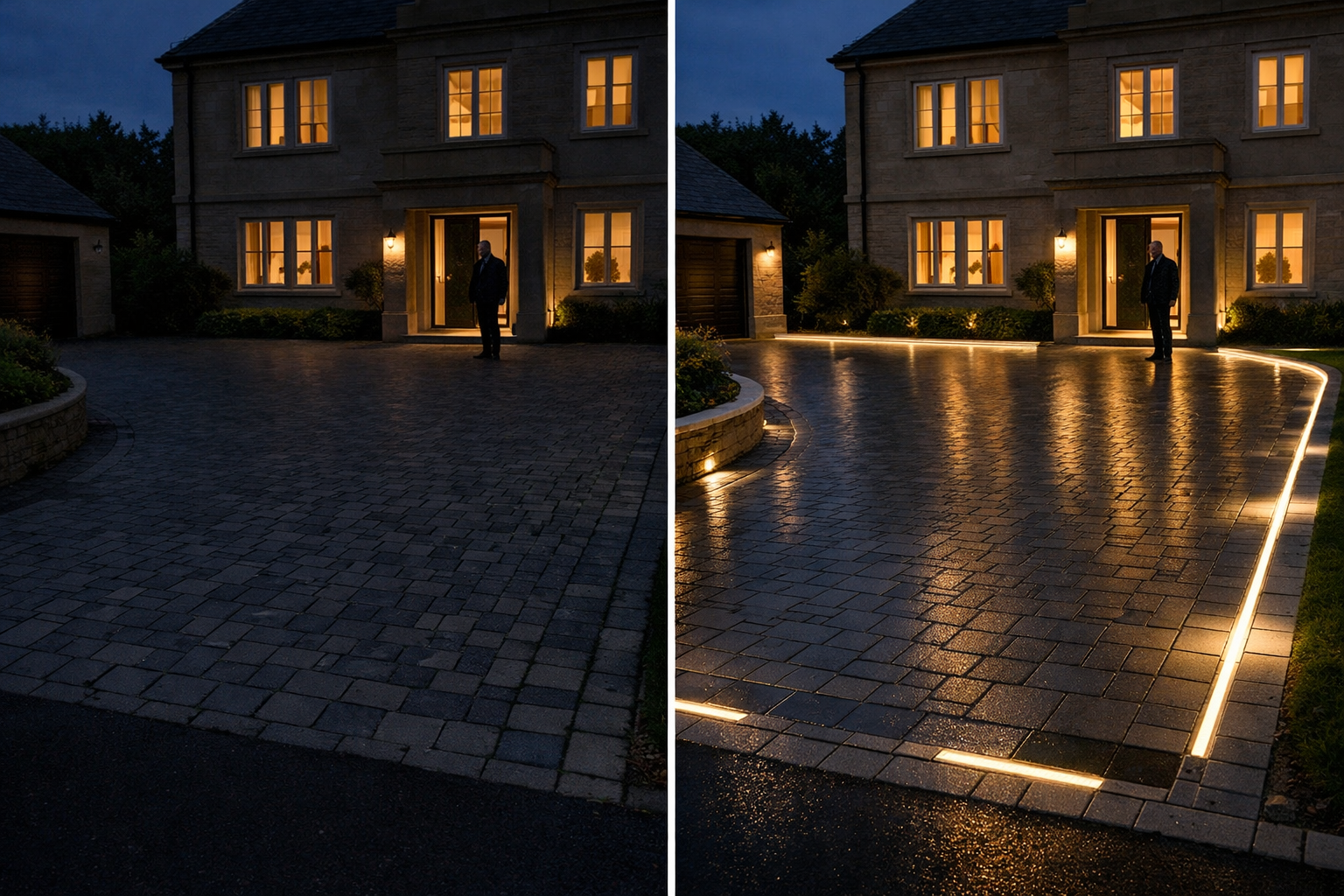
A driveway is often the first part of your home people touch, park on and walk across. After dark, poor lighting can make even a premium surface feel unfinished.
Good lighting helps with:
- 🌙 Night-time arrival – guests can see where to walk and park.
- 🚗 Vehicle guidance – drivers can judge edges, curves and entrances.
- 🏡 Kerb appeal – the driveway frames the property after sunset.
- 🔐 Security confidence – lit approaches feel more controlled.
- 🧱 Material detail – resin, block paving and gravel all look better with low, well-placed light.
Tony Flook, Managing Director: “A driveway is a property investment, not just a parking space. Lighting protects that investment because it makes the entrance work properly at night as well as during the day.”
A simple rule helps.
Choose driveway lighting if you use the space after dark more than twice a week, have a long or narrow approach, have steps or level changes, or want a premium finish that looks deliberate from the street.
If your surface is still at planning stage, lighting should sit alongside drainage, edging and material choice. Our guide to boosting kerb appeal with a premium new drive is a useful next step if you’re designing the full frontage.
✅ Quick example
A homeowner with a 22-metre driveway wanted a smart entrance but not “runway lighting”. The better choice was not brighter fittings. It was fewer, warmer, lower fittings at the edges, with two stronger lights near the turning area.
More control. Less glare.
Common mistake
The most common mistake is fitting lights after the driveway is finished, then realising cables must cross the surface or fittings sit proud where tyres can catch them. Plan early and you’ll have more choices.
What types of LED Lighting for Driveways work best?
The best LED Lighting for Driveways depends on your surface, budget, access to power and the look you want. Embedded strips suit premium, modern entrances; solar fixtures suit quick upgrades; bollards, wall lights and recessed markers suit mixed layouts.
Here’s the practical comparison.
Lighting type |
Best for |
Main benefit |
Watch out for |
|---|---|---|---|
Embedded LED strips |
Resin, concrete, block paving edges |
Clean, modern line of light |
Needs careful channel, cable and drainage planning |
Solar driveway lights |
Gravel drives, long approaches, low-disruption upgrades |
No mains wiring in many cases |
Needs direct sun and good battery quality |
Recessed marker lights |
Entrances, edges, parking bays |
Low-profile guidance |
Must be rated for outdoor and traffic conditions |
Bollard lights |
Long drives and garden edges |
Strong visual rhythm |
Can be hit by vehicles if poorly placed |
Wall-mounted LED lights |
Garages, gates, side returns |
Good task lighting |
Can cause glare if aimed badly |
Motion sensor lights |
Security zones and bin stores |
Light only when needed |
Poor sensors can trigger too often |
Specialist in-ground driveway LED products are available for modern driveway and landscape uses [9]. Some suppliers also offer in-ground LED channel systems for driveway applications [8]. A specific example is the Alcon Lighting 14120 in-ground driveway LED strip light, which is listed with a 3 to 4 week shipping timeframe [1].
That matters when you’re booking trades.
If a driveway installation is scheduled for a certain week, lighting products need to arrive before groundwork reaches the finishing stage. A late fitting can delay surfacing or lead to compromises.
Ben Sperring, Surfacing Manager: “The best lighting jobs are designed into the build-up. You want the channel, cable route, fall and edge detail sorted before the surface goes down.”
🔎 Choose this if…
- Choose embedded strips if you want a crisp, architectural look.
- Choose solar fixtures if digging and cabling are difficult.
- Choose bollards if you have planting borders or a long drive.
- Choose wall lights if the driveway sits close to a garage or side wall.
- Choose motion lights if security and practical access matter more than ambience.
For surface choice, compare options in our best driveway material comparison guide. Lighting details change depending on whether you choose resin, tarmac, block paving or gravel.
How do embedded LED strips work in a driveway?
Embedded LED strips work by placing an LED tape or linear light inside a protective channel, usually with a diffuser and sealed cable route. The channel is built into or alongside the driveway surface so the light sits flush, protected and visually neat.
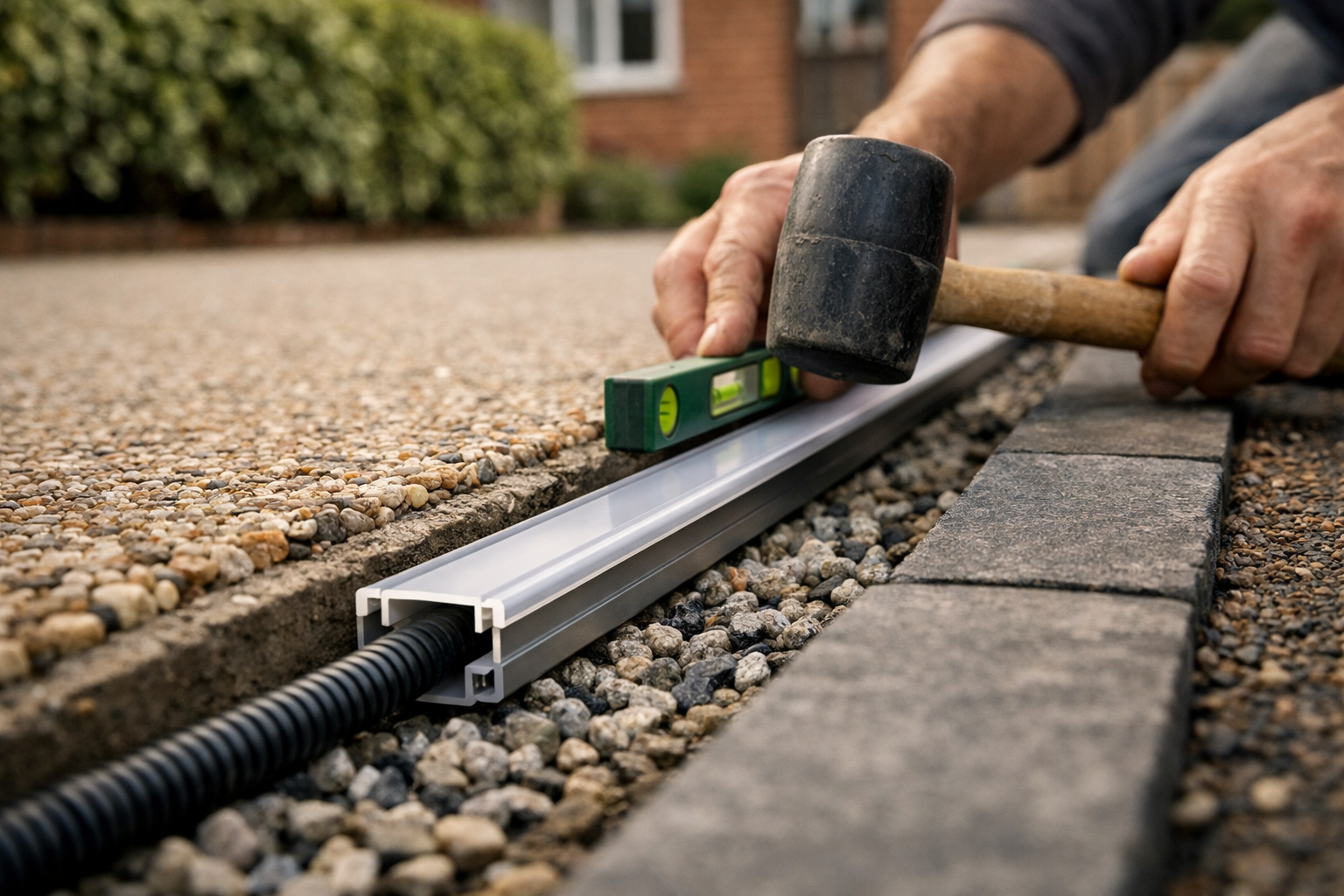
This style is popular because it gives a modern “hotel entrance” feel without bulky fittings.
The key parts are:
- 🧰 LED strip or linear module – the light source.
- 🧱 Aluminium or stainless channel – protects and supports the light.
- 💧 Diffuser and seals – help reduce glare and water ingress.
- 🔌 Outdoor-rated cabling – connects to a driver or transformer.
- ⚡ LED driver – supplies the correct low voltage power.
- 🛠️ Access point – allows future maintenance without lifting half the driveway.
In-ground LED channels are used for driveway and landscape effects [9]. LED strip lighting is also described by lighting suppliers as a significant development for driveway illumination [6].
But installation quality matters more than the product brochure.
A channel that traps water, sits too high, lacks expansion allowance or has no service access can become a headache. Driveways move slightly with heat, frost and load. Lighting details need to respect that.
Mike Clancy, Non-Executive Director: “Premium work is about what you don’t see as much as what you do see. Proper preparation, protection and access are what make an outdoor lighting detail last.”
🧱 Best surfaces for embedded LED strips
Embedded lighting can work with several driveway surfaces, but each has a different detail.
- Resin-bound driveways – excellent for clean edge lines and modern finishes. See our resin driveway installation guide.
- Block paving – useful because blocks can frame channels neatly. Explore block paving driveway options.
- Concrete – strong for recessed channels when planned early.
- Tarmac – possible, but the heat and edge detail need careful handling. Read more about premium tarmac driveways.
- Gravel – better with bollards, marker lights or fixed edge channels rather than loose strip placement.
Common mistake
Do not lay LED strip straight into the driveway without a proper channel. LED tape needs mechanical protection, drainage thought and a way to replace parts later.
Insider tip
Ask one simple question before approving an embedded lighting design:
“If one section fails in five years, how do we access it?”
If the answer is vague, pause the design.
Are solar driveway lights good enough for UK homes?
Solar driveway lights can work well for UK homes when they’re placed in direct sun, used for guidance rather than floodlighting, and bought with realistic expectations. They’re best for edges, long approaches, rural entrances and areas where mains wiring would be costly or disruptive.
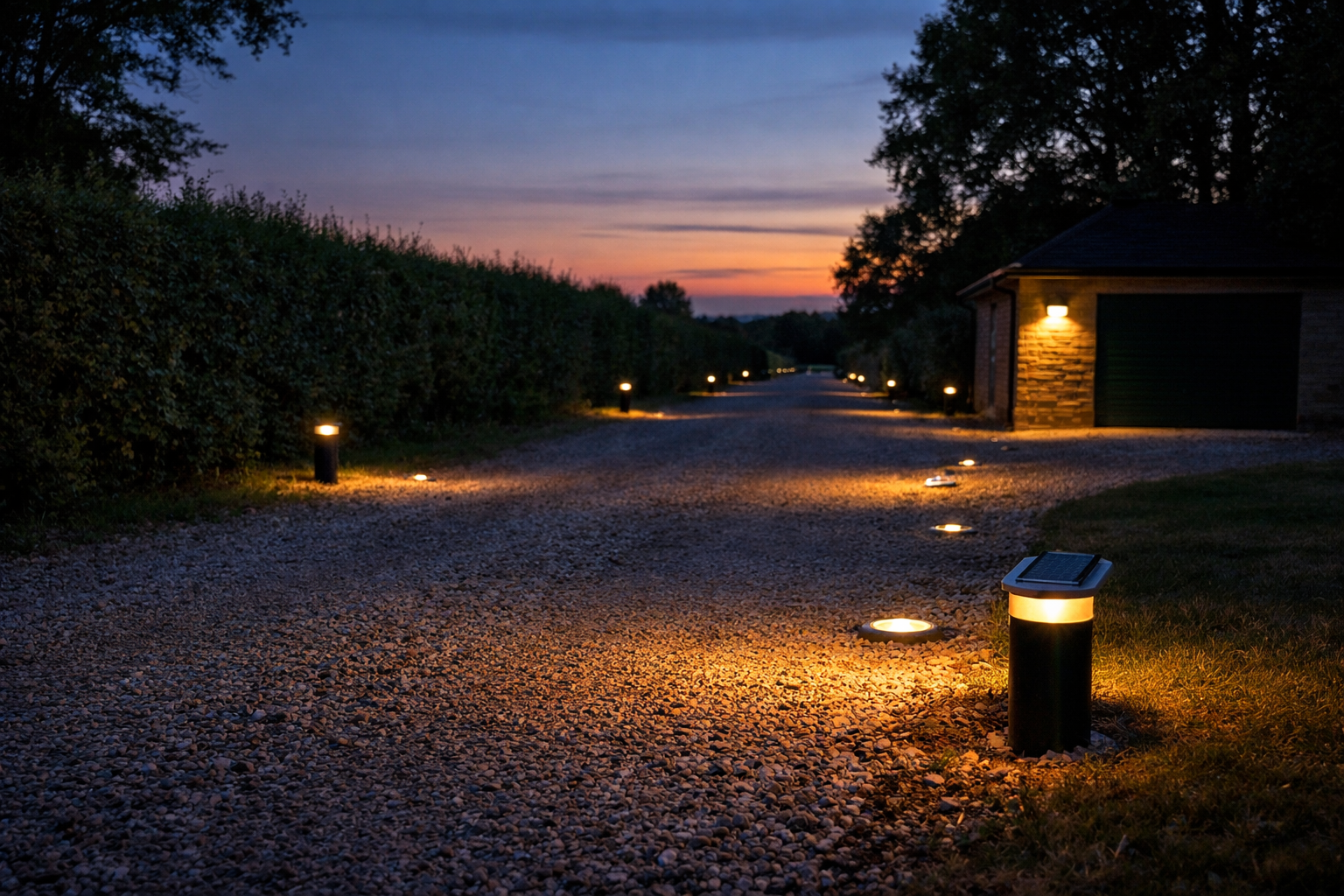
Solar driveway lights usually combine four parts: a solar panel, LED light, rechargeable battery and light sensor. The sensor turns the light on automatically at night, without electrical wiring [3].
That makes solar useful for:
- 🌤️ Long driveways where trenching cable would be disruptive.
- 🪴 Garden edges where soft pools of light look natural.
- 🏡 Existing driveways where you don’t want to lift the surface.
- 🚧 Temporary or phased projects where mains lighting can wait.
- 🌱 Lower-energy upgrades using renewable solar input [3].
Solar lighting is often cost-effective because it avoids complex wiring and may not need professional installation [3][6]. Marketplace options also include motion sensor solar lights, such as 120 LED models discussed in consumer video reviews [5].
Still, solar is not magic.
UK winter light levels are lower. Shaded drives, north-facing boundaries and tree cover can all reduce performance. If a panel sits under a hedge, the battery will struggle.
☀️ Placement rules for solar driveway lights
Use these rules before buying:
- Place panels in direct sunlight for most of the day [3].
- Space lights around 6 to 8 feet apart, then adjust for brightness and driveway shape [3].
- Avoid placing lights where car doors will hit them.
- Use warmer light near the house for a more comfortable look.
- Choose replaceable batteries where possible.
- Check the fitting is suitable for outdoor use.
Choose solar if…
Solar is a good fit if you want a quick visual lift, have limited access to power, or need gentle guidance lighting rather than strong task lighting.
Solar is not ideal if your driveway is heavily shaded, needs guaranteed all-night output in winter, or forms part of a commercial entrance where consistent performance is vital.
For natural-looking gravel approaches, solar markers can pair nicely with stabilised surfacing. Our guide to gravel driveways with hidden grids explains how to keep gravel stable while retaining a softer look.
How should you plan driveway lighting before installation?
Plan driveway lighting by mapping how people move, where cars turn, where water drains and where power can run safely. A good lighting plan starts with function first, then appearance.
Before choosing fittings, walk the driveway at dusk.
Notice where you slow down, where you step out of the car, where visitors hesitate, and where the surface edge disappears. Those are the places lighting earns its keep.
📝 Step-by-step driveway lighting checklist
Mark the entrance
- Gate posts, pillars and road edges need clear definition.
Light the walking route
- Focus on the path from car to front door.
Define surface edges
- This helps on narrow, curved and rural driveways.
Highlight hazards
- Steps, slopes, drains, retaining walls and level changes need attention.
Protect drainage
- Do not block falls, channels or permeable areas.
Plan cable routes
- Keep cables protected, accessible and away from future excavation zones.
Choose the colour temperature
- Warm white usually suits homes better than cool white.
Test glare from driver height
- Sit in a car and check whether fittings shine into your eyes.
Agree maintenance access
- Drivers, batteries and connections need future access.
Coordinate with surfacing
- Lighting should match the build sequence.
If you’re also planning EV charging, think about cable routes together. It’s far better to coordinate lighting, ducts and charging at the same time. Our smart driveway EV charging guide covers future-proof driveway planning.
Tony Flook: “The most expensive cable route is the one you remember after the driveway is finished.”
Common mistake
Many homeowners light the whole driveway evenly. That can feel flat and overdone.
A better plan uses layers:
- Soft edge guidance.
- Brighter task lighting near doors and garages.
- Motion lighting for security spots.
- Accent lighting for planting or entrance features.
What colour, brightness and spacing should driveway LED lights use?
Most homes look best with warm white, low-glare LED lighting and spacing that follows the driveway shape. Brightness should guide movement, not flood the whole frontage.
The best driveway lighting feels calm.
Warm white lighting, often around 2700K to 3000K, tends to suit brick, Bath stone, render, timber doors, planting and resin-bound surfaces. Cool white can work for very modern commercial-style homes, but it can feel harsh on traditional properties.
🌙 Practical spacing guidance
For solar driveway lights, 6 to 8 feet is a common starting point, depending on the output of the fitting and the area being lit [3].
For other fittings, spacing depends on purpose:
Area |
Suggested approach |
|---|---|
Driveway edge |
Regular low-level markers, not too bright |
Entrance from road |
Slightly stronger light to show the opening |
Parking bay |
Gentle wash light from wall or bollard |
Front door route |
Clearer task lighting for safe walking |
Steps or slopes |
Dedicated lighting to reveal level change |
Planting border |
Soft accent light, aimed away from eyes |
🚘 Test from the car
Stand in the garden and lights may look fine. Sit in the driver’s seat and the same lights may glare.
Check:
- Approach from the road.
- Reverse parking angle.
- Garage door view.
- Pedestrian route.
- Neighbouring windows.
Choose dimmable if…
Choose dimmable LED Lighting for Driveways if your home has large windows, close neighbours, reflective paving or a high-end frontage where mood matters. Dimming gives you control as seasons change.
How does LED driveway lighting affect safety and security?
LED driveway lighting improves safety by making edges, steps, slopes and entrances easier to see after dark. It can also support security by removing deep shadow near doors, garages and side access routes.
A well-lit driveway helps people move with confidence.
That matters for older relatives, children, delivery drivers and guests who don’t know the layout. It also matters in wet weather, when a dark surface can hide puddles, moss, ice and level changes.
🔐 Security without over-lighting
Security lighting should not blast the whole street.
Use:
- Motion sensor lights near garages and side gates.
- Low-level marker lights on long approaches.
- Wall lights angled down, not out.
- Timers or smart controls for predictable use.
- Dark-sky thinking, especially near rural areas.
Solar motion sensor lights can be useful where wiring is difficult [5]. Mains motion lighting is often better where you need consistent output every night.
Edge case: steep drives
Steep drives need extra care. Lighting should show the gradient, water flow and walking route. On sloped surfaces, glare from low fittings can be worse because the beam points upward.
If your drive is steep or slippery in wet weather, lighting should work with surface grip and drainage. Start with our guide to steep driveway solutions for wet UK weather.
What does LED Lighting for Driveways cost and how long does installation take?
LED Lighting for Driveways can range from a simple solar upgrade to a more detailed embedded system installed as part of a new driveway. The final cost depends on the number of fittings, power supply, trenching, surface type, controls and whether the driveway is new or existing.
Avoid anyone who prices lighting from a photo alone.
A proper quote should check:
- Driveway length and shape.
- Surface material.
- Drainage layout.
- Power source location.
- Cable routes.
- Outdoor rating of fittings.
- Controls, timers and sensors.
- Access for future repairs.
- Whether an electrician is needed.
For a new driveway, the lighting design should be priced with the whole installation. For wider budgeting, use our 2026 driveway installation costs guide.
⏱️ Timeframe guidance
Solar lights can often be fitted quickly if the ground is suitable and the product is in stock.
Embedded lighting takes longer because it affects the build sequence. Product lead times also matter. For example, one in-ground driveway LED strip product is listed with a 3 to 4 week shipping timeframe [1].
Common mistake
Do not forget the “small” items.
Drivers, connectors, ducting, junction boxes, controls, fixings and testing can all affect the price. A cheap fitting can become expensive if it fails early or needs awkward access.
What maintenance does driveway LED lighting need?
Driveway LED lighting needs light but regular maintenance: clean lenses, check seals, clear leaves, test sensors and keep solar panels free from dirt. Small checks help prevent dim light, water damage and uneven performance.
Outdoor fittings live a hard life.
They face rain, frost, tyre spray, grit, soil, pressure washing and the odd football. Even good fittings need care.
🧽 Simple maintenance routine
Every month in winter:
- Wipe solar panels and lenses.
- Clear leaves from recessed fittings.
- Check motion sensors are not blocked.
- Look for standing water around channels.
- Note any flickering or colour change.
Twice a year:
- Check fixings.
- Inspect cable entry points where visible.
- Review timer settings.
- Replace weak solar batteries if the fitting allows it.
- Clean the driveway surface carefully.
Pressure washing needs care around embedded lights. Do not blast seals at close range. Our driveway maintenance guide for 2026 explains how cleaning and sealing affect different driveway surfaces.
Ben Sperring: “A good driveway should be easy to look after. If a lighting detail makes cleaning awkward, it probably wasn’t detailed properly in the first place.”
Troubleshooting quick guide
Problem |
Likely cause |
First check |
|---|---|---|
Solar lights dim early |
Poor sun or tired battery |
Clean panel and check shade |
One LED strip section fails |
Connector, driver or water ingress |
Isolate power and call a professional |
Lights flicker |
Driver or connection issue |
Do not ignore outdoor flicker |
Motion light triggers too often |
Sensor angle or passing movement |
Adjust direction and sensitivity |
Recessed light holds water |
Poor drainage detail |
Clear debris and inspect channel |
FAQ: LED Lighting for Driveways
LED Lighting for Driveways raises practical questions about safety, cost, power and long-term upkeep. These short answers cover the queries homeowners most often ask before committing.
💡 Can LED driveway lights be driven over?
Some recessed driveway lights are designed for in-ground or driveway use, but not every outdoor LED fitting can take vehicle loads. Always check the product rating and install it in the correct channel or housing.
🌧️ Are driveway LED strips waterproof?
Outdoor LED strips need suitable protection, sealed connections and a proper channel. Water resistance depends on the product and installation detail, so avoid bare LED tape in exposed driveway areas.
🔋 How long do solar driveway lights last at night?
Solar driveway light run time depends on sunlight, battery size, panel quality and season. In UK winter, shaded solar lights may run for fewer hours than they do in summer.
🏡 Do I need planning permission for driveway lighting?
Most small domestic driveway lighting does not need planning permission, but listed buildings, conservation areas and very bright fittings may need extra care. Keep lighting low-glare and neighbour-friendly.
⚡ Do I need an electrician for LED Lighting for Driveways?
Use a qualified electrician for mains-powered outdoor lighting. Solar standalone lights may not need electrical installation, but fixed outdoor circuits should be designed and tested properly.
🚗 What is the best lighting for a narrow driveway?
Low-level edge lighting usually works best for a narrow driveway because it defines the route without taking up space. Avoid bulky bollards where car doors, mirrors or bins may hit them.
🌿 Can driveway lighting work with planting?
Yes, driveway lighting often looks better when combined with planting. Use soft accent lights in borders and keep glare away from windows, drivers and neighbours.
🧊 Will frost damage driveway lights?
Frost can damage poor fittings, weak seals or badly drained recessed channels. Choose outdoor-rated products and make sure water cannot sit around the fitting.
Conclusion
LED Lighting for Driveways can change how your home feels after dark. The right scheme makes parking easier, walking safer and the whole frontage more polished.
Start with the practical questions first.
Where do people walk? Where do cars turn? Where does water drain? Where can power run safely? Once those answers are clear, the style choice becomes much easier.
Choose embedded LED strips if you’re planning a premium new surface and want a clean, architectural finish. Choose solar driveway fixtures if you want a lower-disruption upgrade, especially on long or rural drives with good sunlight. Use wall lights, bollards and motion sensors where they solve a real problem.
And if you’re investing in a new driveway, plan the lighting before the surface goes down.
That single decision can save money, protect the finish and give your home the confident night-time kerb appeal it deserves.
Related reading
- Boost kerb appeal with a premium new drive
- Compare the best driveway materials for UK homes
- Plan smart driveway EV charging
- Read the 2026 driveway installation costs guide
- Maintain your driveway for long-term performance
References
[1] 14120 In Ground – https://www.alconlighting.com/14120-in-ground.html
[2] Driveway Led Strip Lights – https://www.bestledstrip.com/driveway-led-strip-lights
[3] Best Solar Driveway Lights Key Considerations In Lighting Projects – https://www.paclights.com/explore/best-solar-driveway-lights-key-considerations-in-lighting-projects/
[4] Best Solar Driveway Lights Usa 2026 Guide – https://solaraluma.com/blogs/news/best-solar-driveway-lights-usa-2026-guide
[5] Watch – https://www.youtube.com/watch?v=u9S52DX7TBg
[6] Elegant Driveway Lighting 4 Ideas To Elevate Your Homes Curb Appeal – https://twilightsolutions.com/blog/elegant-driveway-lighting-4-ideas-to-elevate-your-homes-curb-appeal/
[7] Led Driveway Lights – https://www.wired4signsusa.com/collections/led-driveway-lights
[8] In Ground Lights – https://clearlighting.com/in-ground-lights/
[9] Driveway Led Lighting – https://www.ecolocityled.com/product/driveway-led-lighting