Last updated: May 8, 2026
Quick answer
One winter downpour can show every weakness in an old blacktop drive: puddles, icy patches, blocked gullies and water tracking towards the house. Tarmac Driveways with Permeable Overlays can upgrade a tired surface by improving drainage, reducing standing water and helping the driveway work better with SuDS principles, provided the base and outfall are designed properly.
For homeowners, prestige property owners and small developers, the key is simple: don’t treat a permeable overlay as a cosmetic skin. Treat it as a drainage system with a wearing surface on top.
Key takeaways
- Tarmac Driveways with Permeable Overlays combine the clean look of blacktop with better surface water control.
- A permeable overlay only works if water has somewhere safe to go, such as an open-graded sub-base, soakaway or approved drainage route.
- Porous asphalt and other permeable systems can reduce stormwater runoff when correctly designed and maintained [3].
- Regular maintenance matters because permeable pores can clog with silt, moss and leaf debris [1].
- Existing tarmac can sometimes be overlaid, but cracked, sunken or poorly drained surfaces often need deeper reconstruction.
- Winter performance improves when standing water is reduced, but no driveway surface is completely ice-proof.
- Costs depend on access, depth, drainage design, edging, preparation and finish, so a site survey is worth more than a square-metre guess.
- If your priority is low maintenance above drainage, standard tarmac or resin-bound surfacing may be better in some locations.
- For new front driveways, SuDS design should be considered from day one, especially where water would otherwise run onto public areas.
- Good installation is not just about the surface. Levels, falls, compaction and edge restraint decide how long the upgrade lasts.
What are Tarmac Driveways with Permeable Overlays?
Tarmac Driveways with Permeable Overlays are existing or new blacktop-style driveways upgraded with a surface system that lets rainwater pass through, rather than sit on top or run straight into drains. The aim is to keep the smart, practical look of tarmac while improving water management.
A permeable overlay may be:
- 🧱 Porous asphalt, also called permeable tarmac or open-graded asphalt
- 🌧️ A permeable wearing course laid over a suitable free-draining build-up
- 🪨 A resin-bound overlay on a prepared porous asphalt base
- 🚗 A hybrid upgrade, where tarmac is retained in some areas and drainage features are added
Permeable tarmac works through connected voids in the surface. Rainwater passes through those voids and moves into the layer below. Source material on porous asphalt describes this type of surface as one that allows rainwater to seep through and reduce runoff [2].
The important phrase is “the layer below.”
If the old driveway is solid, sealed and sloping towards the house, a thin permeable surface on top won’t magically solve drainage. Water may get trapped between layers, which can cause frost damage, soft spots or early failure.
“A permeable overlay is only as good as the preparation underneath. The surface gets the attention, but the base does the hard work.”
Ben Sperring, Surfacing Manager, 25+ years
🧭 Choose this if…
Choose a permeable overlay if your existing driveway has a sound structure, enough depth for drainage correction and a sensible route for water to soak away or be collected.
Avoid it if your tarmac is badly rutted, breaking away at the edges or holding water because the base has failed. In that case, a full rebuild may protect your home better.
For a broader look at when blacktop still makes sense, read our guide to tarmac vs modern driveway alternatives in 2026.
Can Tarmac Driveways with Permeable Overlays help with SuDS compliance?
Yes, Tarmac Driveways with Permeable Overlays can support SuDS goals when the surface, sub-base and drainage route are designed as one system. A permeable surface on its own is not enough if water cannot drain through or be stored safely below.
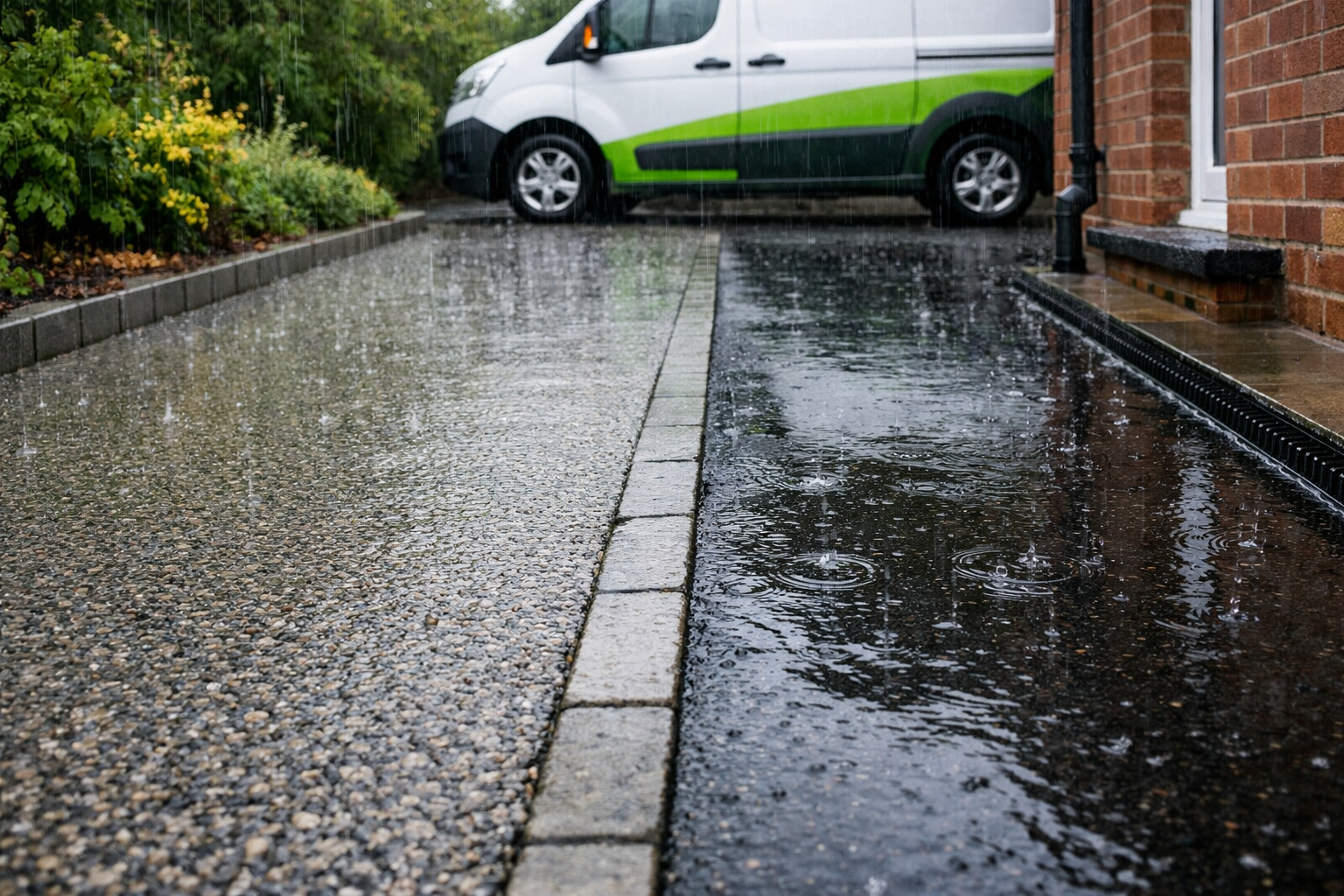
SuDS stands for sustainable drainage systems. The aim is to manage rainwater close to where it lands, rather than pushing it quickly into drains, roads or neighbouring land.
A good SuDS-minded driveway upgrade may include:
- 🌧️ A permeable surface that accepts rainfall
- 🪨 A clean, open-graded stone sub-base for storage
- 🏡 Falls that move water away from the property
- 🌿 Soft landscaping or planted borders for extra absorption
- 🧱 Edge restraints that keep the surface stable
- 🔎 Inspection points where needed for long-term care
Permeable driveway systems can reduce or eliminate stormwater runoff depending on design, which helps lower pressure on drainage infrastructure and can reduce pollutants reaching waterways [3]. Permeable surface options also need maintenance to prevent the surface pores clogging, which is a key point for long-term SuDS performance [1].
The common mistake?
Thinking SuDS means “just use a permeable product.” It doesn’t. SuDS means the whole driveway manages water responsibly.
“For a homeowner, SuDS is not just a planning phrase. It’s peace of mind during heavy rain. Water should be managed before it becomes a problem.”
Tony Flook, Managing Director, 25+ years
✅ SuDS decision rule
Use this simple rule before you commit:
Site condition |
Best next step |
|---|---|
Sound tarmac, good falls, no pooling |
Survey for overlay suitability |
Puddles near house |
Correct falls before overlaying |
Clay soil with slow soakage |
Consider storage layer plus controlled drainage |
Cracked or sunken blacktop |
Rebuild the base, don’t just overlay |
Large new front driveway |
Design SuDS from the start |
If you want a deeper planning overview, our SuDS compliant driveway UK guide explains the practical choices for homeowners and developers.
How do permeable overlays improve winter resilience?
Permeable overlays improve winter resilience by reducing standing water, which can lower the chance of puddles freezing on the surface. They also help water move away from the tyres and footpaths faster, but they still need correct levels and regular cleaning.
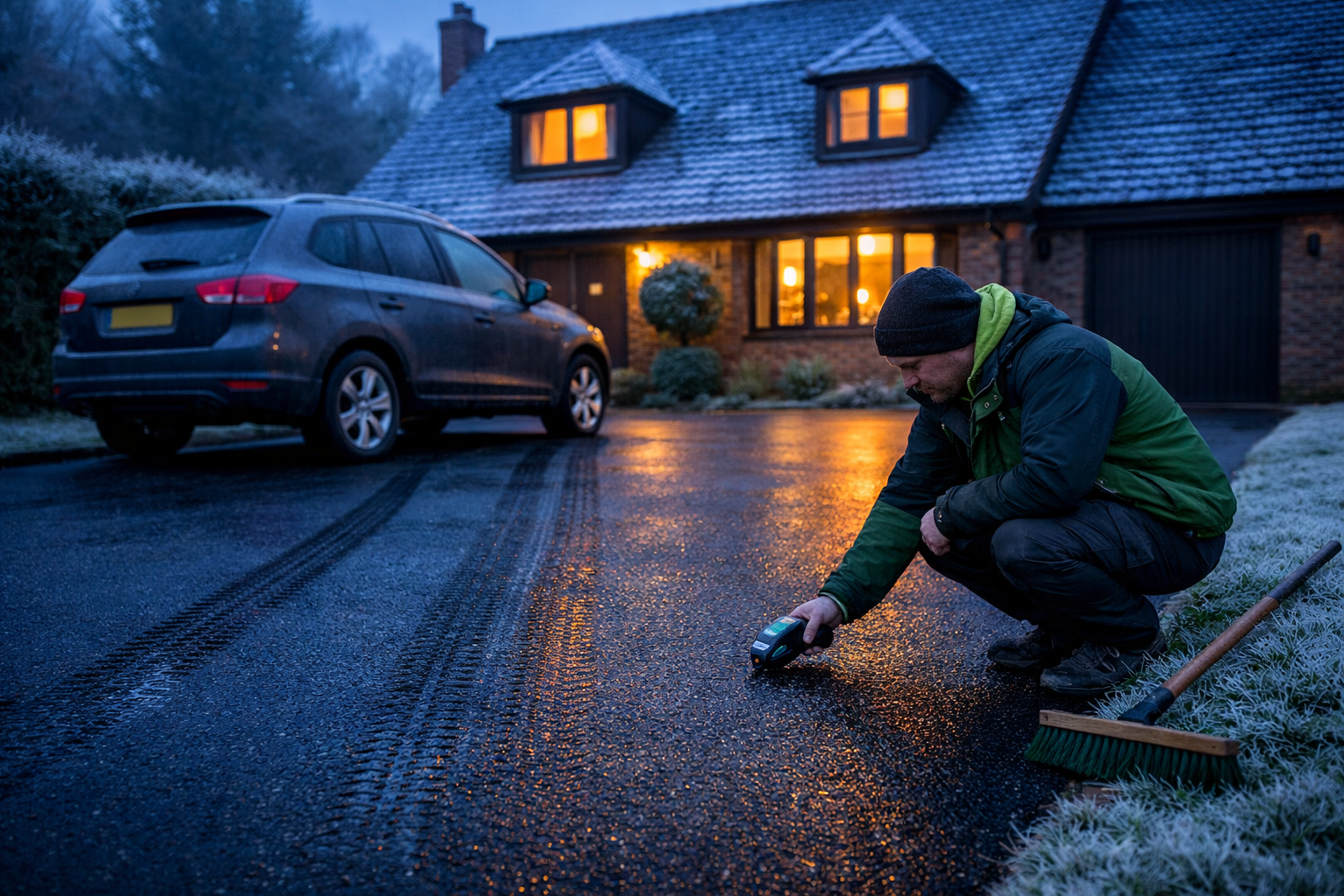
UK winters are rarely simple. One week brings rain. The next brings frost. Then comes leaf fall, salt, grit and delivery vans turning in the same spot every day.
A well-built permeable overlay helps by:
- ❄️ Reducing shallow puddles that can freeze overnight
- 🚶 Improving walkability near doors and paths
- 🚗 Keeping tyre contact more consistent in wet weather
- 🧹 Making winter cleaning easier when the surface is even
- 🌧️ Moving water down through the surface instead of across it
Porous asphalt systems use interconnected voids to let water pass through their structure [3]. That structure is useful in wet weather, but it also means the surface must stay open.
If the pores clog, water sits on top. If water sits on top in January, ice can follow.
⚠️ Winter edge case: shaded driveways
North-facing drives, tree-covered entrances and narrow side returns stay colder for longer. A permeable overlay can help with water movement, but shaded areas may still need winter treatment.
For steep sites, grip and drainage need to be designed together. Our guide to steep driveway traction in wet UK weather covers extra surface and layout options.
“No installer should promise a driveway that never freezes. The honest goal is better drainage, better grip and fewer avoidable hazards.”
Mike Clancy, Non-Executive Director, 30+ years
Is your existing tarmac suitable for a permeable overlay?
Your existing tarmac may be suitable if the surface is stable, well-compacted, correctly edged and free from major cracks or movement. If the driveway has structural failure, overlaying can hide the problem for a short time but usually makes the repair more expensive later.
Before recommending Tarmac Driveways with Permeable Overlays, a competent contractor should inspect more than the top layer.
At Driveways Plus, the survey approach is practical. We look at how the drive behaves, not just how it looks.
🔍 Site survey checklist
A proper assessment should check:
- 🧱 Surface condition: cracks, ravelling, potholes and worn areas
- 📏 Levels and falls: where water goes during heavy rain
- 🚗 Use pattern: cars, vans, turning circles and delivery traffic
- 🪨 Base stability: signs of sinking or pumping
- 🌿 Contamination risk: leaves, moss, soil run-off and trees
- 🏠 Threshold heights: garage doors, air bricks and damp proof courses
- 🧰 Access: machinery, waste removal and material delivery
Tools commonly used on professional driveway surveys include a laser level, straightedge, moisture checks, trial holes where needed and compaction assessment. On larger residential or small commercial projects, a CAT scanner may be used before excavation to check for buried services.
🏡 Mini case example: the smart overlay that nearly wasn’t
A typical homeowner query starts like this: “Can you just lay a new permeable surface over the old tarmac?”
On one recent-style survey scenario, the drive looked acceptable from the pavement. Up close, the car turning area had small crescent cracks and a soft patch near the garage. Water was not failing at the surface; it was failing below.
The right recommendation was partial excavation, new sub-base in the weak zone, corrected falls and then a permeable finish. It cost more than a simple overlay, but it avoided trapping water under a fresh surface.
That’s the difference between a tidy short-term job and a driveway that protects the property.
For more on repair versus renewal, see our tarmac driveway resurfacing, sealants and drainage guide.
How are Tarmac Driveways with Permeable Overlays installed?
Tarmac Driveways with Permeable Overlays are installed by preparing the existing surface, correcting weak areas, creating a drainage-ready base and laying a permeable wearing layer to the right depth and finish. The exact method depends on whether the existing tarmac can be retained or needs partial reconstruction.
A professional process usually follows these stages:
Survey and drainage plan
The contractor checks levels, existing falls, thresholds and water routes.Surface preparation
Loose tarmac, weeds, oil contamination and failed edges are removed.Repairs or excavation
Soft spots, cracked areas and sunken sections are cut out and rebuilt.Base correction
A free-draining aggregate layer may be added where SuDS performance is needed.Edging and restraint
Kerbs, setts or metal edging keep the surface locked in place.Overlay installation
The permeable asphalt or chosen overlay is laid at the specified depth.Compaction and finish
The surface is compacted evenly, with attention to joints and transitions.Handover advice
You should receive guidance on curing, first use, cleaning and winter care.
“The biggest installation pitfall is rushing the prep. If levels are wrong before the overlay, the finished driveway will still send water to the wrong place.”
Ben Sperring, Surfacing Manager, 25+ years
🛠️ Common mistake to avoid
Don’t accept a quote that only says “overlay existing drive” without explaining drainage, edge restraints, depths and preparation.
A proper quote should name the surface type, preparation method, drainage detail and aftercare needs. If a contractor can’t explain how water leaves the system, keep asking questions.
For homeowners comparing full replacement options, our page on premium tarmac driveway installations explains what goes into a properly built blacktop surface.
What do permeable tarmac overlays cost in 2026?
Permeable tarmac overlay costs in 2026 depend on preparation, drainage design, site access, surface area and whether the existing base can stay. International cost guides place permeable asphalt in a broad range, with one source citing $6 to $15 per square foot for permeable pavement installation [3], while another gives a standard two-car permeable paving driveway range of $5,000 to $12,000 [4].
Those are US figures, so treat them as benchmark context, not a direct UK quote.
In the UK, the right price comes from a site survey because two driveways with the same area can need very different groundwork.
💷 What affects the final price?
Key cost drivers include:
- Driveway size and shape
- Depth of excavation
- Existing tarmac condition
- Drainage route and soakaway needs
- Edge restraints and kerbs
- Access for machinery
- Waste removal
- Finish choice
- Local ground conditions
- Traffic load, such as vans or shared access
If you want current UK budgeting guidance by material, read our driveway installation costs 2026 guide.
📊 Permeable overlay versus other driveway options
Option |
Best for |
Watch-outs |
|---|---|---|
Permeable tarmac overlay |
Smart blacktop look with better drainage |
Needs clean pores and proper base |
Porous asphalt rebuild |
Strong SuDS-led blacktop system |
More groundwork than a simple overlay |
Resin-bound on suitable base |
Premium appearance and permeability |
Base preparation is critical |
Gravel with hidden grids |
Natural look and high permeability |
Loose stone feel unless well specified |
Permeable block paving |
Design flexibility and repairability |
Higher labour and joint maintenance |
HomeAdvisor’s cost guide notes porous asphalt can be more economical than permeable pavers in some cases [4]. That fits what we often see in practice: blacktop-based systems can work well for larger areas where speed and value matter.
For a natural alternative, our guide to gravel driveways with hidden grids is worth a look.
How do you maintain a permeable overlay?
A permeable overlay needs regular cleaning to keep the surface pores open. If silt, moss, leaves and fine debris block the voids, water will stop draining as intended and the surface may behave more like standard impermeable tarmac.
Permeable driveway sources warn that regular maintenance is needed to prevent clogging and maintain permeability [1].
The good news? Maintenance is simple when you stay ahead of it.
🧹 Seasonal maintenance plan
Spring
- Sweep grit, mud and winter debris
- Check edges for movement
- Treat early moss growth if needed
Summer
- Remove weeds before roots establish
- Clean oil marks quickly
- Check for scuffing in turning areas
Autumn
- Clear leaves weekly if trees overhang the drive
- Keep gullies, channels and borders free from silt
- Watch for soil washing in from beds
Winter
- Use de-icing products with care
- Avoid piling snow where meltwater refreezes
- Brush away grit build-up after cold spells
🚿 Jet washing: useful or risky?
Light pressure washing can help some surfaces, but aggressive jet washing may disturb joints, edges or surface texture. Always follow the installer’s care advice.
For general upkeep across surface types, use our 2026 driveway maintenance guide.
“A premium driveway is like a roof or a boiler. It performs best when you don’t ignore it for five winters and then expect one clean to fix everything.”
Tony Flook, Managing Director, 25+ years
Who should choose a permeable tarmac overlay, and who should avoid one?
Choose a permeable tarmac overlay if you want the clean look of blacktop, better rainwater control and a practical upgrade for an existing driveway that is structurally sound. Avoid a simple overlay if the base has failed, the site has poor falls or you need a major redesign.
✅ A good fit for
- Homeowners with tired but stable tarmac
- Prestige properties needing discreet drainage improvement
- Small developers who want practical SuDS-aware surfacing
- Shared drives where standing water causes complaints
- Small commercial sites with light vehicle traffic
- Homes where a full visual redesign is not wanted
❌ A poor fit for
- Driveways with major rutting or sinking
- Sites with no viable drainage route
- Areas with heavy silt or mud wash-on
- Very steep drives without grip detailing
- Owners wanting a “fit and forget” surface
- Projects where threshold levels are already too tight
🧠 Insider tip
Ask your contractor this question:
“If we pour a bucket of water here, where exactly will it go?”
A good installer will answer clearly. They’ll talk about falls, surface permeability, sub-base storage and discharge route. If the answer is vague, the design may be vague too.
FAQ
Can you lay a permeable overlay over old tarmac?
Yes, but only if the old tarmac is stable, clean and suitable for the drainage design. If the existing surface is cracked, sunken or holding water, repairs or reconstruction are usually needed first.
Are Tarmac Driveways with Permeable Overlays fully SuDS compliant?
They can be SuDS supportive when the full system is designed correctly. The surface, sub-base and water route must work together, and maintenance is needed to keep the surface draining.
Will a permeable tarmac driveway stop ice forming?
No driveway surface can guarantee zero ice. A permeable overlay can reduce standing water, which may reduce avoidable freezing, but shaded areas and severe weather still need care.
How often should a permeable driveway be cleaned?
Most homes should sweep regularly and carry out a more thorough clean at least once or twice a year. Drives under trees or near soil run-off may need more frequent cleaning.
Is porous asphalt better than resin-bound surfacing?
Porous asphalt can be a practical, cost-effective choice for larger blacktop-style areas. Resin-bound surfacing may suit homeowners who want more colour choice and a decorative finish, but the base still matters.
How long before you can drive on a new permeable overlay?
Your installer should give project-specific advice. Many tarmac-based surfaces need a short curing and cooling period before normal use, with extra care around sharp turns during the early life of the surface.
Do permeable overlays work on clay soil?
They can, but clay soil often drains slowly. The design may need a storage layer, controlled outlet or alternative drainage route rather than relying only on soakage.
What is the biggest cause of permeable driveway failure?
Poor preparation is the biggest cause. Clogged pores, weak bases, bad falls and missing edge restraints can all shorten the life of the driveway.
Conclusion
Tarmac Driveways with Permeable Overlays make sense when you want a smart blacktop finish with better rainwater control and stronger winter performance. The best projects start with drainage, not decoration.
If your existing tarmac is sound, a permeable overlay may be a practical upgrade. If the base is weak or the falls are wrong, the better investment is to correct those issues first.
Here’s your next step:
- Watch where water goes during the next heavy rain.
- Note any puddles, ice patches, cracks or sinking areas.
- Ask for a survey that covers drainage, base condition and threshold levels.
- Compare overlay, rebuild and alternative surface options before choosing.
- Insist on a clear specification, not just a low headline price.
Your driveway protects the first impression of your home. More importantly, it protects the way water moves around it.
For tailored advice, you can request a free driveway quote from Driveways Plus.
Related reading
- Tarmac vs modern driveway alternatives in 2026
- SuDS compliant driveway UK guide
- Driveway installation costs 2026
- Tarmac driveway resurfacing, sealants and drainage
- Driveway maintenance guide 2026
References
[1] The Pros And Cons Of Permeable Surface Options For Driveways – https://beauxfort.com/blog/the-pros-and-cons-of-permeable-surface-options-for-driveways/
[2] Tarmac Driveway Ideas –
[3] Permeable Driveway Guide – https://terrazzo-usa.com/permeable-driveway-guide/
[4] Permeable Pavement –