Skip to content
Last updated: April 22, 2026
Quick answer: A tarmac driveway in reasonable structural condition can be resurfaced, sealed, and fitted with improved drainage for significantly less than the cost of a full replacement. In 2026, the right combination of resurfacing techniques, quality sealants, and SUDS-compliant drainage upgrades can add years of life to an ageing surface while boosting kerb appeal and protecting your property investment.
Key takeaways
- 🔍 Resurfacing works best when the existing base is stable and cracking is minor; widespread alligator cracking or a failed sub-base usually means full replacement [1]
- 💷 Resurfacing costs less upfront because it uses less material and skips major base work [1]
- 🛡️ Seal coating every 3-5 years is the single most cost-effective maintenance step for tarmac [2]
- 💧 SUDS drainage retrofits are increasingly expected under UK planning guidance and can be added during a resurface
- 🧪 Anti-slip additives mixed into sealant significantly improve safety on sloped driveways
- ⏱️ A professional resurface typically takes one to two days for an average residential driveway
- 🏠 Choosing the right approach now prevents far more expensive repairs in two or three years
- 📋 Always get a structural assessment before committing to resurfacing over replacement
Should you resurface or replace your tarmac driveway in 2026?
The answer depends entirely on what’s happening beneath the surface, not just on top of it.
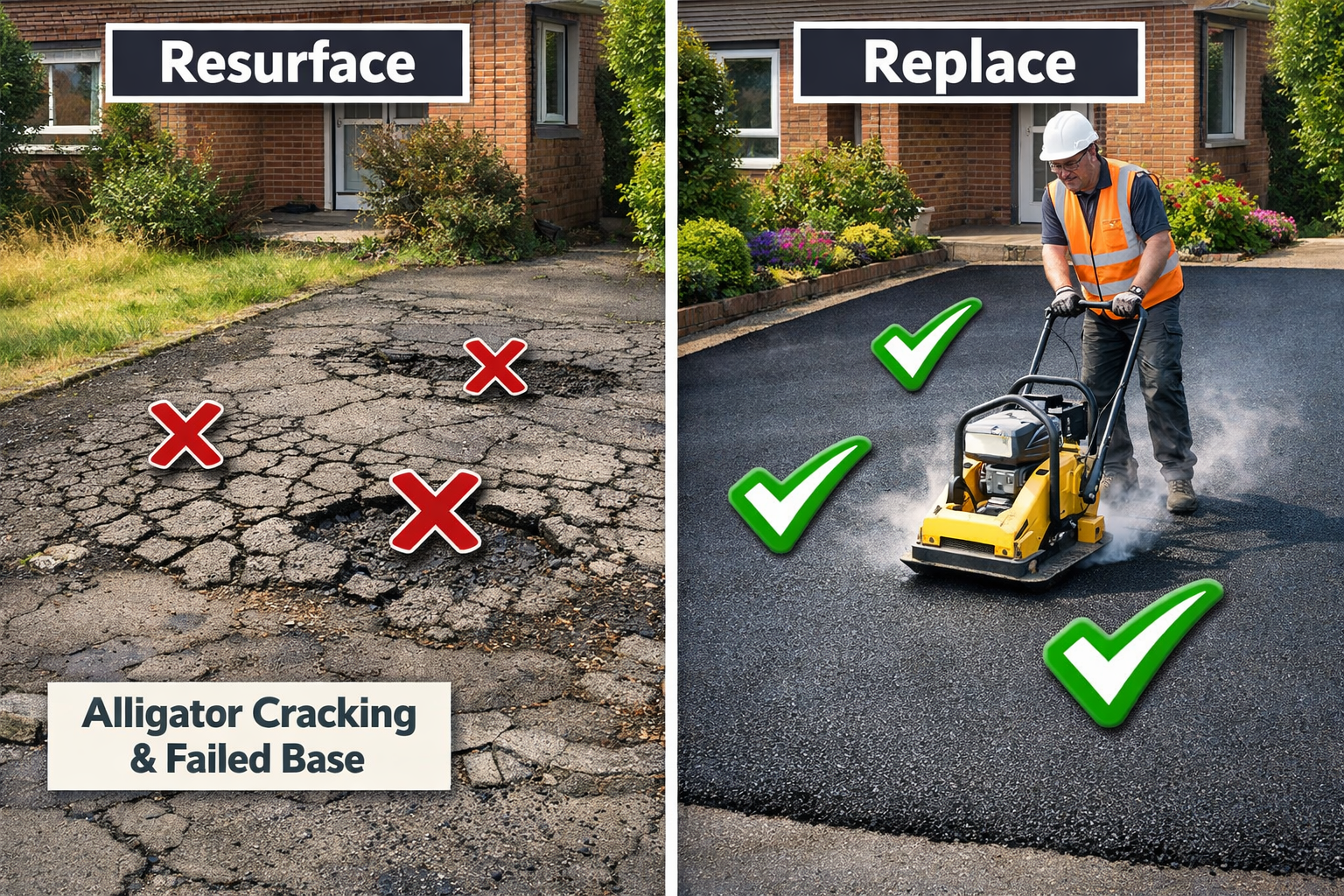
Resurfacing adds a new layer of hot-rolled asphalt or macadam over your existing pavement. It restores smoothness, improves appearance, and costs considerably less than ripping everything out. But it only works when the base underneath is structurally sound [1].
Resurface if your driveway shows:
- 🔎 Small, isolated cracks that haven’t spread into a network pattern
- ✅ A firm, stable base with no soft or “spongy” spots underfoot
- 🔧 Minor edge damage that can be milled cleanly before overlay
- 💧 Drainage that broadly moves water off the surface, even if imperfectly [1]
Replace if you’re seeing:
- ❌ Widespread alligator cracking (the interconnected mosaic pattern)
- ❌ Deep potholes that keep returning after filling
- ❌ Visible base failure, pooling water, or frost heave
- ❌ Multiple previous overlays already in place [1]
Ben Sperring, Surfacing Manager (25+ years): “The biggest mistake homeowners make is resurfacing over a compromised base. You’re just delaying the inevitable and spending money twice. A proper assessment takes 20 minutes and saves you thousands.”
If you’re unsure which category your driveway falls into, our guide on common driveway problems and how to fix them permanently walks through the diagnostic steps in detail.
What does a professional tarmac resurfacing process actually involve?
A quality resurface isn’t just laying new tarmac on top of old. There’s a clear sequence that separates a lasting result from one that fails within a season.
The professional resurfacing process:
- Structural assessment – Check sub-base integrity, identify problem areas
- Crack and pothole repair – Fill and compact any voids before overlay
- Edge preparation – Mill or cut edges cleanly for a neat, bonded finish
- Tack coat application – Bitumen emulsion applied to improve adhesion between old and new layers
- Hot-rolled asphalt overlay – Typically 40-50mm for residential driveways
- Compaction – Plate compactor or roller to achieve correct density
- Sealant application (optional) – Applied once the surface has cured [2]
The result looks and performs like a new installation, at a fraction of the replacement cost [2].
Tony Flook, Managing Director (25+ years): “We’ve resurfaced driveways that were 20 years old and given them another 15 years of life. The key is honest assessment upfront. If the base is good, resurfacing is genuinely excellent value for money.”
For a broader look at material options alongside tarmac, the best driveway material comparison is worth a read before you commit.
Which sealants work best for tarmac driveways in 2026?
The right sealant protects your tarmac from UV degradation, water ingress, oil stains, and freeze-thaw damage. Applied correctly, it’s the most cost-effective maintenance step available [2].

The main sealant types compared:
Sealant type | Best for | Typical recoat interval | Notes |
|---|---|---|---|
Bitumen emulsion sealant | Standard residential tarmac | 3-5 years | Cost-effective, widely available [2] |
Coal tar-free acrylic sealant | Eco-conscious homeowners | 3-4 years | Lower VOC, good UV resistance |
Polymer-modified sealant | High-traffic or commercial use | 5-7 years | Higher upfront cost, longer life |
Anti-slip sealant (with grit additive) | Sloped or north-facing driveways | 3-5 years | Silica or aluminium oxide aggregate added |
🔐 Anti-slip additives: a smart upgrade for sloped drives
Anti-slip additives are simply fine aggregate particles, typically silica sand or aluminium oxide, mixed into the sealant before application. They create a textured surface that dramatically improves grip in wet conditions.
If your driveway slopes toward the road or sits in a shaded spot that stays damp, this is a straightforward upgrade worth adding at sealant time. The cost difference is minimal. The safety benefit is significant.
For advice specific to sloped surfaces, our steep driveway advice guides cover grip, drainage, and material selection in detail.
Mike Clancy, Non-Executive Director (30+ years): “Sealant is cheap insurance. A homeowner who seals their tarmac every four years will spend a fraction of what their neighbour pays for a full resurface ten years earlier than necessary.”
Practical sealant tips:
- ⏳ Wait at least 30 days after resurfacing before applying sealant
- 🌡️ Apply in dry weather above 10°C for proper curing
- 🧹 Clean the surface thoroughly before application; oil stains need treating first (see our guide on removing oil stains from your driveway)
- 🔄 Two thin coats outperform one thick coat every time
How do SUDS drainage upgrades work with tarmac resurfacing?
SUDS (Sustainable Urban Drainage Systems) retrofits manage surface water at source rather than sending it straight into the public drainage network. In 2026, they’re increasingly expected under UK planning guidance for any driveway work that alters drainage patterns.
The good news? A resurface is the ideal time to upgrade your drainage. You’re already disturbing the surface, so adding channel drains or switching to a permeable tarmac layer adds relatively little to the overall cost.
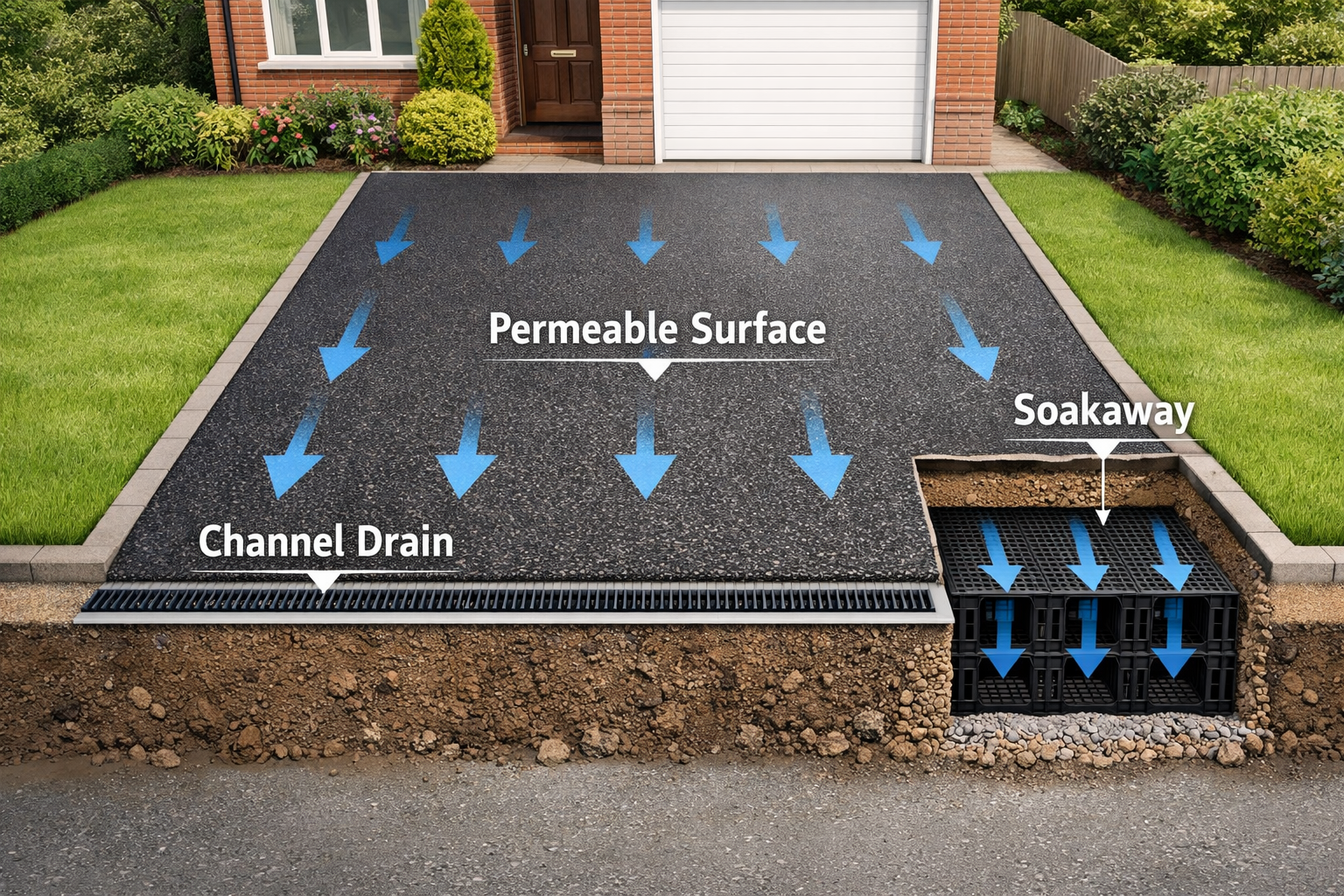
SUDS retrofit options for tarmac driveways:
- 💧 Linear channel drains – Installed at the base of the driveway apron to intercept runoff before it reaches the pavement; connects to a soakaway or soak pit
- 🌱 Permeable tarmac overlay – Open-graded asphalt allows water to pass through the surface layer into a sub-base aggregate reservoir
- 🪣 Soakaway crates – Modular plastic crates buried at the driveway edge; water infiltrates slowly into surrounding ground
- 🔄 Slot drains – Narrow drainage channels that blend neatly into the tarmac surface
Ben Sperring, Surfacing Manager: “We fit channel drains on almost every tarmac job now. It’s a small addition at the time of resurfacing that prevents a much bigger problem down the line, both for the homeowner and for the drainage network.”
Our detailed guide on SUDS-compliant driveways and permeable paving regulations explains the planning requirements and which solutions qualify.
What does tarmac resurfacing cost in 2026?
Costs vary by region, driveway size, and the extent of preparatory work needed. The figures below are indicative for a standard UK residential driveway (approximately 40-60m²).
Work type | Estimated cost range | Notes |
|---|---|---|
Resurfacing only (overlay) | £800 – £2,000 | Assumes sound base; no major repairs |
Full replacement | £2,500 – £6,000+ | Includes sub-base work and disposal |
Sealant application | £150 – £400 | Professional application; size dependent |
Channel drain installation | £300 – £800 | Per linear metre installed; varies by spec |
Anti-slip additive (to sealant) | £50 – £150 extra | Minimal cost addition |
Resurfacing is typically the lower-cost option upfront because it uses less material and requires minimal base work [1]. But if your base has failed, investing in full replacement now is more cost-effective long-term than resurfacing over a problem that will resurface again within a few years [1].
Budgeting checklist:
- ✅ Get a structural assessment before accepting any quote
- ✅ Ask specifically what sub-base preparation is included
- ✅ Confirm the tarmac layer thickness (40mm minimum for residential)
- ✅ Check whether drainage work is included or quoted separately
- ✅ Ask about the sealant schedule and what’s recommended post-install
For a full overview of tarmac specifications and what to expect from a quality installation, our premium tarmac driveway guide covers everything in one place.
How does resurfaced tarmac compare to permeable alternatives?
Sometimes a resurface isn’t the only option worth considering. If your drainage is genuinely poor or you’re planning a significant upgrade, it’s worth comparing tarmac against permeable alternatives.
Surface | Drainage | Maintenance | Approx. cost per m² | SUDS compliant? |
|---|---|---|---|---|
Resurfaced tarmac (standard) | Surface runoff only | Seal every 3-5 years | £20-£40 | No (unless channel drain added) |
Permeable tarmac | Through-surface infiltration | Jet wash annually | £35-£60 | Yes |
Resin-bound gravel | Through-surface infiltration | Low; occasional clean | £40-£80 | Yes |
Block paving (permeable) | Through-joint infiltration | Re-sand joints periodically | £50-£100 | Yes |
Resin-bound surfaces have grown in popularity for homeowners who want SUDS compliance with a premium finish. See our resin driveway guide for a full comparison.
Standard resurfaced tarmac remains the most cost-effective option when the base is sound and drainage is manageable. Permeable alternatives make more sense when drainage is a persistent problem or when planning permission requires a SUDS solution.
FAQs: tarmac driveway resurfacing, sealants and drainage
How long does a resurfaced tarmac driveway last? A professionally resurfaced tarmac driveway, with a sound base and regular sealant maintenance, can last 15-20 years. Skipping sealant or resurfacing over a compromised base significantly reduces that lifespan.
Can I resurface tarmac myself? Small patch repairs are manageable as DIY, but a full overlay requires specialist equipment and hot-mix asphalt that isn’t available to the public. Professional installation is strongly recommended for anything beyond minor repairs [3].
How soon can I drive on resurfaced tarmac? Most residential tarmac surfaces are safe to drive on within 24-48 hours of laying, though full curing takes longer. Avoid sharp turns and heavy vehicles for the first week.
Do I need planning permission to resurface my driveway? Generally, no, as long as you’re like-for-like resurfacing. However, if you’re changing the drainage arrangement or extending the driveway, permitted development rules may apply. Check with your local planning authority if you’re unsure.
What’s the difference between tarmac and asphalt? In everyday UK usage, the terms are often used interchangeably. Technically, tarmac refers to tar-macadam (now largely replaced by bitumen-bound macadam), while asphalt uses bitumen as the binder. Modern “tarmac” driveways are almost always hot-rolled asphalt or dense macadam. Our asphalt and tarmac advice hub explains the distinctions clearly.
Is permeable tarmac worth the extra cost? If drainage is a genuine problem on your property, yes. Permeable tarmac eliminates surface runoff, is SUDS compliant, and reduces the risk of standing water. The higher upfront cost is often offset by avoiding additional drainage infrastructure.
Conclusion: the smartest approach to tarmac driveway refreshers in 2026
Tarmac driveway refreshers in 2026 aren’t just about aesthetics. Done properly, resurfacing, sealing, and drainage upgrades protect your property, extend surface life by a decade or more, and prevent far costlier work down the line.
The decision tree is straightforward: assess the base first, then choose the right intervention. Resurface when the base is sound. Replace when it isn’t. Seal every three to five years regardless. Add drainage improvements at the point of resurfacing, because that’s when the cost is lowest and the disruption is already happening.
Your next steps:
- 🔍 Walk your driveway and check for the warning signs listed above
- 📋 Book a structural assessment with a qualified contractor before committing to any quote
- 💧 Ask specifically about SUDS drainage options during any resurfacing conversation
- 🛡️ Schedule sealant application 30 days after any new surface work
- 📞 Get a free quote from Driveways Plus and speak to a specialist about what your driveway actually needs
Your driveway is one of the first things people see. It’s also one of the hardest-working surfaces on your property. Treat it accordingly.
References
[1] Resurface Or Replace Your Driveway New Year Budgeting Checklist For 2026 – https://www.marshikenterprise.com/resurface-or-replace-your-driveway-new-year-budgeting-checklist-for-2026
[2] Tarmac Driveway Ideas – https://a1driveways.uk/tarmac-driveway-ideas/
[3] How To Resurface Your Asphalt Driveway – https://www.doitbest.com/global/ideas/home-improvement/how-to-resurface-your-asphalt-driveway/