Last updated: July 4, 2026
Most driveway failures don’t start on the surface. They start six inches down, in a sub-base that was rushed, under-compacted, or never really there in the first place. Get the foundation right and a well-laid drive can comfortably hit 20 to 25 years. Get it wrong and you’ll see ruts, puddles and cracked edges inside two winters.
Quick answer
Driveway sub-base preparation is the process of excavating the subgrade, laying a geotextile membrane, then compacting a layer of MOT Type 1 crushed stone (typically 100-200mm deep) to form a stable, free-draining foundation. Combined with proper drainage layers, it’s the single biggest factor in how long your resin, tarmac, block paving or gravel driveway will last. Skip it and you’re building on borrowed time.
Key takeaways
- 🧱 MOT Type 1 is a graded, angular crushed limestone or granite that locks together under compaction, creating a load-bearing base to Highways England Series 800 specification.
- 📏 For cars, aim for 100-150mm of compacted sub-base; for vans, motorhomes or clay soils, go 200mm or more.
- 💧 Drainage layers stop water pooling under the surface, which causes frost heave, rutting and sinkage.
- ⚙️ Compaction must be done in layers of 75-100mm using a vibrating plate or roller; one thick lift will never bind properly.
- 💷 Proper sub-base prep typically adds £15-£35 per m² but doubles the working life of the drive.
- 🚫 Skipping the sub-base is the number one reason driveways fail within 5 years.
- 🌧️ Since October 2008, new driveways over 5m² must be permeable or drain to a soakaway, not the public sewer.
What is MOT Type 1 and why do I need it for my driveway?
MOT Type 1 is a crushed aggregate specified by the Department for Transport (formerly the Ministry of Transport, hence “MOT”) for use as a road sub-base. It’s made from angular crushed limestone, granite or clean recycled concrete, graded from dust up to 40mm so smaller particles fill gaps between larger ones and lock together when compacted.
You need it because a driveway carries repeated point loads from tyres, and the ground underneath moves with moisture and temperature. MOT Type 1 spreads that load across a wider area and stops the surface course from flexing, cracking or sinking.
Why not just use any hardcore?
- 🪨 Uncrushed gravel has rounded stones that roll under load rather than lock.
- 🚧 Building rubble contains plaster, timber and voids that collapse over time.
- ✅ Type 1 is quality-controlled to a written specification, so you know what you’re getting.
“In 25-plus years of surfacing, I’ve never seen a well-compacted MOT Type 1 base fail on its own. It’s always the surface, the edges or the drainage that goes first. That’s why we won’t cut corners on it.” – Ben Sperring, Surfacing Manager, Driveways Plus
How thick should my driveway sub-base be?
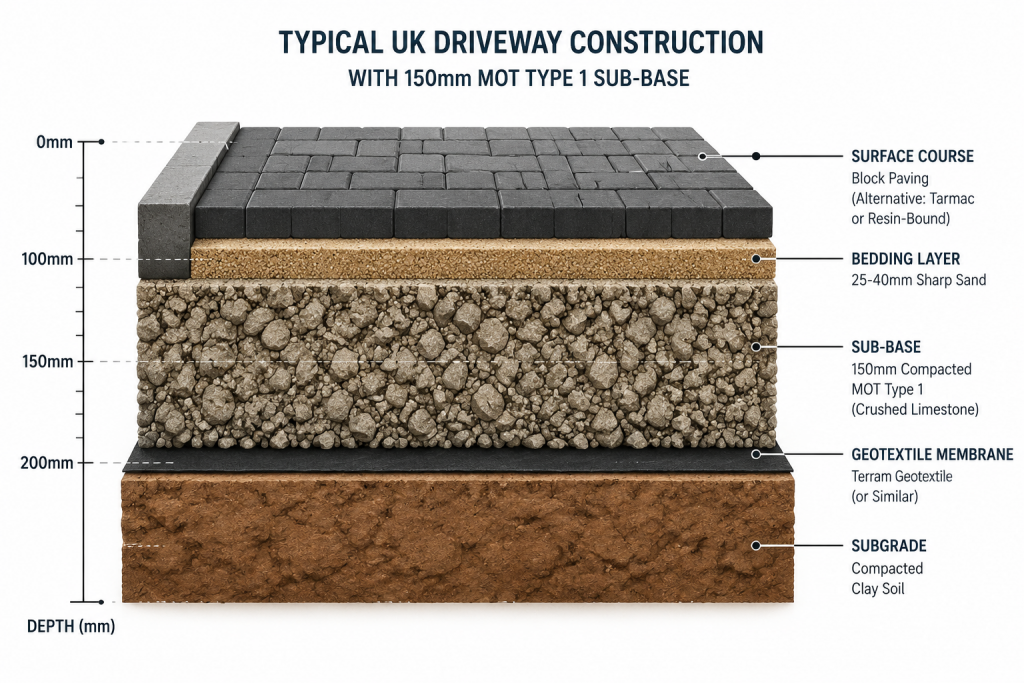
For a standard car driveway on reasonable ground, aim for 100-150mm of compacted MOT Type 1. For heavier vehicles or poor soil, increase to 200-250mm and consider a sub-base capping layer beneath.
Here’s a working guide based on what we specify on projects across Bath, Bristol and the surrounding counties:
Use case |
Sub-base depth (compacted) |
Notes |
|---|---|---|
Car driveway, firm ground |
100-150mm |
Standard residential spec |
Car driveway, clay soil |
150-200mm |
Add geogrid if very soft |
Van, motorhome or 4×4 |
200-250mm |
Consider Type 3 sub-layer |
Steep or sloping drive |
150-200mm |
Plus reinforced edging |
Commercial or shared drive |
250mm+ |
Engineered spec required |
Remember: those are compacted depths. You’ll need to lay roughly 25-30% more loose material to end up at the finished thickness after compaction.
Do I really need a drainage layer under my driveway?
Yes, in almost every case. Water is the number one enemy of a driveway. It softens the subgrade, freezes and expands in winter (frost heave), and washes fines out of the sub-base until it slumps.
A proper drainage strategy usually combines three things:
- 🧵 Geotextile membrane between subgrade and sub-base to stop soil pumping up into the aggregate.
- 🕳️ Free-draining sub-base (MOT Type 1 is naturally reasonably permeable when properly graded).
- 🌊 Surface drainage such as ACO channels, permeable surfaces, or falls to a soakaway.
Since October 2008, planning rules require new front driveways over 5m² to be permeable or drain to a soakaway rather than the highway. Our SUDS-compliant driveway guide walks through what that means in practice.
What’s the difference between MOT Type 1 and Type 2 for driveways?
MOT Type 1 has a defined grading from dust to 40mm and produces a dense, load-bearing base. MOT Type 2 has a similar top size but allows more fines and is less strictly graded, making it cheaper but less stable under repeated loading.
Use Type 1 for the main driveway sub-base. It’s the specified material for adopted highways for good reason.
Use Type 2 only as a lower capping layer on very deep builds, or for footpaths, sheds and low-traffic areas.
Decision rule: if a car will drive on it regularly, use Type 1.
How much does proper driveway sub-base preparation cost?
Expect to pay £15-£35 per m² for professional sub-base preparation in the UK in 2026, depending on excavation depth, soil conditions, spoil disposal and access. That’s typically 20-30% of the total driveway cost.
Rough breakdown for a 50m² driveway:
- 🚜 Excavation and muck-away: £800-£1,500
- 🧵 Geotextile membrane: £100-£200
- 🪨 MOT Type 1 supply (approx 15 tonnes): £450-£750
- ⚙️ Laying and compacting: £400-£700
- 💧 Drainage (ACO channel, soakaway): £300-£1,200
For a full picture across resin, tarmac, block and gravel, see our 2026 driveway installation costs guide.
Can I skip the sub-base and just lay tarmac directly?
No, not if you want it to last. Laying 40-60mm of tarmac straight onto soil or a thin scattering of hardcore is one of the most common reasons cheap driveways fail within two or three years.
What actually happens:
- 🕳️ Tyres press the tarmac into the soft ground, creating ruts.
- 💧 Water pools in the ruts, softening things further.
- ❄️ Winter frost lifts the surface, cracking it.
- 🌱 Weeds and grass push through the cracks.
By year three, you’re usually paying to have it dug up and done again. That’s not a saving; that’s paying twice.
What happens if you don’t prepare the sub-base properly?
Poor sub-base prep causes rutting, cracking, sinkage, edge failure, puddling and frost heave, usually within 2-5 years. The failures are cosmetic first, then structural, and repairs are almost always more expensive than doing it right initially.
Common failure patterns we see on remedial jobs:
- 🚗 Tyre-track ruts in tarmac from insufficient depth
- 🧊 Frost heave lifting block paving in patches
- 🌊 Standing water where the surface has slumped
- 🧱 Edge collapse on block paving without proper haunching
- 🕸️ Alligator cracking in tarmac from a flexing base
Our guide to common driveway problems and permanent fixes covers what these look like and whether they can be salvaged.
How long does a driveway last with good sub-base preparation?
With a properly prepared sub-base, expect 20-25 years from tarmac, 25-30 years from block paving, 15-20 years from resin-bound, and 10-15 years from gravel (with occasional top-ups). Cut corners on the base and you can knock 40-60% off every one of those numbers.
The surface layer gets the credit, but the foundation does the work.
“Homeowners fixate on colour and finish, which is understandable; that’s what you see every day. But if you’re spending five figures on a driveway, the money you don’t see spent, on excavation, membrane and Type 1, is what protects the investment.” – Tony Flook, Managing Director, Driveways Plus
Best way to compact driveway sub-base material
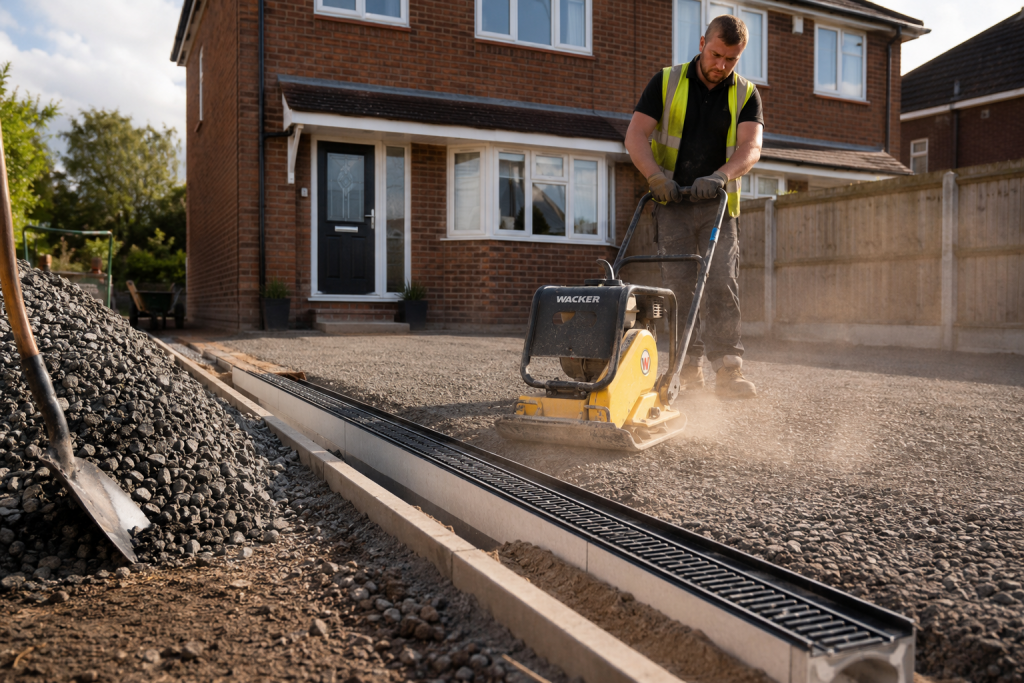
Compact MOT Type 1 in layers of 75-100mm using a vibrating plate compactor (for residential) or a small ride-on roller (for larger areas). Each layer must be fully compacted before the next is laid, and material should be lightly dampened, not soaked, to help fines settle.
Step-by-step:
- 🚜 Excavate to the required depth, checking for soft spots.
- 🧵 Lay geotextile membrane, overlapping joints by 300mm.
- 🪨 Tip the first 100mm of Type 1 and rake level.
- 💦 Lightly mist with water if bone dry.
- ⚙️ Compact with a plate (minimum 80kg for domestic) making 4-6 passes.
- 🔁 Repeat in 75-100mm lifts until you reach finished sub-base level.
- 📏 Check falls: aim for 1:60 to 1:80 for drainage.
Common mistake: dumping the full 150mm in one go and running the plate over the top. The bottom half stays loose and the drive slumps within a year.
Do clay soil driveways need a different sub-base than gravel or sandy soils?
Yes. Clay soils hold water and shrink and swell dramatically with moisture, so they need deeper sub-bases (200mm+), geogrid reinforcement, and stronger drainage. Sandy or gravelly soils drain freely and generally accept a standard 150mm sub-base without modification.
Quick soil check: dig a 300mm hole, fill with water, and see how long it takes to drain. If it’s still there an hour later, you’ve got poor-draining ground and should upgrade the spec.
Can I use recycled asphalt or recycled aggregate instead of MOT Type 1?
Yes, 6F2 recycled aggregate (crushed concrete and asphalt planings, graded to a specification) is an accepted alternative to primary MOT Type 1 for most residential driveways. It’s typically 15-25% cheaper and has a lower carbon footprint.
What to check:
- ✅ Supplied to a written specification (not just “crush and run”)
- ✅ Free of soil, timber, plaster and rebar
- ✅ Graded 0-40mm, similar to Type 1
- ⚠️ Not suitable where a Highways-adopted spec is required
For a typical resin, tarmac or block driveway, quality 6F2 performs comparably to primary Type 1. We use it regularly on residential jobs where clients want a greener build.
How to tell if my driveway sub-base is failing
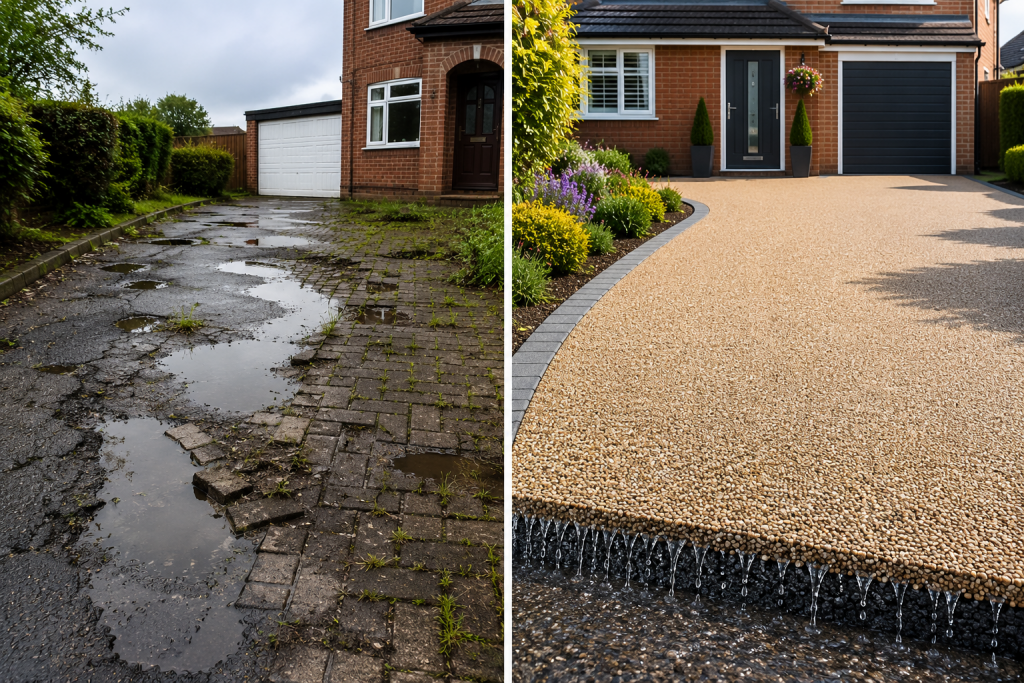
Look for localised dips, tyre-track depressions, standing water, cracks that follow wheel paths, and blocks that rock underfoot. These are all symptoms of movement in the base, not surface wear.
Quick self-check:
- 👟 Walk the drive after heavy rain: any puddles deeper than a coin suggest slumping.
- 🔨 Tap suspect block paving: hollow sounds mean the bedding has washed out.
- 📏 Lay a straight edge across ruts: more than 15mm deflection is structural.
Surface repairs on a failing base are cosmetic sticking plasters. If the foundation’s gone, plan for a full rebuild of that section.
Is professional sub-base preparation worth the money?
For anything larger than a small path, yes. Professional prep brings correct excavation depth, proper compaction equipment, graded materials, drainage design and, crucially, insurance and workmanship guarantees. DIY is realistic for a 10m² parking pad, ambitious for anything more.
“The bit homeowners underestimate isn’t laying stone – it’s reading the ground. Where does water go? What’s the subgrade CBR? Where will the wheel tracks concentrate load? That’s 30 years of judgement you can’t hire by the hour.” – Tommy Clancy, Pre-Construction Consultant, Driveways Plus
What’s the cheapest way to prepare a driveway sub-base without cutting corners?
Use quality 6F2 recycled aggregate instead of primary Type 1, do your own excavation if you’re able and dispose of spoil yourself, and pick a permeable surface course that reduces the need for extensive drainage infrastructure. You’ll shave 20-30% off costs without compromising longevity.
What not to skimp on: membrane, compaction, and depth. Those three decide whether the drive lasts.
FAQ
Can I lay a sub-base in wet weather? Light rain is fine and actually helps compaction. Heavy or persistent rain turns the subgrade to soup and should be avoided; wait for a dry window of at least 48 hours.
How long should the sub-base settle before the surface goes on? If it’s properly compacted, none. You can lay tarmac, resin or blocks the same day. If it hasn’t been mechanically compacted, don’t lay on it at all.
Do I need planning permission for a new driveway? Not usually, as long as the surface is permeable or drains to a soakaway within your property. Non-permeable drives over 5m² draining to the highway do need permission.
Can I put a sub-base over an existing concrete drive? Sometimes, if the concrete is sound and levels allow. More often the concrete traps water and cracks come through, so full excavation is safer.
What’s the best surface for a steep driveway? Resin-bound or tarmac with a textured finish, on a well-drained deep sub-base. See our steep driveway solutions guide for the full picture.
Does a sub-base matter for a gravel driveway? Absolutely. Gravel without a sub-base migrates, ruts and turns to mud. A compacted Type 1 base with a grid system keeps gravel driveways stable for decades.
Conclusion: the foundation is the driveway
If you take one thing from this guide, make it this: the surface you choose decides how your drive looks, but the sub-base decides how long it lasts. Skimping below ground is the single most expensive mistake homeowners make on driveway projects.
Your next steps:
- 📋 Ask any contractor for a written sub-base specification (depth, material, compaction method).
- 🕳️ Insist on excavation to firm subgrade, not just “scrape and lay”.
- 💧 Plan drainage before you plan the finish.
- 📞 Get a free, no-pressure quote that shows the sub-base spec in writing.
Do it once, do it right, and you’ll be enjoying that driveway long after your neighbours are digging theirs up for the second time.
References
- Department for Transport, Specification for Highway Works, Series 800: Road Pavements – Unbound, Cement and Other Hydraulically Bound Mixtures (2021). https://www.standardsforhighways.co.uk/
- UK Government, Guidance on the permeable surfacing of front gardens (2008, updated). https://www.gov.uk/government/publications/permeable-surfacing-of-front-gardens-guidance
- The Planning Portal, Paving your front garden. https://www.planningportal.co.uk/permission/common-projects/paving-your-front-garden
- British Standards Institution, BS 7533 Pavements constructed with clay, natural stone or concrete pavers. https://www.bsigroup.com/