Skip to content
Last updated: March 25, 2026
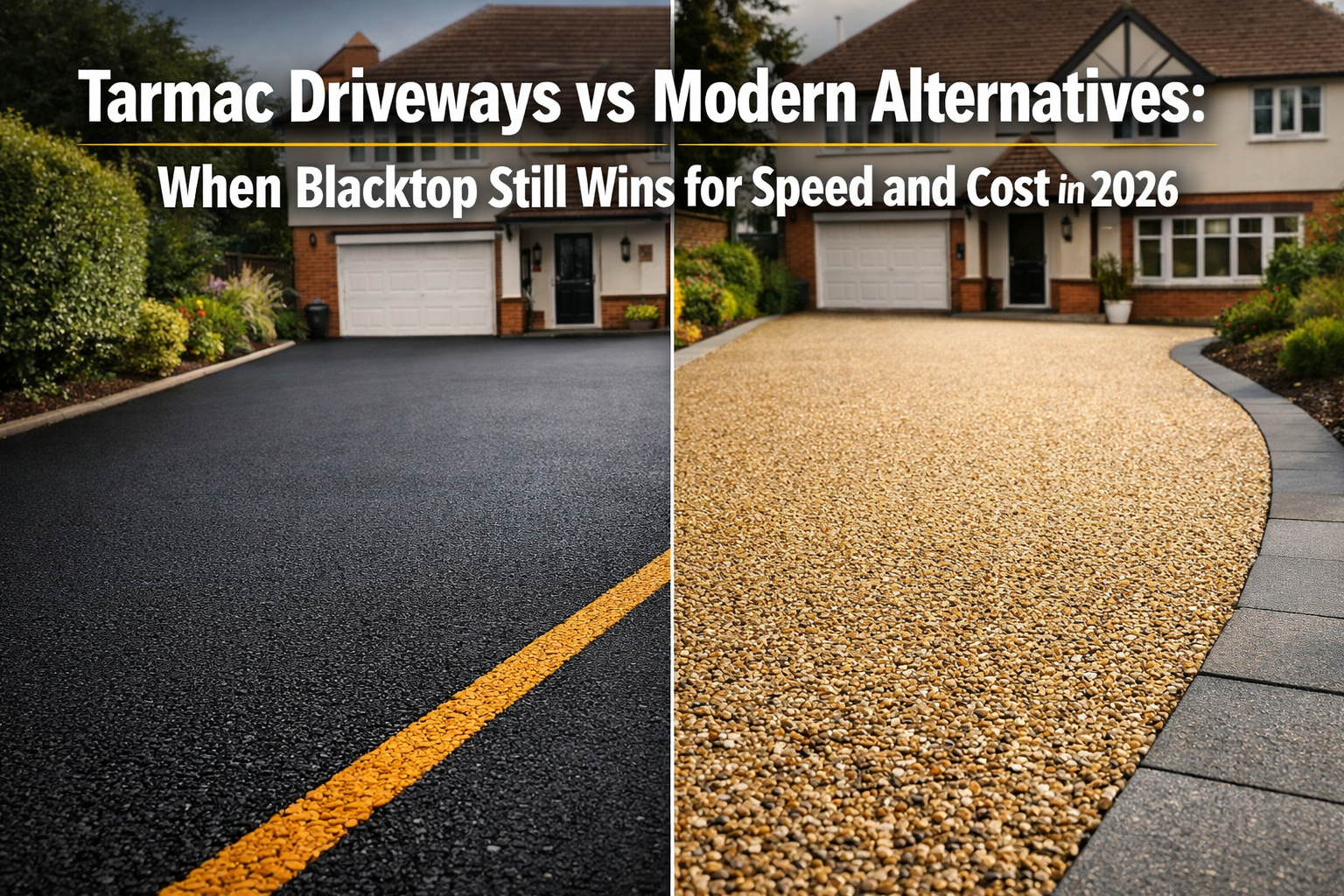
Quick answer: Tarmac remains one of the most cost-effective and fastest driveway surfaces to install in the UK. For homeowners on a clear budget, those with steep or high-traffic driveways, or anyone needing a reliable surface laid quickly, blacktop still beats most modern alternatives on price and practicality. Resin and block paving offer longer lifespans and better kerb appeal, but they come at a premium. The right choice depends on your priorities.
Key takeaways
- 💷 Tarmac is typically the most affordable driveway surface to install per square metre in the UK
- ⚡ Installation is faster than resin-bound, block paving, or concrete, often completed in one to two days
- 🚗 Excellent for heavy vehicles and high-traffic use, including vans, SUVs, and commercial traffic
- ❄️ Handles UK winters well, with good frost and freeze resistance built in
- 🔧 Easiest and cheapest to repair of all common driveway surfaces [2]
- ⏳ Lifespan of 15-20+ years with proper maintenance, versus 20-25 years for resin-bound [2]
- 🌿 Modern tarmac now includes eco-friendly options, such as warm-mix asphalt and recycled materials [5]
- ⚖️ Resin and block paving win on aesthetics and permeability, but cost significantly more upfront
- 🏠 Steep driveways benefit particularly from tarmac’s grip and fast-cure properties
- 📋 Always check SuDS compliance before choosing a non-permeable surface
Why does tarmac still compete so strongly in 2026?
Tarmac holds its own in 2026 because it solves the most common homeowner problems quickly and affordably. It’s durable, fast to lay, and easy to maintain, without the complexity or cost of newer alternatives. [6]
Industry analysis confirms tarmac remains a go-to choice because it delivers durability, weather resistance, and everyday practicality without unnecessary complexity. [6] That’s not a small thing when you’re weighing up a significant home improvement spend.
For a full breakdown of surface types, the best driveway material comparison covers all the key options side by side.
Tony Flook, Managing Director at Driveways Plus (25+ years’ experience): “Homeowners often come to us having been dazzled by resin or pattern imprinted concrete, only to realise their budget doesn’t stretch that far. Tarmac is never the ‘second choice’ – for the right property, it’s absolutely the first choice. We’ve installed thousands of tarmac driveways over the years and the feedback is consistently positive.”
How does tarmac compare to modern alternatives on cost and installation speed?

Tarmac is cheaper to install and faster to complete than virtually every modern alternative. That combination matters enormously for homeowners working to a deadline or a tight budget.
💷 Cost comparison: tarmac vs the alternatives
Here’s a realistic guide to installed costs per square metre in the UK in 2026 (estimates based on typical residential projects; always get quotes for your specific site):
Surface | Estimated cost per m² | Typical install time | Lifespan |
|---|---|---|---|
Tarmac | £45-£80 | 1-2 days | 15-20+ years [2] |
Resin-bound | £65-£120 | 2-3 days | 20-25 years [2] |
Block paving | £80-£150 | 3-7 days | 20-30 years |
Concrete | £75-£130 | 3-5 days + cure time | 25-30 years |
Gravel | £20-£40 | 1 day | 5-10 years |
Costs are estimates for guidance only. Actual prices vary by region, groundwork required, and project complexity.
Tarmac’s installation speed is a genuine advantage. [2] A standard driveway can often be completed in a single day, with the surface usable within 24-48 hours. Concrete, by contrast, needs several days to cure before you can drive on it.
Choose tarmac if: you need the job done quickly, you’re working to a firm budget, or you want a proven surface that won’t surprise you with hidden costs.
Choose resin-bound if: aesthetics are a priority, you need a SuDS-compliant permeable surface, or you’re happy to invest more upfront for a longer lifespan. See our guide to stunning resin driveways for more detail.
Is tarmac the right choice for steep driveways and heavy vehicle use?
Yes, and it’s one of the strongest arguments for choosing tarmac. Steep driveways and high-traffic properties put surfaces under real stress, and tarmac handles both well. [2]
Tarmac provides excellent traction for larger vehicles, including vans, SUVs, and heavier commercial traffic. The surface texture grips tyres effectively, which matters on a slope where a slippery surface becomes a safety issue.
Ben Sperring, Surfacing Manager at Driveways Plus (25+ years’ experience): “On steep driveways, we always think carefully about surface choice. Tarmac gives you consistent grip and it doesn’t shift or move underfoot the way loose gravel can. It’s also much easier to lay correctly on a gradient than block paving, where you need very precise levels to avoid water pooling.”
For homes with challenging gradients, our safe and stylish steep driveway solutions page covers what to consider before you commit to any surface.
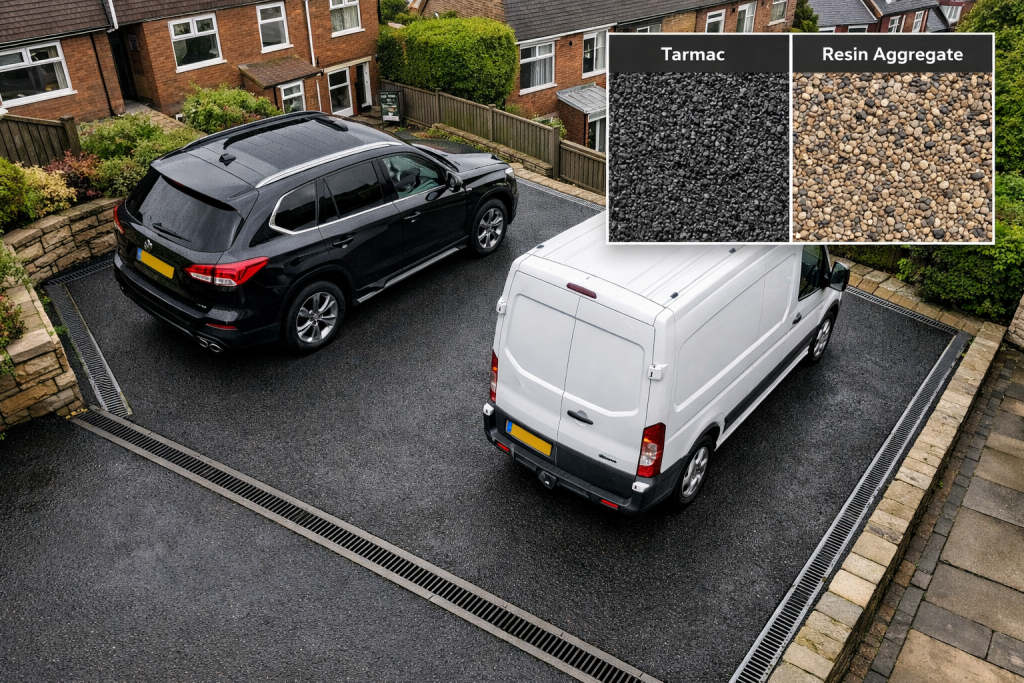
Common mistake: Choosing decorative block paving for a steep driveway without properly accounting for drainage. Water running down a slope can undermine the sub-base over time. Tarmac, laid correctly with proper falls, manages this more predictably.
How does tarmac perform against resin-bound driveways specifically?
This is the comparison most homeowners ask about in 2026, and it’s where the “tarmac driveways vs modern alternatives” debate gets most interesting.
Resin-bound surfaces look beautiful, last slightly longer (20-25 years versus tarmac’s 15-20 years), and are fully permeable, which means they meet SuDS drainage regulations without additional work. [2] Those are real advantages.
But tarmac fights back on several fronts:
- Lower upfront cost, often by 30-50% per square metre
- Faster installation, with no mixing or curing delays
- Easier repairs – a pothole or crack in tarmac can be patched quickly and cheaply [2]
- Proven frost resistance in UK winters [2]
- No UV fading issues (resin surfaces can lighten over time in direct sunlight)
Mike Clancy, Non-Executive Director at Driveways Plus (30+ years’ industry experience): “Resin-bound is a genuinely excellent product when it’s installed properly. But ‘installed properly’ is the key phrase. Poor resin work fails within a few years. Tarmac is more forgiving of minor installation variations, which is why it’s consistently reliable across a wider range of contractors and conditions.”
For more on resin options, our resin-bound driveway advice hub is a useful starting point.
💡 Insider tip: If you like the look of resin but want tarmac’s cost efficiency, consider a tarmac base with a resin-bound border or edging detail. You get the aesthetic accent without the full resin price tag.
What about maintenance: does tarmac really cost less to keep up?
Yes. Tarmac has the simplest and most affordable maintenance of any common driveway surface. [2]
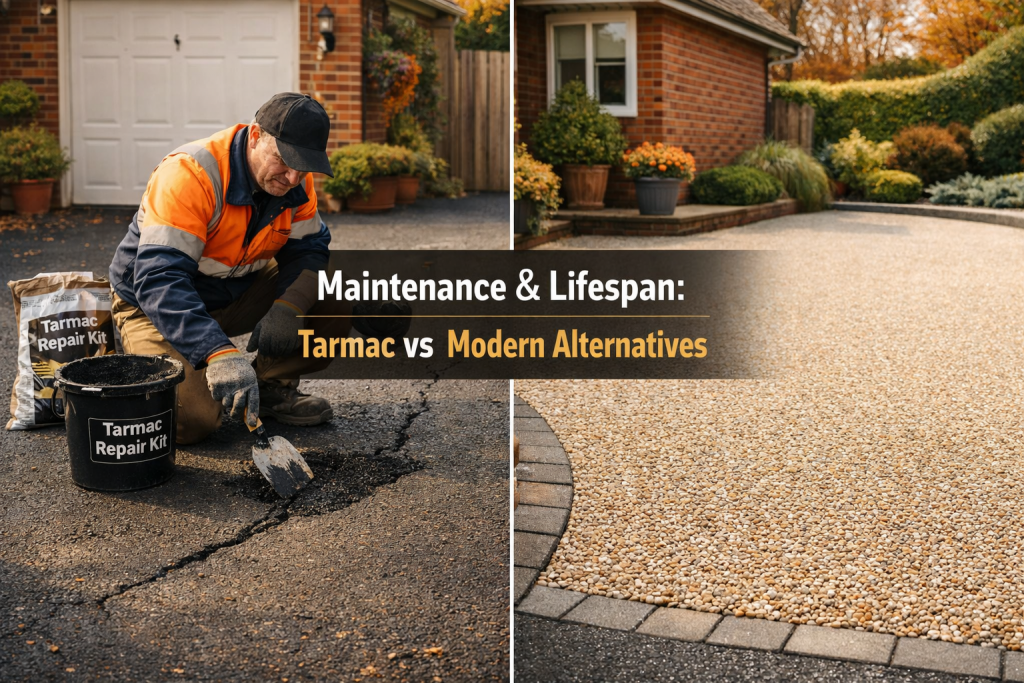
Minor cracks can be filled with tarmac repair compound, available from any builders’ merchant. Surface wear can be addressed with a sealcoat or thin resurfacing layer, which costs a fraction of replacing block paving or resin.
🔧 Maintenance comparison at a glance
- Tarmac: Seal every 3-5 years, patch cracks as needed. Low cost.
- Resin-bound: Occasional jet washing, limited repair options if sections fail. Higher repair cost.
- Block paving: Weed growth between joints, re-sanding, occasional re-levelling. Time-consuming.
- Concrete: Crack repairs are visible and difficult to blend. Resurfacing is expensive.
- Gravel: Regular raking, top-ups needed, displacement on slopes.
If you’re dealing with existing surface problems, our guide to common driveway problems and how to fix them covers the most frequent issues across all surface types.
One thing worth noting: tarmac can suffer from oil staining, which is more visible on a dark surface. Our guide to removing oil stains from driveways has practical solutions.
Has tarmac technology improved, or is it still the same old blacktop?
Modern tarmac is meaningfully better than it was 20 years ago. The core material is the same, but the formulations and installation techniques have advanced considerably. [5]
Contemporary installations now use:
- 🧪 Polymer-modified asphalt for increased durability and flexibility [5]
- ♻️ Warm-mix asphalt that requires less energy to produce and lay [5]
- 🌡️ Weather-resistant additives that extend surface life in harsh conditions [5]
- 💡 Design integrations including LED edge lighting, under-driveway heating, and bold aluminium or steel edging [3]
- 🔲 Mixed-material designs combining tarmac with block paving borders, resin inserts, or permeable paving zones [3]
Property owners who chose modern asphalt installations report higher satisfaction with weather resistance, longevity, and visual appeal compared to traditional blacktop. [5]
So if you’ve dismissed tarmac as purely functional and a bit dull, it’s worth revisiting. A well-designed tarmac driveway with quality edging and good proportions can look genuinely smart.
What are the genuine weaknesses of tarmac you should know about?
Tarmac isn’t perfect for every situation. Being honest about its limitations helps you make the right call.
Where tarmac underperforms:
- ❌ Aesthetics – it won’t match the visual impact of quality block paving or resin-bound aggregate
- ❌ Permeability – standard tarmac is not permeable, which may create SuDS compliance issues for larger driveways. Check our SuDS compliant driveway guide before you decide
- ❌ Heat sensitivity – in very hot summers, tarmac can soften slightly, leaving marks from kickstands or stiletto heels
- ❌ Shorter lifespan than concrete or quality block paving when comparing best-case scenarios
- ❌ Kerb appeal ceiling – for prestige properties, tarmac may not be the finish that best reflects the home’s value
Choose a modern alternative if: your property is high-value and kerb appeal matters significantly, you need a permeable surface for planning permission, or you want a surface that lasts 25+ years with minimal intervention.
For inspiration on what’s possible with other surfaces, browse our completed driveway projects.
Frequently asked questions
Is tarmac cheaper than block paving in 2026? Yes, in most cases significantly so. Tarmac typically costs £45-£80 per square metre installed, while block paving ranges from £80-£150 per square metre. For a 50m² driveway, that difference can easily exceed £3,000-£4,000.
How long does a tarmac driveway take to install? Most residential tarmac driveways are completed in one to two days, depending on size and groundwork requirements. [2] The surface is usually driveable within 24-48 hours of laying.
Does tarmac meet SuDS drainage regulations? Standard tarmac is not permeable and may not meet SuDS requirements for driveways over a certain size. Permeable tarmac options exist, or you can combine tarmac with permeable border zones. Always check planning requirements before installation.
Can tarmac be laid over an existing driveway? In some cases, yes. If the existing sub-base is sound and levels allow, tarmac can be overlaid. A qualified contractor will assess whether this is suitable or whether full excavation is needed.
How often does a tarmac driveway need resealing? Every three to five years is a common recommendation, though this depends on traffic levels and weather exposure. Regular sealing protects against water ingress and extends surface life.
Is tarmac suitable for a driveway with a steep slope? Yes, and it’s often the preferred choice for steep driveways. Tarmac provides consistent grip, handles drainage well when laid with correct falls, and is easier to install accurately on a gradient than block paving. [2]
Conclusion
When it comes to tarmac driveways vs modern alternatives, there’s no single winner for every home. But blacktop still wins clearly on speed, cost, and practicality for a large number of UK homeowners in 2026.
If your priority is a reliable, fast-install, budget-friendly surface that handles heavy vehicles and UK winters without fuss, tarmac is hard to beat. [6] It’s not glamorous, but it’s genuinely good at what it does, and modern formulations mean it performs better than ever. [5]
For homeowners where aesthetics, permeability, or maximum lifespan are the deciding factors, resin-bound or quality block paving may justify the extra investment.
Your next steps:
- Decide your top priority: cost, speed, aesthetics, or lifespan
- Check SuDS requirements for your driveway size and location
- Get at least three quotes from reputable local contractors
- Ask specifically about sub-base preparation, which is where most driveway failures begin
Ready to explore your options? Get a free driveway quote from the team at Driveways Plus, or browse our expert driveway material guides to dig deeper before you decide.
References
[1] Paving The Way Tarmac Vs Other Driveway Materials A Guide To Informed Choices – https://nmdriveways.co.uk/paving-the-way-tarmac-vs-other-driveway-materials-a-guide-to-informed-choices/
[2] Resin Vs Tarmac Driveways Uk – https://a1driveways.uk/resin-vs-tarmac-driveways-uk/
[3] Tarmac Driveways Traditional Vs Modern Design Trends – https://wollastondriveways.co.uk/tarmac-driveways-traditional-vs-modern-design-trends/
[4] Tarmac Driveways Vs Other Driveway Materials Making An Informed Decision – https://ashforddriveways.co.uk/tarmac-driveways-vs-other-driveway-materials-making-an-informed-decision/
[5] Traditional Vs Modern Asphalt Driveway Techniques A Comprehensive Comparison – https://townsendskurskypavingllc.com/traditional-vs-modern-asphalt-driveway-techniques-a-comprehensive-comparison/
[6] What Makes Tarmac A Go To Choice For Driveways In 2026 – https://bsedriveways.co.uk/what-makes-tarmac-a-go-to-choice-for-driveways-in-2026/
[7] Asphalt Vs Concrete Driveway – https://www.nerdwallet.com/home-ownership/home-improvement/learn/asphalt-vs-concrete-driveway
[8] Resin Vs Tarmac Driveways – https://groundtekcivils.co.uk/blog/resin-vs-tarmac-driveways