Skip to content
Last updated: March 18, 2026
Quick answer: The best steep driveway solutions for wet UK weather combine textured or open-graded tarmac, resin-bound surfaces with high-grit aggregate, or block paving laid in a herringbone pattern with chamfered edges. Each material can be specified or installed to dramatically improve grip on slopes, while also managing surface water to meet SUDS drainage requirements.
Key takeaways
- 🏔️ Slopes above 1:10 (10%) need surface materials specified for grip, not just aesthetics
- 💧 Open-graded tarmac and resin-bound surfaces both drain water through the surface, reducing standing water on slopes
- 🧱 Herringbone block paving with chamfered edges outperforms stretcher bond on steep gradients
- 🔒 Anti-slip aggregate ratings (R10, R11, R12) matter; ask your installer which rating their resin mix achieves
- 🛠️ Geotextile membranes and reinforcement grids beneath the surface prevent creep and movement on steep slopes
- 📐 Tar-and-chip (surface dressing) offers a cost-effective, naturally textured alternative to full tarmac resurfacing
- 🌧️ UK rainfall averages around 1,154mm per year (Met Office estimate), making drainage specification essential, not optional
- ✅ Any new driveway over 5m² must comply with SUDS regulations if it drains to a public road
Why do steep driveways become so dangerous in wet UK weather?
Water is the enemy of grip on any slope. When rain falls on a smooth, impermeable surface, it forms a thin film that reduces tyre and foot contact with the ground. On a gradient, that film moves faster, and the risk of skidding or slipping increases significantly.
Standard tarmac and some block paving surfaces are designed for relatively flat applications. Specify the same material on a 1:8 slope without adjusting the surface texture or drainage, and you’re creating a hazard every time it rains.
The good news? With the right steep driveway solutions, grip and drainage can be engineered into the surface itself.
Ben Sperring, Surfacing Manager: “The mistake most homeowners make is choosing a material based on how it looks in a brochure, then finding out in November that it’s like a skating rink. Grip needs to be specified at the design stage, not retrofitted as an afterthought.”
What are the best traction boosters for steep tarmac driveways?
Textured and open-graded tarmac are the two most effective solutions for sloped asphalt surfaces. Standard dense macadam becomes slippery when wet because water sits on the surface. Open-graded tarmac, sometimes called porous asphalt, uses a coarser aggregate mix with air voids that allow water to drain through rather than pool.
For existing tarmac driveways, surface dressing (tar-and-chip) is a practical upgrade. A bitumen binder is applied, then sharp chippings are rolled in, creating a naturally textured, high-friction surface [1][4]. It’s particularly well-suited to slopes because the aggregate is pressed firmly into the binder, and the irregular stone surface gives tyres something to bite into.
Choose open-graded tarmac if: you’re installing a new surface and want maximum drainage performance built in from day one.
Choose tar-and-chip if: you have an existing tarmac base in reasonable condition and want a cost-effective grip upgrade without full resurfacing [2].
Common mistake: Using standard 6mm dense macadam as a wearing course on slopes steeper than 1:10. The smooth finish offers minimal grip when wet. Specify 10mm or 14mm open-graded wearing course instead.
For a deeper look at material specifications, our tarmac driveway guide covers aggregate sizing and mix types in detail.
How does resin-bound paving improve grip on steep driveways?
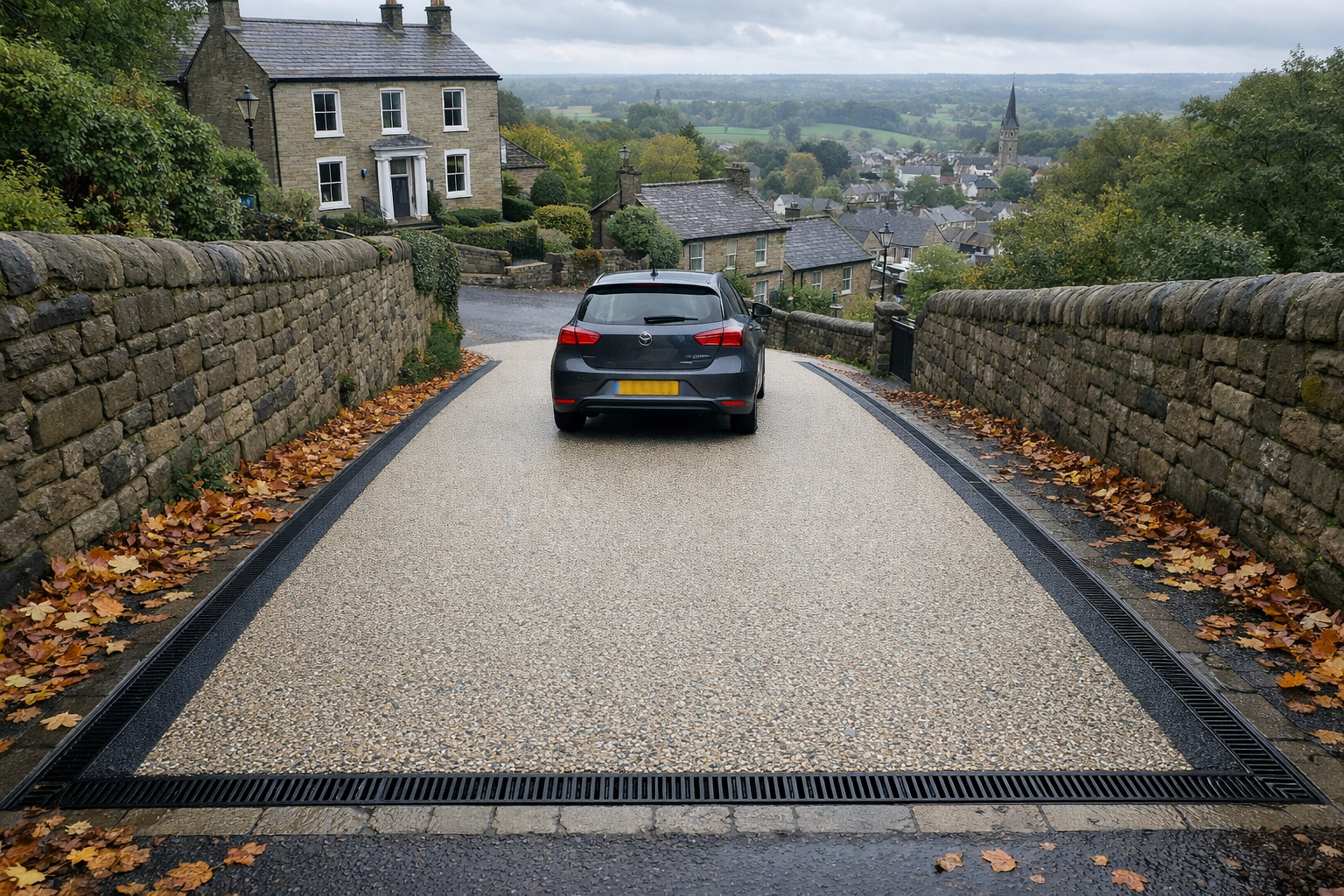
Resin-bound surfaces are one of the most effective steep driveway solutions available in 2026, combining excellent drainage with specifiable anti-slip aggregate. The surface is permeable by design, so water drains straight through the matrix rather than running down the slope in sheets [3].
The key variable is aggregate selection. Harder, angular aggregates (such as granite or basalt) create more friction than rounded river gravels. Installers can also blend in anti-slip granules or specify a coarser particle size to increase surface texture.
Anti-slip ratings to ask about:
Rating | Surface texture | Typical use |
|---|---|---|
R10 | Slightly textured | Gentle slopes, pedestrian areas |
R11 | Moderately textured | Slopes up to 1:10, mixed use |
R12 | Heavily textured | Steep slopes, high-risk areas |
For slopes above 1:8, specifying an R11 or R12 aggregate blend is strongly advisable.
Tony Flook, Managing Director: “Resin-bound is our most requested surface for steep driveways right now, and it’s not hard to see why. You get a beautiful finish, it drains freely, and you can dial in the grip level by adjusting the aggregate. It ticks every box for a premium property.”
Explore resin driveway options and colours to see how the surface can be tailored to your property’s style as well as its safety requirements.
Which block paving patterns work best on steep slopes?
Herringbone is the go-to pattern for steep block paving driveways. The interlocking 45-degree or 90-degree layout creates mechanical interlock between individual blocks, which resists horizontal movement under braking and acceleration forces [6][7].
Stretcher bond (the standard brick-style layout) looks smart on flat surfaces but can creep on slopes over time as blocks shift under repeated load. Herringbone distributes those forces across the whole surface rather than along single lines of jointing.
Additional grip boosters for block paving on slopes:
- 🧱 Chamfered edge blocks: The bevelled top edge creates a small channel between blocks that improves surface drainage and adds texture underfoot
- 🔒 Polymeric jointing sand: Locks blocks together more firmly than standard kiln-dried sand, reducing movement and weed ingress
- 📐 Soldier course edging: A perpendicular border course at the base of the slope acts as a physical restraint against downhill creep
- 💧 Linear drainage channels: Installed across the slope at intervals to intercept surface water before it builds up speed
For inspiration on patterns and finishes, browse our block paving driveway designs to see what works well in real UK installations.
Mike Clancy, Non-Executive Director: “After 30 years in this industry, I’d say herringbone block paving on a properly prepared sub-base is still one of the most durable solutions for a steep residential drive. The key word is ‘properly prepared.’ The surface is only as good as what’s underneath it.”
What sub-base and drainage work does a steep driveway actually need?
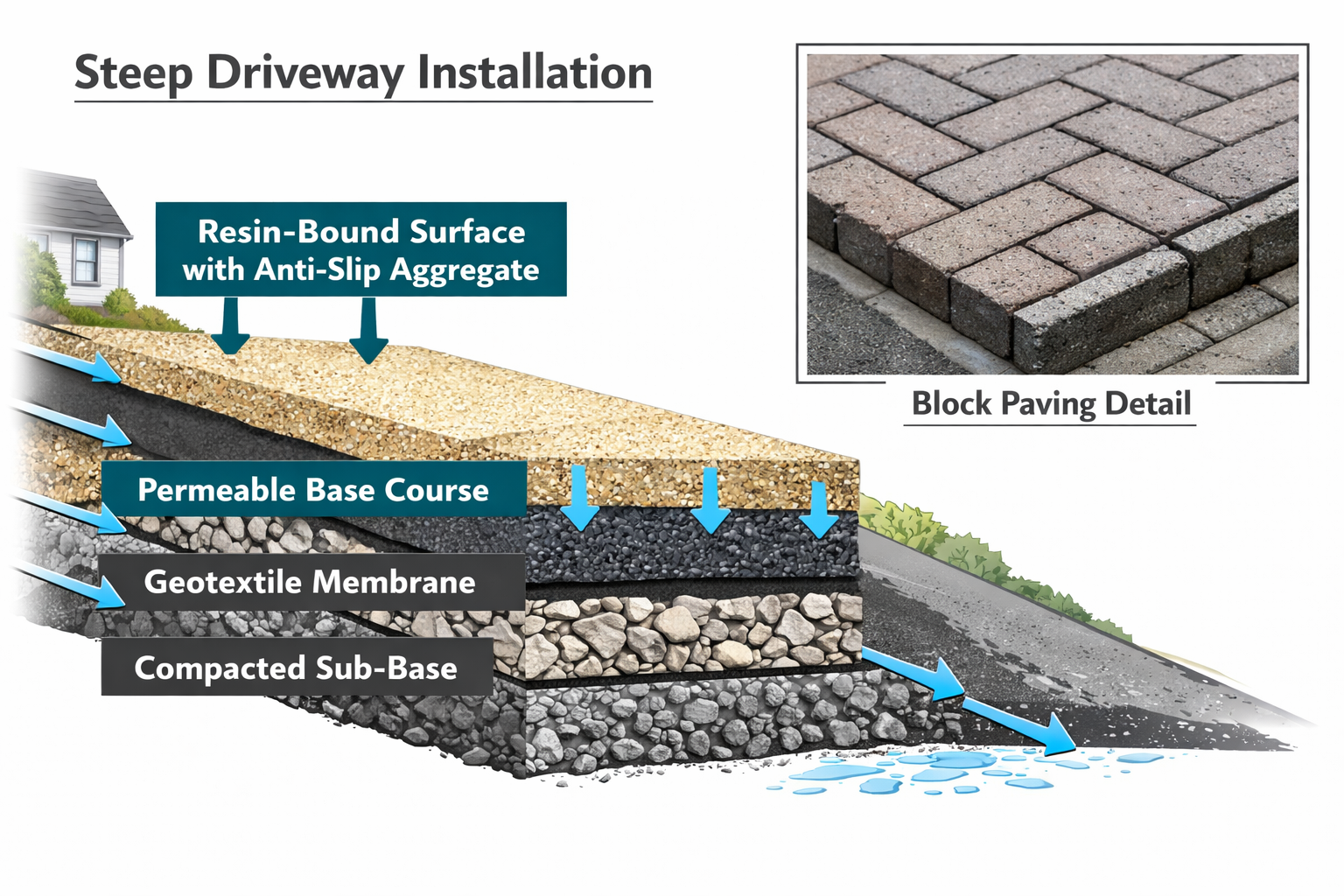
The sub-base is where steep driveway solutions either succeed or fail. A surface with perfect grip is useless if the layers beneath it shift, settle, or wash out on a slope.
For steep gradients, the installation process should include:
- Excavation to at least 200mm below finished surface level (deeper on poor ground)
- Geotextile membrane laid across the full excavation to separate sub-base from natural ground and prevent fines migration [6]
- Compacted MOT Type 1 sub-base at a minimum 150mm depth, laid and compacted in layers
- Reinforcement grids (such as geocells or plastic mesh grids) on slopes above 1:8 to prevent sub-base creep
- Edge restraints on all sides, with particular attention to the downhill edge
- Surface water drainage designed to intercept runoff before it leaves the driveway
SUDS compliance is also a legal consideration. Any new driveway over 5m² that drains to a public road or sewer requires a permeable surface or a drainage system directing water to a soakaway. Our SUDS compliant driveway guide explains the regulations in plain English.
Can you retrofit grip to an existing steep driveway without full resurfacing?
Yes, in many cases you can improve traction without starting from scratch. The right approach depends on the existing surface condition and gradient.
For tarmac: Surface dressing (tar-and-chip) is the most cost-effective retrofit. A contractor applies a bitumen spray coat and rolls in angular chippings. The result is a textured, grippy surface that bonds to the existing tarmac [1][4]. It works best when the existing base is structurally sound with no major cracking or rutting.
For block paving: Re-sanding with polymeric jointing sand and adding a linear drainage channel across the slope can make a meaningful difference. If blocks have shifted or settled, re-laying in herringbone with proper edge restraints is a more lasting fix.
For resin: If your existing resin surface has worn smooth, a thin anti-slip overlay using coarser aggregate can restore grip. This is a specialist application; not all resin installers offer it, so ask specifically.
When retrofit won’t work: If the sub-base has failed (you’ll see cracking, sinking, or surface water pooling), there’s no surface-level fix that will hold. Full excavation and reinstatement is the only reliable solution. See our guide to common driveway problems and permanent fixes for more on diagnosing sub-base failure.
How do you choose the right steep driveway solution for your property?
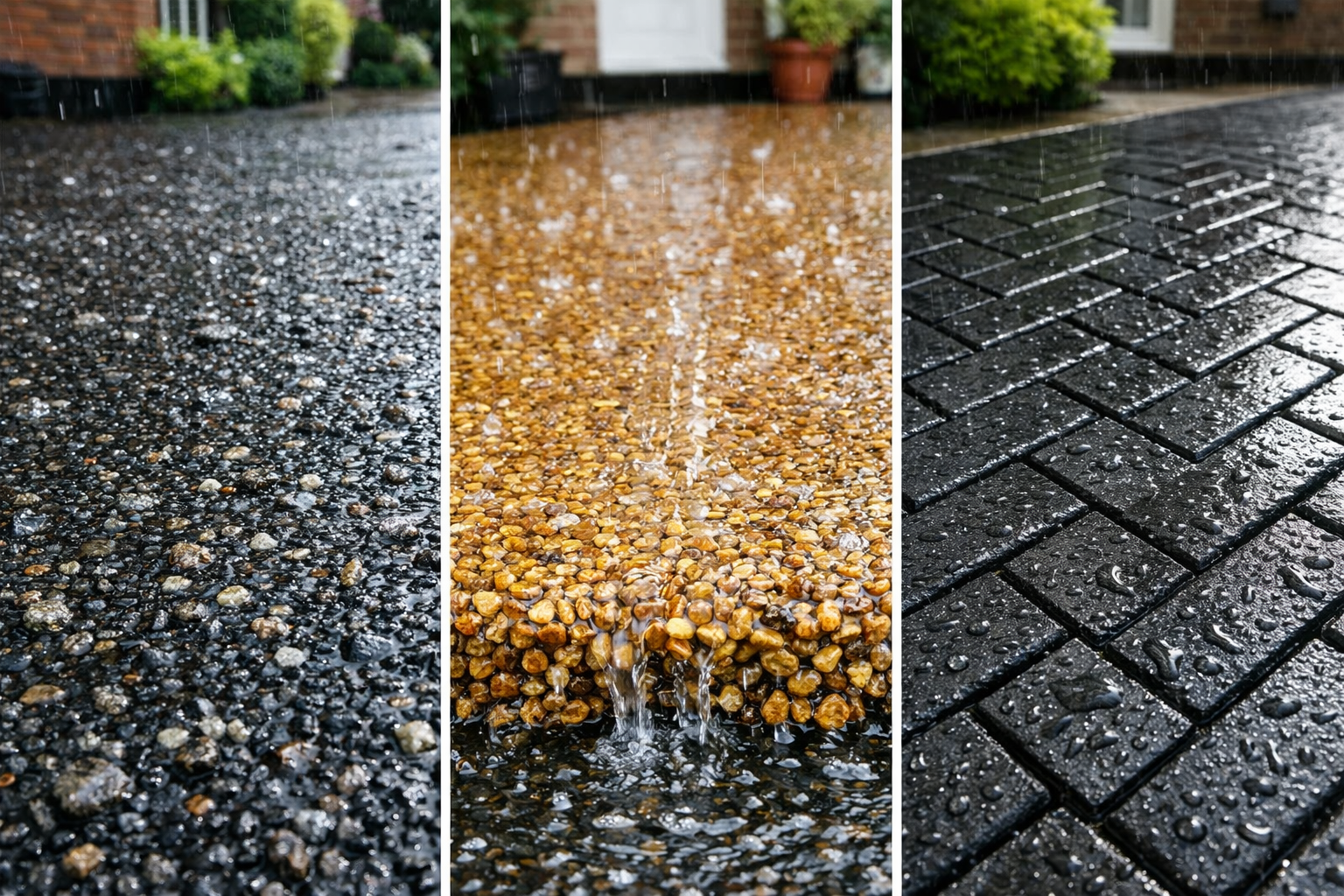
Match the solution to your slope gradient, surface condition, budget, and planning context. There’s no single best material; the right answer depends on your specific situation.
Gradient | Recommended surface | Key feature |
|---|---|---|
Up to 1:15 | Any well-specified surface | Standard drainage sufficient |
1:10 to 1:15 | Open-graded tarmac, R11 resin, herringbone block | Enhanced drainage + texture |
1:8 to 1:10 | R11/R12 resin, tar-and-chip, herringbone block + geocell | Full drainage spec + reinforcement |
Steeper than 1:8 | R12 resin or tar-and-chip with full sub-base reinstatement | Specialist installation essential |
Choose resin-bound if you want a premium finish, full SUDS compliance, and the ability to specify grip level precisely [3][7].
Choose open-graded tarmac if you want a practical, durable surface at a lower cost per square metre, with good drainage built in.
Choose herringbone block paving if you want a classic look with long-term repairability and strong mechanical interlock.
For a full side-by-side comparison of all driveway materials, our driveway material comparison guide is a useful starting point before you request quotes.
You can also explore our full range of safe and stylish steep driveway solutions to see how these principles apply to real projects.
Frequently asked questions
Q: What gradient is considered a steep driveway in the UK? A: Most industry guidance treats any slope steeper than 1:10 (10%) as steep, requiring specific surface and drainage considerations. Slopes above 1:8 (12.5%) are considered very steep and may need specialist sub-base reinforcement and surface specification.
Q: Is resin-bound paving slippery when wet on a slope? A: A well-specified resin-bound surface with angular aggregate (R11 or R12 rating) is not slippery when wet. The permeable matrix drains water through the surface, and the textured aggregate provides consistent grip. The key is specifying the right aggregate for your gradient, not just choosing the most attractive colour.
Q: Does tar-and-chip work on very steep driveways? A: Yes. Tar-and-chip (surface dressing) is widely used on steep access roads and driveways precisely because the embedded chippings create a naturally textured, high-friction surface [1][2][4]. It performs well on slopes up to around 1:6, provided the existing base is sound.
Q: Will block paving move or creep on a steep slope over time? A: Standard stretcher bond block paving can creep on steep slopes without adequate edge restraints and sub-base reinforcement. Herringbone pattern with polymeric jointing sand, a solid edge restraint at the base, and a reinforced sub-base significantly reduces this risk [6].
Q: Do I need planning permission for a new steep driveway? A: In most cases, no planning permission is required for a residential driveway if it uses a permeable surface or drains to a soakaway. Impermeable surfaces draining to the highway may require permission. Always check with your local planning authority, particularly if your property is listed or in a conservation area.
Q: How long does a resin-bound driveway last on a steep slope? A: A properly installed resin-bound surface on a well-prepared sub-base typically lasts 15 to 25 years. On steep slopes, longevity depends heavily on sub-base quality and drainage design. Cutting corners on the base to save money is the most common cause of premature failure.
Conclusion
A steep driveway in wet UK weather doesn’t have to be a liability. With the right material specification, a properly engineered sub-base, and drainage designed for your gradient, it can be as safe and attractive as any flat surface.
The practical next steps:
- Measure your driveway gradient (a spirit level and tape measure will do it)
- Assess your existing surface condition: is the base sound, or has it failed?
- Decide on your priorities: grip, drainage, aesthetics, budget, or a combination
- Get quotes from installers who can specify anti-slip ratings and sub-base reinforcement, not just lay a surface
- Check SUDS compliance requirements before work starts
Driveways Plus has been installing driveways across the South West for over 25 years, with commercial-grade expertise now applied to residential projects. If you’d like an expert assessment of your slope and a no-pressure recommendation, get in touch for a free quote.
References
[1] Why Tar Chip Is Ideal For Driveways With Steep Slopes – https://leedsresin.co.uk/why-tar-chip-is-ideal-for-driveways-with-steep-slopes/
[2] Is Tar And Chip Suitable For Steep Driveways – https://nsdrivewaysashtead.co.uk/is-tar-and-chip-suitable-for-steep-driveways/
[3] Grip And Glamour Slip Resistant Driveway Options For Steep Terrain – https://www.resindrivewaystorquay.co.uk/grip-and-glamour-slip-resistant-driveway-options-for-steep-terrain
[4] The Natural Grip Of Tar Chip For Steep Access Roads – https://uckfielddriveways.co.uk/the-natural-grip-of-tar-chip-for-steep-access-roads/
[6] Best Surfacing Sloping Driveways – https://www.debmatsurfacing.co.uk/blog/best-surfacing-sloping-driveways/
[7] Which Type Of Surface Is Best For Sloped Driveways – https://smartsurfacingsolutions.co.uk/which-type-of-surface-is-best-for-sloped-driveways/