Skip to content
Picture this: you pull onto your driveway after a long day, plug in your electric car, and head inside. By morning, it’s fully charged, using the cheapest electricity rates, and you’ve spent a fraction of what you’d pay at a public charger.
That’s the reality for thousands of UK homeowners who’ve cracked the code on smart driveway design. And in 2026, it’s never been easier or more affordable to join them.
With planning permission requirements scrapped for most installations[2], government investment flooding into EV infrastructure, and smart charging technology that practically pays for itself, your driveway can become more than just a parking space. It can be a genuine asset that saves you over £1,000 annually[2] whilst future-proofing your property.
But here’s the thing: not all driveways are created equal when it comes to EV charging. The decisions you make now about surface materials, cable routing, and charger positioning will determine whether your setup is convenient or frustrating for years to come.
Key takeaways
- 🔌 Planning permission eliminated for standard home EV chargers on driveways in England since June 2025, saving homeowners £258 in application fees[2]
- 💰 Annual savings exceed £1,000 compared to public charging, with installation costs ranging from £800-£2,000 depending on complexity[3][6]
- 🏡 Smart driveway design integrates cable management, proper surface materials, and future-proof infrastructure from day one
- ☀️ Solar integration is standard on 2026 smart chargers, allowing properties to prioritise surplus generation and maximise savings[1]
- ⚡ Installation takes half a day for standard setups, with Building Regulations compliance and DNO notification still mandatory despite planning exemption[4]
Why your driveway matters more than you think for EV charging
Your driveway isn’t just the bit of ground where you park. When it comes to EV charging, it’s the foundation of your entire home energy strategy.
And most homeowners get this bit wrong.
They install the charger first, then realise their driveway surface can’t accommodate proper cable routing. Or they choose a beautiful material that makes future upgrades nearly impossible. Or they position everything perfectly for today’s car, completely forgetting they’ll probably own three more EVs over the next 20 years.
The smart driveway approach flips this thinking.
“After 25 years installing commercial surfacing, I’ve seen what happens when infrastructure isn’t planned properly,” says Ben Sperring, our Surfacing Manager. “The driveways that work brilliantly for EV charging are the ones where cable routes, surface materials, and charging locations were considered together from the start. Retrofitting is always more expensive and often compromises the finish.”
Here’s what makes a driveway genuinely smart for EV charging:
- 🔋 Integrated cable management that’s invisible but accessible
- 🎯 Strategic charger positioning that works for multiple parking scenarios
- 🛠️ Surface materials that allow future modifications without total replacement
- 📱 Proper electrical infrastructure sized for today’s needs and tomorrow’s upgrades
- 🌍 Drainage and groundwork that accommodates underground conduits
The difference between a standard installation and a smart driveway setup? About £500-£800 in avoided future costs, plus the daily convenience of a system that just works.
Think of it like building an extension. You could bodge it together cheaply, or you could do it properly once. Your driveway deserves the same consideration.
Understanding the 2026 EV charging landscape in the UK
The rules changed dramatically in June 2025, and most homeowners haven’t caught up yet.
Planning permission is gone for standard installations. That’s right, completely eliminated for most UK driveways[2]. The previous £258 application fee? History. The weeks of waiting for approval? Not needed anymore.
But before you start celebrating, there’s a crucial detail: Building Regulations compliance remains absolutely mandatory[4].
📋 What you still need to comply with
Even without planning permission, your installation must meet:
- Building Regulations Part S (infrastructure for electric vehicle charging)
- Building Regulations Part P (electrical safety in dwellings)
- DNO notification (telling your Distribution Network Operator about the new electrical load)[4]
- BS 7671 wiring regulations (the fundamental electrical installation standard)
Your installer handles most of this, but you need to verify they’re properly certified. Look for NICEIC, NAPIT, or ELECSA registration as a bare minimum.
🏛️ Listed buildings and conservation areas: the exception
If your property sits in a conservation area or holds listed building status, stop right there. You’ll need formal approval from your local planning authority before proceeding[2][4].
It’s frustrating, but there’s logic behind it. These protections exist to preserve architectural heritage, and a wall-mounted charger can genuinely impact a building’s character.
The good news? Post-mounted chargers or concealed installations often sail through approval where wall-mounted units might struggle.
💷 The financial reality in 2026
Installation costs range from £800 to £2,000+ for a standard 7kW domestic charger[3][6]. That’s a wide bracket, and here’s why:
Basic installation (£800-£1,200):
- Charger positioned close to your consumer unit
- No groundworks required
- Existing electrical capacity adequate
- Simple cable routing
Complex installation (£1,500-£2,000+):
- Long cable runs across the property
- Consumer unit upgrade needed
- Underground cable routing through driveway
- Multiple parking positions served
“The hardware cost is often the smallest part of the equation,” explains Tony Flook, our Managing Director. “What drives the price is the electrical work, the groundworks, and whether your existing infrastructure can handle the load. That’s why a proper survey matters, it reveals the true cost before anyone starts digging.”
But here’s the brilliant bit: even at £2,000, you’ll recoup that investment through savings. Annual charging costs at home average £500-£600, versus £1,600+ for equivalent public rapid charging[2]. That’s a two-year payback period, maximum.
☀️ Solar integration: the 2026 game-changer
Every smart charger sold in 2026 comes with solar integration capability[1]. If you’ve got solar panels (or you’re considering them), your charger can prioritise surplus generation automatically.
On a sunny day, your car charges for free using electricity you’d otherwise export to the grid at pittance rates. The savings compound quickly, especially with battery storage in the mix.
Designing your smart driveway for seamless EV charging
This is where the magic happens. Where careful planning saves you thousands and daily frustration.
A smart driveway isn’t about the most expensive materials or the flashiest charger. It’s about intelligent integration that makes EV charging feel effortless.
🎯 Charger positioning: getting it right first time
The single biggest mistake? Mounting the charger in the most convenient spot for installation rather than the most practical spot for daily use.
Wall-mounted installations work brilliantly when positioned:
- Within 1-2 metres of where your car’s charge port sits when parked
- Close to your front door or garage for shortest cable runs[3]
- Protected from direct weather exposure (under eaves or porch areas)
- Visible from inside the house for security
Post-mounted chargers suit properties with:
- Open parking bays without nearby walls
- Multiple parking positions to serve
- Listed building restrictions on wall mounting
- Driveways where wall distance exceeds 10 metres
Cable length matters more than you’d think. Standard tethered chargers come with 5-7 metre cables. That sounds generous until you’re stretching it across a wide driveway in the rain, wishing you’d positioned things differently.
🧱 Surface materials that work with EV charging infrastructure
Not all driveway materials play nicely with integrated charging systems. Some make cable routing simple; others turn it into an expensive nightmare.
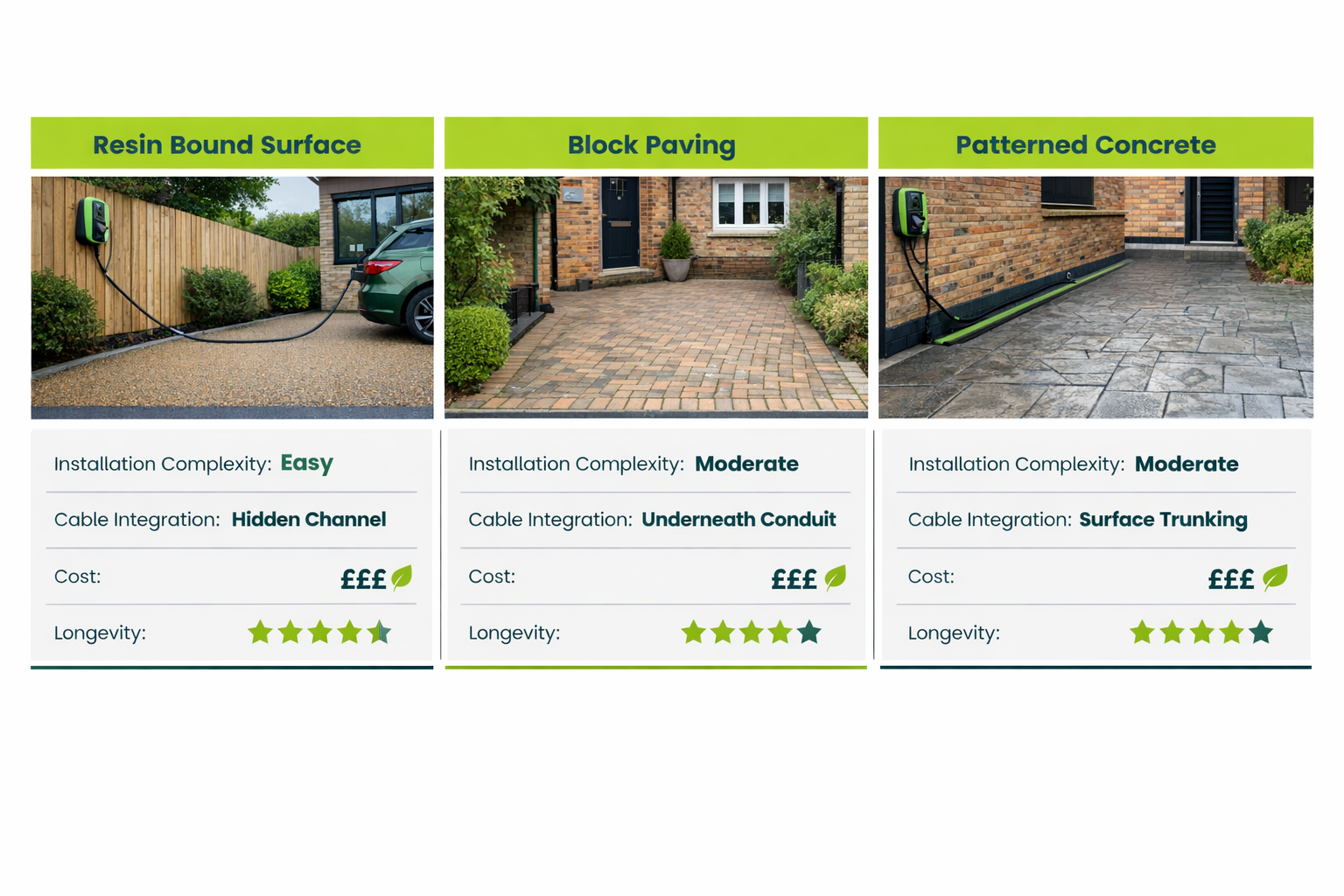
Resin-bound driveways excel for EV charging:
- ✅ Seamless surface allows discreet cable routing
- ✅ Easy to cut channels for underground conduits
- ✅ Can be patched invisibly if modifications needed
- ✅ Permeable options meet SuDS drainage requirements
- ✅ Modern aesthetic complements smart home technology
Block paving offers flexibility:
- ✅ Individual blocks lift for cable access without damage
- ✅ Colour-matched cable channels blend seamlessly
- ✅ Future modifications straightforward
- ✅ Traditional aesthetic suits period properties
- ❌ Slightly more visible cable routing than resin
Concrete driveways require careful planning:
- ✅ Durable and long-lasting
- ✅ Can incorporate cable conduits during installation
- ❌ Difficult and expensive to modify after curing
- ❌ Cutting channels damages appearance
- ⚠️ Plan cable routes before pouring
Gravel driveways present challenges:
- ✅ Cheapest to modify
- ✅ Easy underground cable installation
- ❌ Loose surface makes cable management difficult
- ❌ Trip hazard with surface cables
- ⚠️ Underground routing essential
“The smartest installations I’ve seen use resin-bound surfaces with pre-planned conduit routes,” says Ben Sperring. “You lay the conduit during groundworks, even if you’re not installing the charger immediately. It costs perhaps £200 extra at that stage, versus £800-£1,000 to retrofit later. That’s the kind of forward thinking that protects your investment.”
For more guidance on choosing the right surface, our complete driveway material comparison breaks down every option.
⚡ Cable routing: the invisible infrastructure
This is where amateur installations fall apart and professional ones shine.
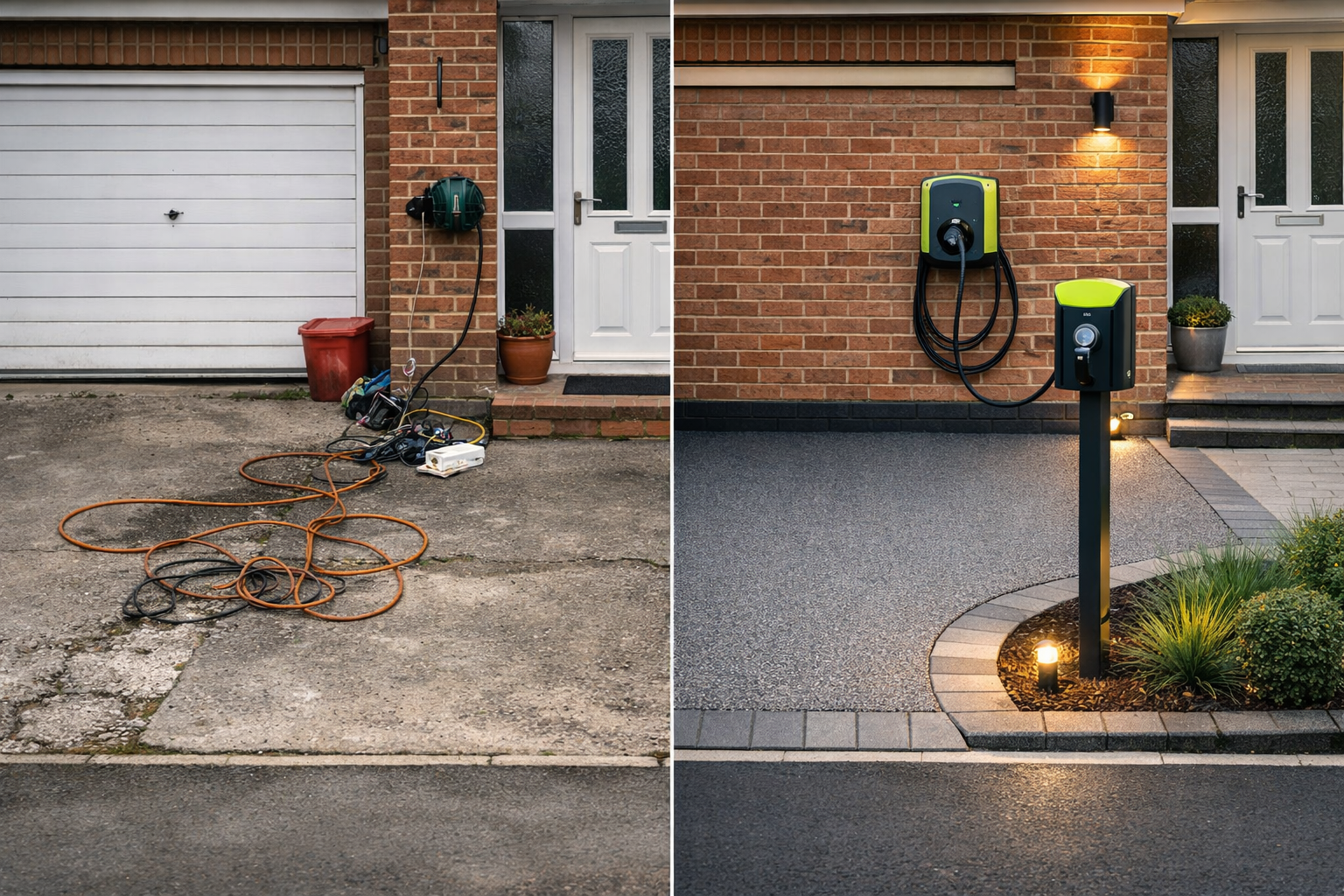
Surface cable routing (the budget option):
- Plastic trunking attached to driveway surface
- Quick and cheap to install
- Visible and potentially unsightly
- Trip hazard, especially in low light
- Vulnerable to damage from vehicles
Concealed cable routing (the smart driveway approach):
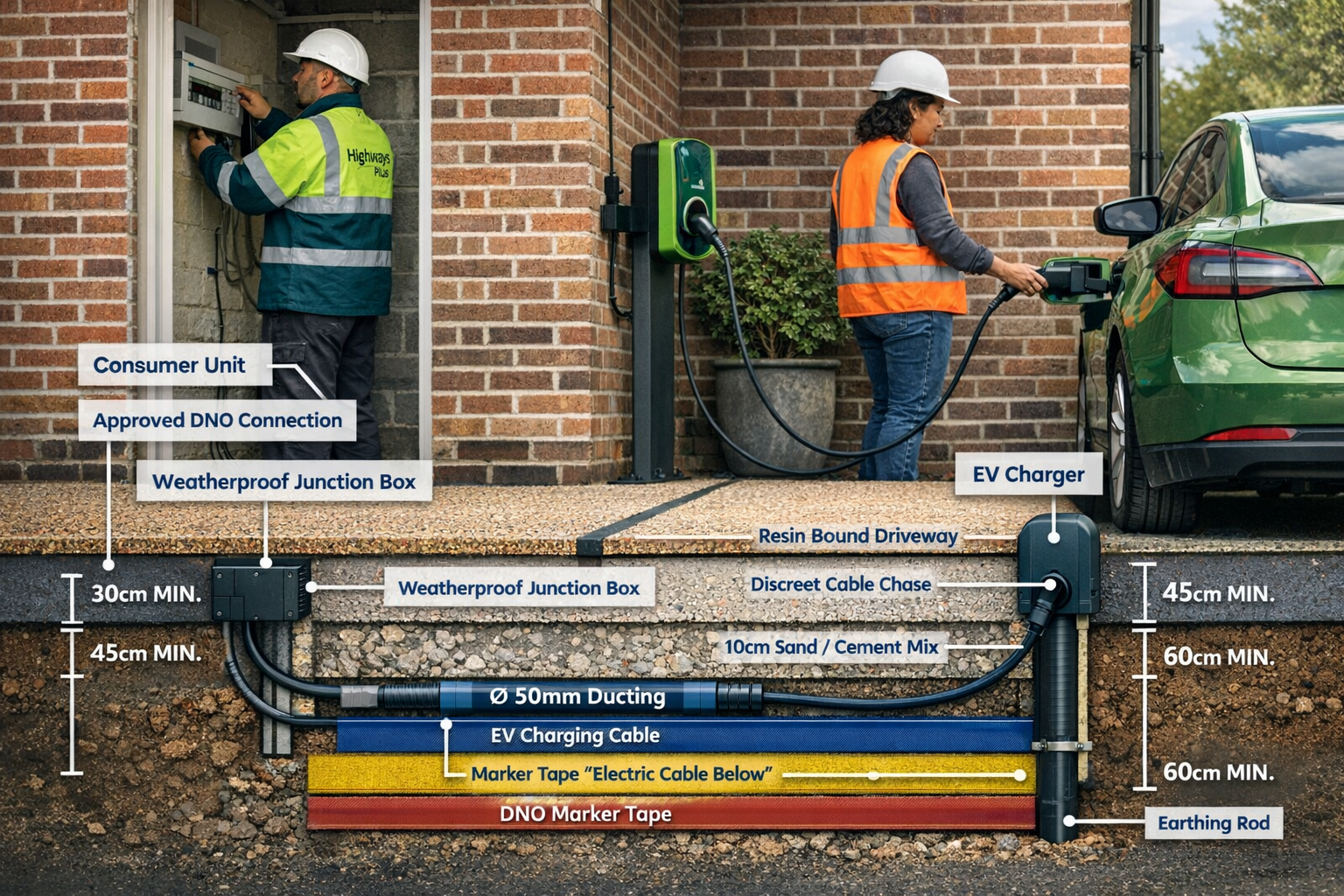
- Underground conduit from consumer unit to charger
- Invisible and protected
- Future-proof for upgrades
- Adds £300-£600 to installation cost
- Requires proper groundworks and waterproofing
The underground route isn’t just prettier. It’s safer, more durable, and adds genuine value to your property. When you’re spending £15,000-£30,000 on a premium new driveway, the extra £500 for proper cable infrastructure is a rounding error.
🔌 Multiple charging points: planning for the future
Here’s a prediction: within five years, you’ll want to charge two vehicles simultaneously. Maybe it’s a second family car. Maybe it’s a visiting relative. Maybe it’s an electric van for your business.
Future-proofing options:
Oversized electrical infrastructure (install now, activate later)
- Run conduit for second charger during initial groundworks
- Size consumer unit for dual chargers
- Adds minimal cost now, saves thousands later
Load management systems (one connection, multiple chargers)
- Smart chargers share available power
- Automatically balance load between vehicles
- Prevents circuit overload
- Costs £200-£400 extra
Dedicated EV circuit (the gold standard)
- Separate circuit from consumer unit
- Sized for current and future needs
- Simplifies upgrades and modifications
- Required for DNO notification anyway
Think of it like plumbing. You wouldn’t install a bathroom with pipes too small for future fixtures. Same logic applies here.
The installation process: what actually happens
You’ve designed the perfect smart driveway layout. You’ve chosen your materials. Now comes the bit where theory meets reality.
Standard installations take approximately half a day[4]. More complex jobs involving significant groundworks, long cable runs, or consumer unit upgrades can take a full day or more.
📝 Step 1: Pre-installation survey
Before anyone touches your property, a qualified electrician conducts a thorough survey[4]. This isn’t a five-minute glance. It’s a detailed assessment covering:
- Main fuse capacity (can your supply handle the additional load?)
- Consumer unit condition (does it need upgrading to current standards?)
- Earthing system (TN-S, TN-C-S, or TT, and is it adequate?)
- Driveway layout (optimal charger position and cable routing)
- Distance to parking position (cable length requirements)
- Internet connectivity (Wi-Fi or mobile signal strength for smart features)
This survey determines the actual installation cost. Any quote given before this survey is essentially guesswork.
“I’ve seen too many homeowners accept quotes over the phone, then face surprise bills when the installer discovers their consumer unit needs replacing,” warns Mike Clancy, our Non-Executive Director with 30 years in the industry. “A proper survey protects both parties. It sets realistic expectations and reveals the true scope of work.”
🔧 Step 2: DNO notification
Your installer must notify your Distribution Network Operator about the new electrical load[4]. This isn’t planning permission; it’s a technical notification ensuring the local grid can handle your charger.
Most DNOs approve automatically for standard 7kW chargers. Occasionally, they’ll request a survey or grid upgrade, particularly in rural areas with limited capacity.
This process takes 1-3 weeks typically, though some DNOs offer expedited processing.
⚡ Step 3: Electrical work and groundworks
On installation day, the work typically follows this sequence:
Morning:
- Consumer unit modifications (if needed)
- Cable routing from consumer unit to charger location
- Groundworks for underground conduits
- Driveway surface preparation for cable channels
Afternoon:
- Charger mounting (wall or post)
- Final electrical connections
- System testing and commissioning
- Smart features configuration
- Handover and demonstration
For installations requiring significant groundworks, this might extend to two days. If you’re combining the charger installation with a complete driveway renovation, coordinate timing carefully. The electrical work should happen after base preparation but before final surfacing.
📱 Step 4: Smart features setup
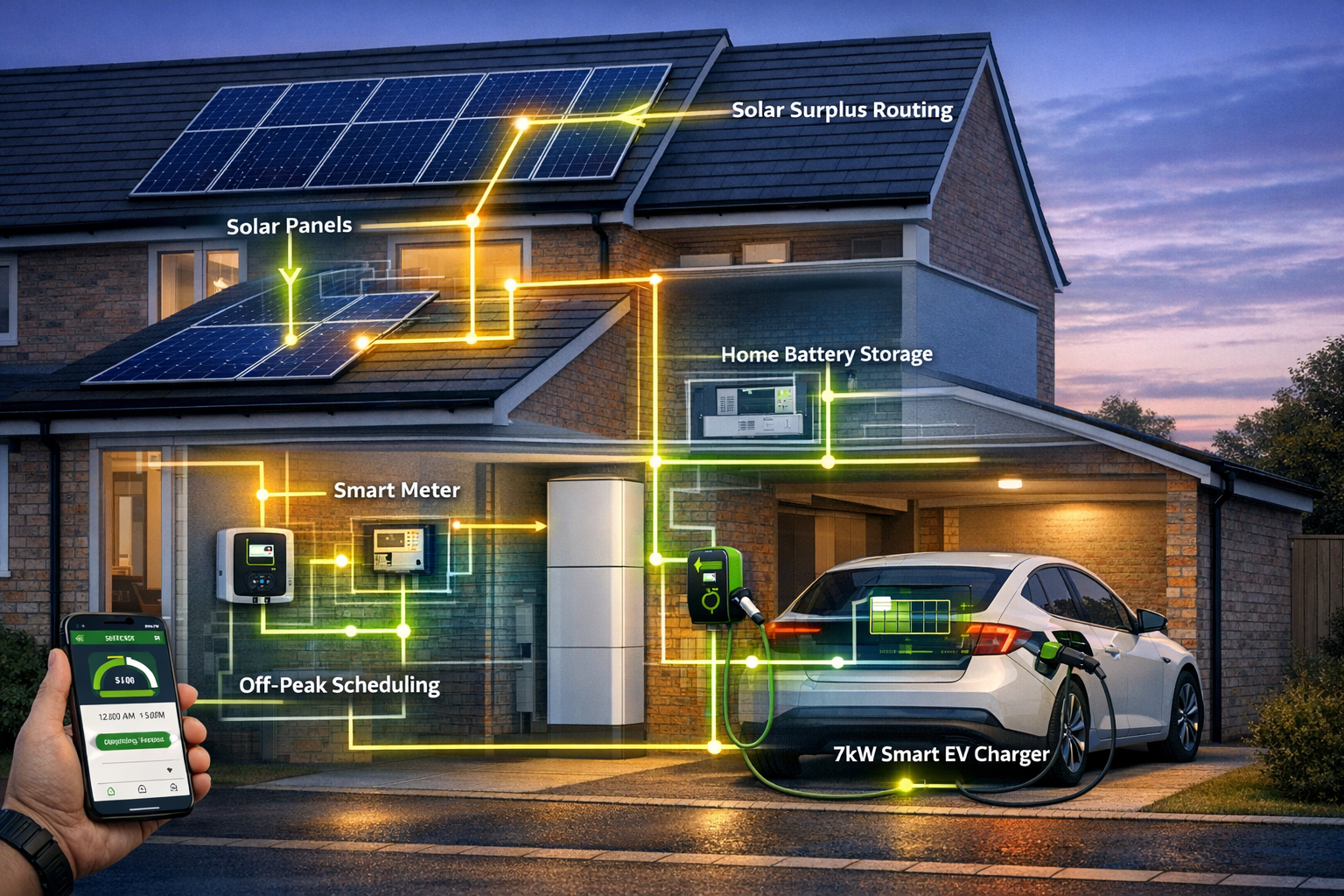
Modern smart chargers include features that seemed like science fiction just five years ago[1]:
- App-based controls (start/stop charging remotely)
- Scheduling (charge during off-peak tariff periods automatically)
- Solar integration (prioritise surplus solar generation)
- Load management (prevent circuit overload)
- Access control (PIN or app lock to prevent unauthorised use)
- Usage monitoring (track costs and energy consumption)
- Over-the-air updates (firmware improvements without engineer visits)
Your installer should configure these during handover, connecting the charger to your Wi-Fi and walking you through the app interface.
✅ Step 5: Certification and compliance
Upon completion, you’ll receive:
- Electrical Installation Certificate (proving Building Regulations compliance)
- DNO notification confirmation (grid operator acknowledgment)
- Manufacturer warranty documentation (typically 3 years for charger)
- User manual and safety information
- Installer contact details (for ongoing support)
Keep these documents safe. They’re essential for insurance, future property sales, and warranty claims.
Maximising your smart driveway investment
Installation complete, charger commissioned, car plugged in. Job done?
Not quite. The difference between a good EV charging setup and a brilliant one lies in optimisation.
💰 Tariff optimisation: where the real savings live
Your electricity tariff matters more than your charger choice. Seriously.
Standard tariff charging costs:
- Average UK electricity rate: 24.5p per kWh (2026)
- Typical EV (60kWh battery): £14.70 per full charge
- Annual cost (10,000 miles): £500-£600
Off-peak tariff charging costs:
- Economy 7/Octopus Go rates: 7-9p per kWh overnight
- Same 60kWh battery: £4.20-£5.40 per full charge
- Annual cost (10,000 miles): £180-£230
That’s £300-£400 annual savings just from switching tariffs. Your smart charger’s scheduling function makes this automatic, charging between midnight and 7am when rates plummet[1].
Popular EV tariffs in 2026:
- Octopus Go (7p/kWh for 4 hours overnight)
- OVO Charge Anytime (7p/kWh, flexible timing)
- EDF GoElectric (9.9p/kWh overnight)
- British Gas Electric Driver (variable off-peak rates)
☀️ Solar and battery integration
If your property has solar panels, or you’re considering them, the synergy with EV charging is remarkable[1].
Typical solar setup:
- 4kW solar array generates 3,400kWh annually
- Without battery: export surplus at 4-5p/kWh
- With smart EV charging: use surplus to charge car at 0p/kWh
On a sunny day, a 4kW solar array generates enough to add 20-25 miles of range. Over a year, that’s 2,000-2,500 “free” miles.
Add a home battery (10-15kWh capacity), and you can store surplus solar for evening charging when the sun’s gone down. The economics stack beautifully:
- Solar generation: 3,400kWh/year
- Home consumption: 2,800kWh/year
- EV charging: 2,000kWh/year
- Total usage: 4,800kWh/year
- Solar covers: 71% of total electricity needs
That’s a £700-£900 annual saving on combined home and transport energy costs.
🔄 Load management for multiple vehicles
Remember that future-proofing we discussed? Here’s where it pays off.
Without load management:
- Two 7kW chargers = 14kW demand
- Exceeds typical single-phase supply (60-80A)
- Requires expensive grid upgrade
- DNO may refuse connection
With load management:
- Two chargers share available capacity
- Automatically balance load (e.g., 4kW + 3kW)
- Both cars fully charged by morning
- No grid upgrade needed
- Costs £200-£400 for the technology
It’s the difference between a £5,000 electrical upgrade and a £300 smart solution.
🛡️ Maintenance and longevity
EV chargers are remarkably low-maintenance, but they’re not fit-and-forget.
Annual checks:
- Visual inspection for damage or wear
- Cable and connector condition
- Mounting security (wall or post)
- Software updates via app
- RCD testing (push the test button monthly)
Every 3-5 years:
- Professional electrical inspection
- Firmware updates if not automatic
- Replacement of worn cables or connectors
Most issues arise from physical damage (cars reversing into chargers, cables run over by vehicles) rather than electrical faults. Positioning your charger sensibly prevents 90% of problems.
“The installations that last decades are the ones where someone thought about protection,” notes Ben Sperring. “A charger tucked slightly into a recess, or a post-mounted unit with bollard protection, survives years longer than one exposed to accidental vehicle contact. It’s the little details that matter.”
Common mistakes to avoid with smart driveway EV charging
After helping hundreds of homeowners through this process, we’ve seen the same errors crop up repeatedly. Learn from others’ expensive lessons.
❌ Choosing charger location based on installation cost alone
The cheapest installation spot is rarely the most practical parking spot. Saving £200 on installation costs you £2,000 in daily frustration over ten years.
Position the charger where it serves your actual parking habits, not where the cable run is shortest.
❌ Ignoring future vehicle changes
Your current car’s charge port is on the left rear. Perfect, you’ve positioned everything accordingly.
Then you buy a new EV two years later. Charge port’s on the right front. Now your cable barely reaches, and you’re parking at awkward angles.
The solution: Position chargers to serve the parking space, not a specific vehicle. Central locations with adequate cable length accommodate any car.
❌ Skipping the underground cable route to save money
Surface trunking saves £400-£600 initially. It costs you:
- Property value (buyers notice amateur installations)
- Safety (trip hazards, especially with visitors)
- Durability (surface cables damaged by vehicles)
- Aesthetics (ruins your beautiful new driveway)
This is the classic “penny wise, pound foolish” scenario. Do it properly once.
❌ Undersizing electrical infrastructure
Installing a 7kW charger on a circuit that can barely handle it leaves no headroom for:
- Future second charger
- Home battery addition
- Heat pump installation
- General electrical upgrades
Size infrastructure for tomorrow’s needs, not just today’s. The marginal cost difference is minimal during initial installation.
❌ Forgetting about drainage
Underground cable conduits need proper drainage consideration. Water follows cable routes, and pooling water near electrical installations is asking for trouble.
Your installer should coordinate with your driveway contractor to ensure:
- Conduits slope away from charger and consumer unit
- Drainage channels don’t cross cable routes
- Waterproof junction boxes at connection points
- Proper sealing where cables enter buildings
This is why coordinating EV charging with a complete driveway renovation makes so much sense. Everything gets planned together, avoiding conflicts and compromises.
❌ Neglecting smart features setup
You’ve paid for a smart charger. Use its smart features.
Too many homeowners never configure scheduling, solar integration, or app controls. They’re essentially using a £1,200 smart charger as a £400 dumb one.
Spend 30 minutes with the app during setup. The annual savings from optimised charging schedules justify that time investment hundreds of times over.
Frequently asked questions
Can I install an EV charger if I don’t have a driveway?
Cross-pavement charging solutions are emerging for properties without off-street parking. Proposed 2026 reforms aim to remove planning requirements for cross-pavement charging gullies, potentially saving households up to £250 in planning fees[5]. Over £25 million in government funding supports local councils installing this infrastructure[2][5]. Contact your local authority to inquire about available schemes in your area.
Do I need planning permission for a post-mounted charger?
Standard post-mounted chargers are exempt from planning permission in England, provided they don’t exceed 0.2 cubic metres in volume and are positioned at least 2 metres from the public highway[2]. Listed buildings and conservation areas require approval regardless of charger type[2][4]. Always verify with your local planning authority if you’re uncertain about your property’s status.
Can I install an EV charger myself to save money?
No. EV charger installations must comply with Building Regulations Part P, which requires work to be carried out by a qualified electrician registered with a competent person scheme (NICEIC, NAPIT, ELECSA)[4]. DIY installations void warranties, invalidate insurance, and create serious safety risks. The savings aren’t worth the liability and danger.
How long does a home EV charger last?
Quality home chargers typically last 10-15 years with minimal maintenance. The charger unit itself is solid-state electronics with few moving parts. Cables and connectors may need replacement every 5-7 years depending on usage intensity. Most manufacturers offer 3-year warranties, with extended warranties available for an additional cost. Regular visual inspections and annual electrical checks maximise longevity.
Will an EV charger increase my property value?
Yes, particularly for properties with well-integrated installations. A 2026 study found that homes with EV charging infrastructure sold 20% faster than comparable properties without, and commanded a 2-3% price premium in competitive markets. The key is professional installation with proper cable management; amateur installations can actually decrease value. Think of it like a fitted kitchen: done well, it’s an asset; done poorly, it’s a liability.
Can I charge two cars from one charger?
Not simultaneously from a single unit, but you can install load management systems that allow two chargers to share available electrical capacity. This enables both vehicles to charge overnight without exceeding your supply limits. Alternatively, you can charge vehicles sequentially using scheduling features on smart chargers. For households with multiple EVs, dual charger installations with load management are increasingly common and add only £500-£800 to initial setup costs.
Conclusion: your smart driveway starts with smart planning
The UK’s EV charging landscape has never been more favourable for homeowners. Planning permission eliminated, installation costs falling, smart technology improving, and annual savings exceeding £1,000 compared to public charging[2].
But the difference between a good installation and a brilliant one comes down to planning.
A smart driveway integrates EV charging from the ground up, considering cable routing, surface materials, electrical infrastructure, and future needs before anyone starts work. It’s the difference between a retrofit that shows and an installation that looks like it was always meant to be there.
The homeowners who get this right think beyond next week. They consider the next vehicle, the next decade, the next owner. They invest in underground cable routing, properly sized electrical infrastructure, and surface materials that accommodate future modifications.
Your next steps:
- Assess your current driveway against EV charging requirements
- Request a free pre-installation survey from a certified installer
- Consider coordinating charger installation with driveway renovation for seamless integration
- Choose surface materials that support both aesthetics and functionality
- Size electrical infrastructure for future needs, not just current requirements
At Driveways Plus, we’ve spent 25 years translating commercial-grade expertise into residential projects that last. We understand that your driveway isn’t just a parking space; it’s an investment in your property and your daily life.
Whether you’re planning a complete driveway renovation or simply want to ensure your existing surface can accommodate EV charging, we’re here to help. Our team works alongside certified EV installers to coordinate groundworks, cable routing, and surface finishing for installations that look professional and function flawlessly.
The future of transport is electric. Make sure your driveway is ready for it.
Explore our stunning driveway installations or get in touch for expert advice on designing your smart driveway.
References
[1] Best Smart Ev Home Charger For Uk Driveways 2026 – https://www.energyplus.co.uk/ev-charger/best-smart-ev-home-charger-for-uk-driveways-2026
[2] England Eases Driveway Rules For Home Ev Chargers 524685 – https://evrimagaci.org/gpt/england-eases-driveway-rules-for-home-ev-chargers-524685
[3] Home Ev Chargers 2026 Buyers Guide – https://citaevcharger.co.uk/blog/home-ev-chargers-2026-buyers-guide
[4] Ev Charger Installation – https://homebattery.ecoflow.com/uk/blog/ev-charger-installation
[5] Planning Your 2026 Ev Charger Installation What To Consider – https://mcnallyev.uk/planning-your-2026-ev-charger-installation-what-to-consider/
[6] Ev Charger Installation Costs – https://www.electriccarscheme.com/blog/ev-charger-installation-costs