Skip to content
The safest, most durable steep driveway combines correct gradient design (including a 1‑in‑40 fall away from the highway at the kerb), deep engineered groundwork suited to local soils, SUDS‑compliant drainage, and a high‑grip surface such as resin‑bound, tarmac (asphalt), or permeable block paving. Get the transition zones right, specify the sub‑base properly, and hire an accredited specialist—your driveway will be safe, long‑lasting, and good‑looking.
Steep driveways can be a headache—or a highlight. Done properly, your driveway that’s on an incline becomes safer to use in wet or icy weather, adds real curb appeal, and feels effortless to drive on. In this expert guide, we show you how to fix a steep driveway the right way, from gradient rules and groundwork to the best surface for traction and durability. Along the way, we’ll flag key regulations, typical costs, and the questions that protect you from cowboy installers. With our steep driveway solutions, you’ll find the perfect balance between safety and style.
Steep driveway design essentials: gradient, safety, and kerb transitions
Design comes first. Before choosing a surface, you need a safe, buildable driveway slope and compliant details where it meets the pavement.
Key principles
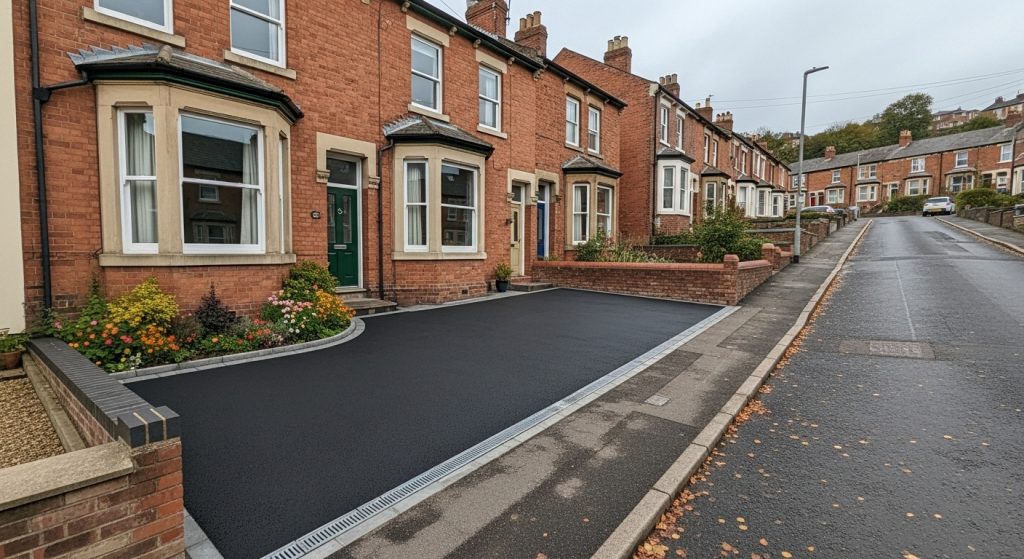
- Driveway slope & gradient: For safe daily use, aim to keep the maximum driveway slope as modest as the site allows. Many UK councils require a minimum 1‑in‑40 (2.5%) fall away from the public highway across the first metre or two so surface water drains back into your property, not onto the road. This small gradient at the end of your driveway is non‑negotiable for approvals and prevents run‑off and scraping at the curb/kerb.
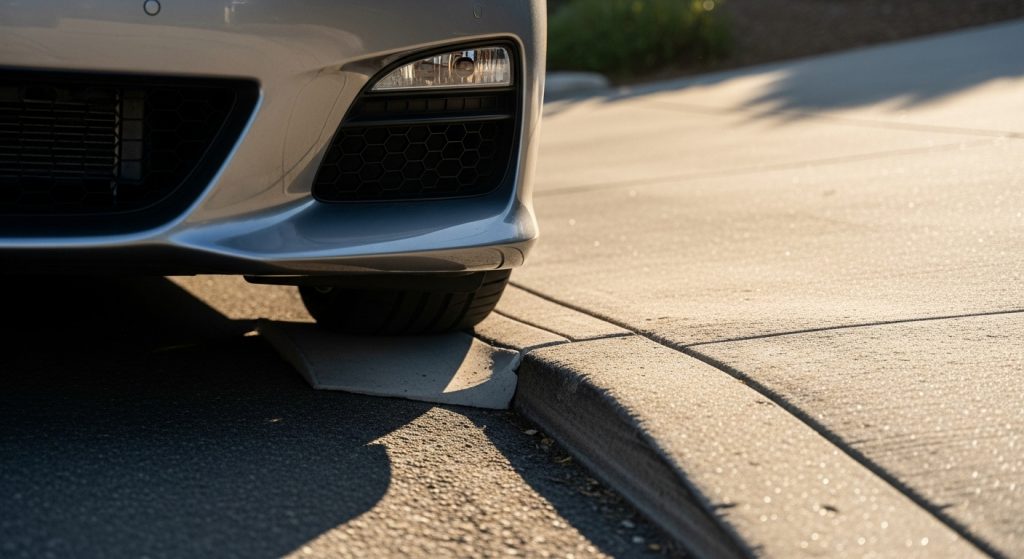
- Transition zones: The most common scraping happens at the garage threshold and the end of your driveway. We design gentle transitions—short, flatter sections or compound curves—so low cars clear comfortably.
- Sightlines & safety: On a steep hill or a sloped driveway that joins a busy road, visibility and turning radii matter. If in doubt, plan a wider paved driveway throat and ensure adequate stopping space inside the site.
“On steep plots, the gradient isn’t the main hazard. Poor transitions at the kerb and garage are. Get those right, and you’ve solved most day‑to‑day usability issues.”
Tony Flook, Managing Director, Driveways Plus
Groundwork that lasts: building on clay and other tricky soils
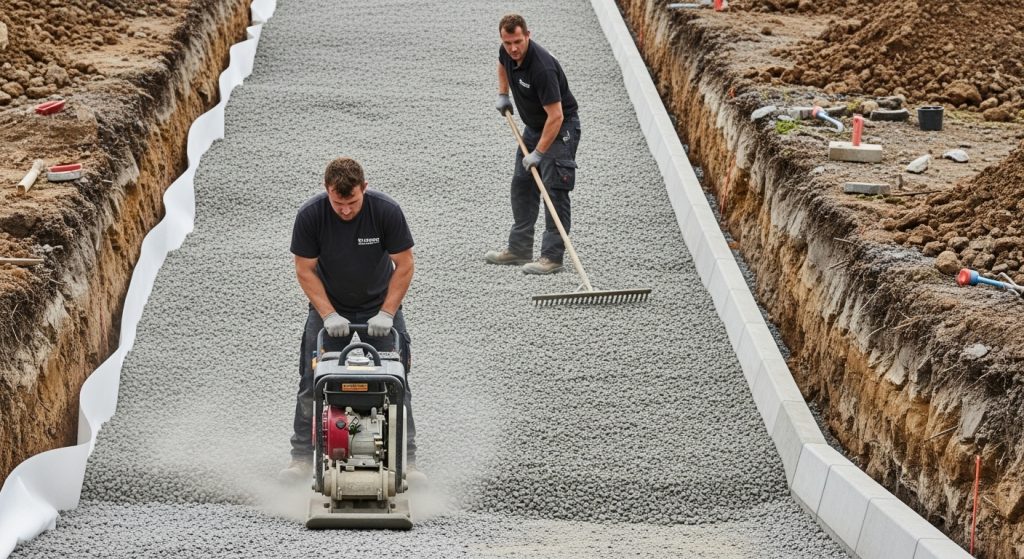
If you remember one thing, make it this: your driveway’s performance is set by what you don’t see. In Bristol, Bath, and much of the South West, heavy clay is common. Clay swells when wet, shrinks when dry, and can erode a standard sub‑base. The fix is a civil‑engineering approach:
Best‑practice groundwork on an incline
- Deeper excavation: Typically 300–450 mm to remove unstable material and create a structural section appropriate for a steep slope.
- Geotextile separation membrane: Prevents fines pumping and keeps the gravel and sand layers where they belong.
- Open‑graded sub‑base (often MOT Type 3): Faster drainage through the pavement build‑up reduces water pooling and wash‑out. On clay, this is your best bet.
- Layered compaction: Compact in thin lifts using plate or roller compaction; more passes are needed on an incline to lock the sub‑base.
- Edge restraints & kerbs: Concrete kerb units and haunching resist downhill creep and protect the wearing course.
- Effective drainage: Design before you pave—more on SUDS next.
Why groundwork can be up to 80% of cost
Robust excavation, removal, membranes, quality aggregate, and careful compaction add cost up‑front but reduce the risk of settlement, cracking, and premature wear and tear. On steep slopes and clay, skipping these steps is the quickest route to failure.
For those looking for effective and stylish options, consider our range of steep driveway solutions that cater to various needs and preferences.
SUDS and drainage: how to keep water under control on a steep slope
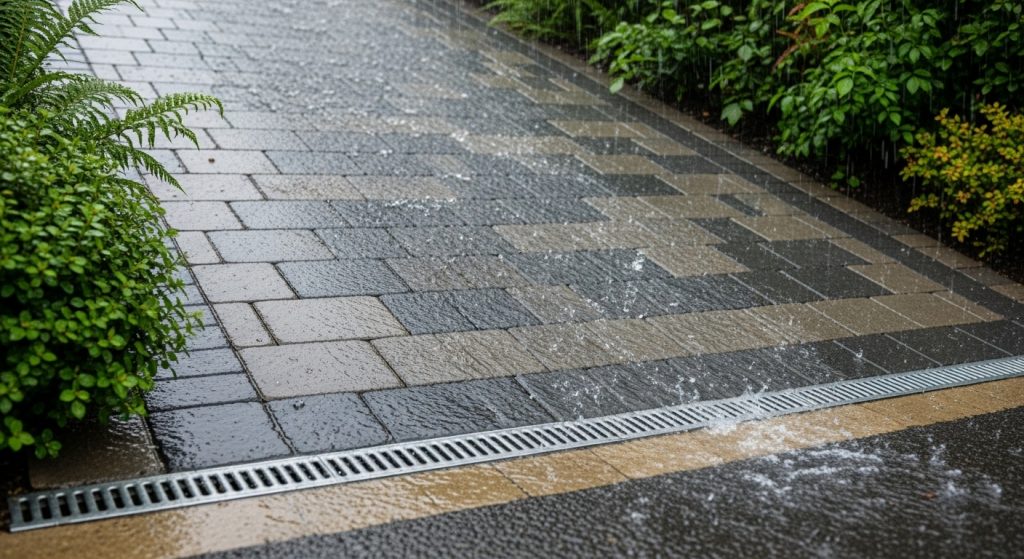
Rainfall runs faster on a gradient, so you need proper drainage. To stay within UK rules, you must prevent runoff from entering the highway and, for impermeable surfaces over 5 m², direct water into your garden via a soakaway or similar.
Designing for downpour – your options
Drainage system | Best for | Pros | Cons | Typical cost* |
Permeable surface (e.g., resin‑bound, permeable block paving) | Most residential drives | Eliminates surface run‑off at source; reduces ice risk; SUDS‑compliant | Requires specific permeable sub‑base | Included in surface cost |
Channel drain + soakaway | Capturing fast surface run‑off at the end of your driveway or garage line | High capture rate; tidy finish | Needs maintenance; requires precise levels | £700–£1,100 |
French drain | Poorly draining soils / intercepting edge run‑off | Invisible after install; lowers water table | Labour‑intensive; less effective for sudden surges | Higher than channels |
*Guide figures only; site‑specific.
Smart details on steep sites
- Put linear channel drains across the garage threshold or at the bottom of the slope to reduce the risk of water entering the property.
- Keep soakaways at least 5 m from buildings, and size them using a percolation test.
- If you prefer a non‑permeable paved driveway, combine channels, French drains, and a soakaway to achieve effective drainage.
Which surface is safest on an incline? Resin, tarmac, and block compared
Choosing a surface isn’t just about look; it’s about traction, longevity, maintenance, and compliance. Below is a quick comparison tailored to steep driveway solutions.
Table 1. Surface performance on steep slopes (UK residential)
Surface | Grip (wet/icy) | Longevity | SUDS | Key steep‑slope notes | Typical installed £/m² |
Resin‑bound | Excellent wet; fair icy | 15–25 yrs | Fully permeable | Needs expert mixing and laying from bottom‑up to avoid slumping | £60–£100 |
Tarmac (asphalt) | Excellent | 15–20 yrs | Porous options available | Great for precise falls; compaction quality is critical | £40–£70 |
Permeable block paving | Good; fair icy | 25+ yrs | Fully permeable | Strong edge restraints stop downhill creep | Higher; varies by block |
PIC / concrete driveway | Safe only with broomed or textured finish plus anti‑slip seal | 20–30 yrs | Not permeable | Requires a stiff mix; specialist finishing essential | ~£80 average |
Gravel in place (with grids) | Very good | 20+ yrs (grids) | Fully permeable | Limit gradient to ~15% (1:6.7); angular stone only | £35–£55 |
Our take
If you want a sleek finish that handles heavy rain, resin‑bound over a permeable sub‑base is hard to beat. If you prioritise a cost‑effective, flexible surface, tarmac is excellent, with porous asphalt available. For a classic look with high performance, permeable block paving wins, just make sure the kerbs and edge restraints are bulletproof.
“No surface will save a poor sub‑base. On steep plots, we specify deeper sections, robust kerbs, and permeable build‑ups as standard, then choose the surface to suit the home.”
Ben Sperring, Surfacing & Civils Manager, Driveways Plus
Regulations that matter: SUDS, planning, and the 1‑in‑40 rule
For full details and up‑to‑date requirements, visit the relevant authorities:
- UK Government Planning Portal
- Environment Agency – Sustainable Drainage Systems (SUDS)
- Bristol City Council – Dropped Kerb Applications
- Bath & North East Somerset Council – Vehicle Crossings
- Oxfordshire County Council – Highway Standard Details
- SUDS compliance: Use a permeable surface or collect run‑off within your boundary to a soakaway. Installing an impermeable new driveway over 5 m² without on‑plot drainage typically requires planning permission.
- Dropped kerb: You must not drive over the public pavement without a legally constructed vehicle crossover. Applications go through your local highways authority; some councils insist on accredited contractors.
- 1‑in‑40 at the highway: Expect your council to require a fall of at least 1:40 away from the highway for the first one to two metres. It protects the public road, prevents water pooling at the curb, and helps avoid car scraping.
Local focus: Bristol, Bath & the Thames Valley
- Bristol & Bath: Highway excavation and dropped kerb applications are handled by the councils. You hire an approved contractor; licences are issued under the Highways Act. Transition gradients and drainage at the end of your driveway get close scrutiny.
- Oxfordshire (Thames Valley): The county publishes detailed Highway Standard Details drawings for crossovers and kerbs. Expect a by‑the‑book process and strict checks on construction quality.
Paperwork in plain English
Planning permission is usually not required if your new driveway uses a permeable surface or drains to a soakaway within your plot. A dropped kerb licence is a separate highways application. We handle both as part of our turnkey service.
How to fix a steep driveway: a practical step‑by‑step
- Measure the gradient with a long spirit level or digital level. Record rise and run; know your maximum steepness before you start.
- Sketch the layout showing the garage, boundaries, and where the drive meets the road. Mark transition zones you want flatter.
- Choose your drainage strategy early, permeable build‑up, or channels plus soakaway, so the levels work.
- Shortlist surfaces based on your priorities: low‑maintenance resin, cost‑effective tarmac, or classic block paving.
- Get quotes from specialist driveway installers with steep‑slope experience. Ask for written specs including excavation depth, sub‑base type, compaction method, and kerb details.
- Apply for approvals: dropped kerb first if you need one, then any planning permission for impermeable paving.
- Build from the ground up: excavation, membrane, open‑graded sub‑base, kerbs, drainage, then the surface.
- Finish with safety: texture concrete or PIC, add anti‑slip where needed, and verify the 1‑in‑40 fall at the highway.
Budgeting: realistic numbers for a steep driveway
- Surface & labour: Around a two‑car new driveway of 30-40 m², expect £1,050–£1,650 for a gravel‑grid system; £1,800–£3,000+ for resin‑bound; tarmac and concrete vary with access and thickness; block paving tends higher due to labour.
- Drainage add‑ons: Channel drains and a soakaway typically £700–£1,100.
- Dropped kerb: Commonly £800–£1,200 including fees.
- Planning fee (if needed): £206 in England.
- Retaining walls: Can run to several thousand pounds when engineering design is required.
For complex sites in clay, a realistic total project range is £6,150–£17,500, reflecting deeper groundwork and drainage.
Material deep‑dives: pro notes by surface
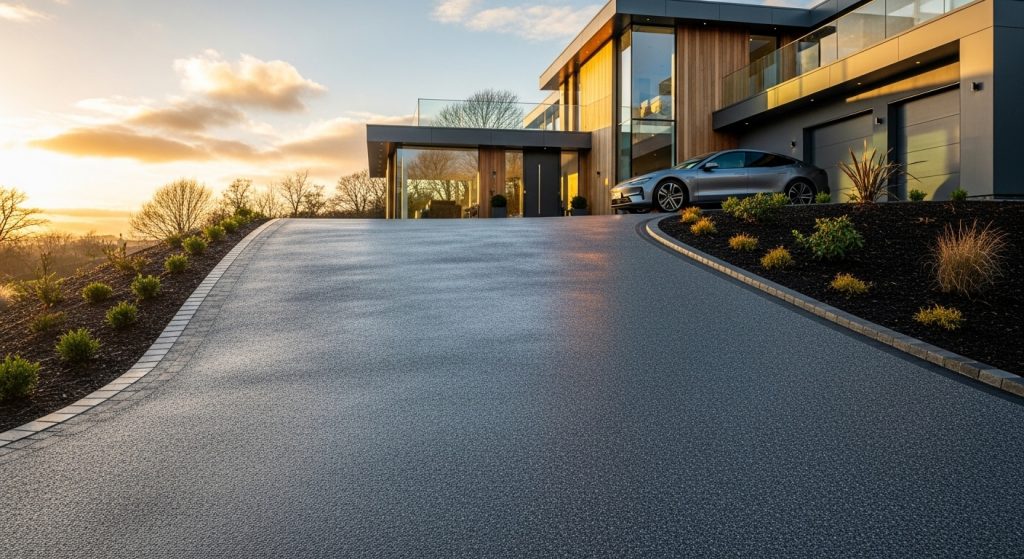
- Works brilliantly on slopes when installed by specialists who use thicker mixes, apply from the bottom upwards, and include anti‑slip top dressings if required. Fully permeable; looks seamless.
- Flexible binder helps accommodate small movements on slopes; allows precise shaping of falls and camber. Choose porous asphalt for SUDS, or design channels if using standard tarmac.
Permeable block paving driveways
- Highest design flexibility. The must‑haves on a steep slope are deep, well‑compacted sub‑base, strong edge restraints, and installation progressing uphill to lock the pattern.
- Never specify a smooth finish. Use a heavy broom finish or a deep PIC imprint, then seal with an anti‑slip additive. Concrete needs a stiff mix on inclines to avoid slumping.
- Only with cellular stabilisation. Use 10–14 mm angular stone. Keep gradients moderate and consider wheel tracks or intermittent rumble strips for extra traction.
Rogue‑trader checklist: how to avoid the cowboys
Twenty essential questions to ask
- Show recent steep‑slope projects nearby
- Offer references you can visit
- Experience on local clays
- Memberships or approved installer status
- Excavation depth
- Sub‑base type (Type 1 vs Type 3) and why
- Geotextile use
- Compaction method and layers
- SUDS solution
- How they’ll prevent scraping at both ends of your driveway
- Familiarity with your council’s dropped kerb process
- SWQR/NRSWA accreditation for highway work
- Public liability insurance (£5m+)
- Itemised written quotation
- Formal contract and payment schedule
- Sensible deposit only
- Written workmanship warranty
- Awareness of the Consumer Rights Act
- Who handles permits
- Full business address and landline
Red flags
- “Leftover tarmac” deals today‑only, cash‑only requests, unusually low quotes, pressure to start tomorrow, or refusal to put details in writing. Walk away.
“If a quote for an existing driveway on a steep slope looks too good to be true, it is. The corners cut are always the ones you can’t see.”`
Tony Flook, Managing Director, Driveways Plus
FAQs: steep driveway solutions for UK homeowners
What’s the maximum gradient for a residential driveway?
There’s no single national maximum, but comfort, safety, and access usually push designs toward the shallowest practical slope, with 1‑in‑40 away from the highway at the boundary. We’ll assess car clearances and transitions on site.
Can I install a resin driveway on a slope?
Yes—resin‑bound works very well when installed by experts using correct techniques. It offers great wet‑weather traction and is fully permeable.
Is gravel suitable on an incline?
Loose gravel, no. Gravel with stabilisation grids, yes—up to moderate gradients. Use angular stone and a deep, well‑compacted sub‑base to keep the gravel in place.
Do I need planning permission?
If your surface is impermeable and over 5 m² with run‑off to the road, yes. Permeable surfaces or on‑plot drainage usually avoid planning. A dropped kerb licence is a separate highways approval.
How do you stop cars scraping?
We design compound transitions, slightly flatter sections at the garage and at the kerb, to protect low bumpers. Small level tweaks make a big difference.
What’s the safest surface in icy weather?
Textured finishes with anti‑slip treatments help. Block patterns, resin with suitable aggregate grading, or treated tarmac all perform well. De‑icing and prompt snow clearance still matter when it’s very wet or icy.
Key takeaways
- Design transitions first; then set overall gradient and drainage.
- On clay and steep slopes, invest in deeper excavation, a geotextile, and an open‑graded sub‑base.
- Choose a surface for traction and SUDS compliance—resin‑bound, tarmac, or permeable block paving are the stand‑outs.
- Budget realistically: groundwork and drainage often dominate cost on steep sites.
- Always use accredited specialists and get everything in writing.
Ready to conquer the climb?
We combine residential design flair with Highways Plus commercial‑grade engineering to deliver steep driveway solutions that are safe, long‑lasting, and beautiful.
Next step
👉 Book your free design consultation: We’ll measure your driveway slope, assess drainage, and show surface samples at your home.
Call 01761 202 012 or visit drivewaysplus.co.uk.
Prefer to research first? Explore our other surface options: New Driveway Surface Options