Last updated: June 11, 2026
Quick answer: Planning a new driveway in 2026 takes roughly 4 to 12 weeks from your first quote to the final sealcoat, depending on material choice, site conditions, and local planning requirements. Active installation typically runs 3 to 7 days, followed by a curing period before full use. Getting the planning stages right is what separates a driveway that lasts 25 years from one that needs attention within five.
Key takeaways
- 🗓️ Allow 4 to 12 weeks from first enquiry to finished surface, including surveys, permissions, and scheduling
- 💷 UK driveway costs in 2026 vary significantly by material; get at least three itemised quotes before committing
- 📋 Most driveway replacements in England require a Sustainable Drainage System (SuDS) check; new front drives may need permitted development approval
- 🏗️ Sub-base preparation is the single most important factor in driveway longevity, not the surface material
- 🌱 Permeable surfaces are increasingly popular and can simplify planning compliance under tightening UK drainage rules
- 🔍 Always verify a contractor’s insurance, references, and whether they offer a written guarantee before signing anything
- 🛡️ Sealcoating is the most cost-effective maintenance step you can take in year one, protecting your investment from day one
- ⚠️ The most common homeowner mistake is rushing the contractor selection phase, often leading to poor sub-base work that’s invisible until it fails
What does the full driveway project timeline look like?
Planning a new driveway in 2026 follows a clear sequence, and understanding each stage helps you stay in control of the project.
Here’s the complete journey, from first call to final coat:
Stage |
Typical duration |
What happens |
|---|---|---|
Initial enquiries and quotes |
1 to 3 weeks |
Site visits, measurements, material decisions |
Design and planning checks |
3 to 7 days |
SuDS assessment, permitted development check |
Contractor selection |
3 to 7 days |
Comparing quotes, checking credentials |
Scheduling and materials |
1 to 4 weeks |
Booking slot, ordering materials |
Excavation and sub-base |
1 to 2 days |
Dig out, drainage, MOT Type 1 base layer |
Surface installation |
1 to 3 days |
Laying chosen material |
Curing and finishing |
3 to 28 days |
Dependent on material choice |
Sealcoating (if applicable) |
Half a day |
Applied after full cure |
Active on-site work typically spans 3 to 7 days for a standard residential driveway [1]. Larger or more complex projects, such as those with drainage channels, retaining walls, or multiple surface zones, can extend to 10 days [2].
💬 Tommy Clancy, Pre-Construction Consultant at Driveways Plus: “The homeowners who have the smoothest experience are the ones who contact us six to eight weeks before they want the work done. That window gives us time to do a proper site assessment, handle any planning queries, and schedule your project without rushing any stage.”
How much does a new driveway cost in 2026?
Driveway costs in 2026 vary considerably based on material, size, and site complexity. There’s no single “average” figure that applies to every home, but you can expect broad UK price ranges like these:
Material |
Approximate cost per m² (installed) |
|---|---|
Tarmac / asphalt |
£40 to £70 |
Block paving |
£70 to £130 |
Resin-bound |
£65 to £120 |
Printed concrete |
£60 to £100 |
Gravel with stabilisation grid |
£25 to £55 |
For a typical UK driveway of 40 to 60m², you’re looking at a total investment ranging from roughly £1,500 for gravel up to £7,800 for premium block paving or resin. Our full driveway installation costs guide for 2026 breaks these figures down in detail.
What affects your local price?
- 📍 Regional labour rates (the South West and South East typically run 10 to 20% higher than the Midlands)
- 🚛 Access for machinery and skip lorries
- 🌊 Drainage requirements and existing surface condition
- 📐 Shape complexity, gradients, and any retaining edges needed
💬 Tony Flook, Managing Director: “A driveway is one of the highest-return home improvements you can make. We’ve seen quality installations add genuine kerb appeal and real market value. But the cheapest quote rarely delivers that. The price difference between a good job and a poor one is often just a few hundred pounds, yet the difference in lifespan can be 15 years.”
Do you need a permit to replace your driveway?
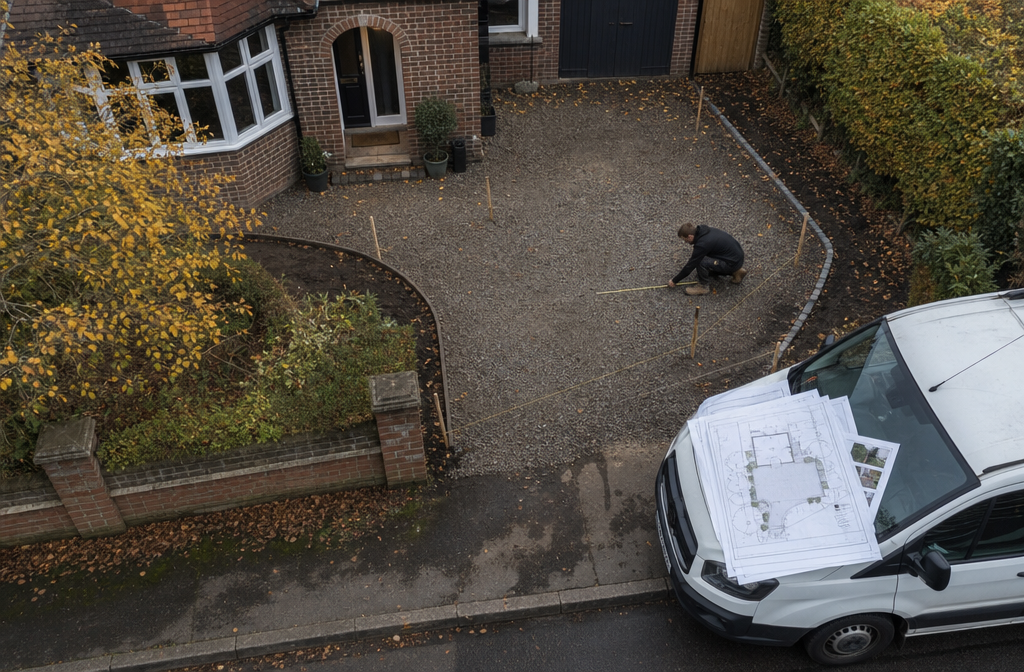
In England, replacing an existing driveway with a permeable surface doesn’t require planning permission. However, if you’re installing an impermeable surface (such as standard concrete or tarmac) on a front garden larger than 5m², you’ll need permitted development approval or must incorporate drainage to divert runoff away from the road [9].
The key rules for 2026:
- ✅ Permeable surfaces (resin-bound, gravel, permeable block paving) are generally permitted development
- ⚠️ Impermeable surfaces on front drives over 5m² require either planning permission or a drainage solution
- 🌧️ SuDS (Sustainable Drainage Systems) compliance is increasingly enforced; your contractor should carry out a site drainage assessment before work begins
- 🏴 Rules differ in Wales, Scotland, and Northern Ireland; always check with your local planning authority
Our guide to SuDS-compliant driveways in the UK explains the drainage requirements in plain English, including which materials qualify automatically.
Common mistake: Homeowners often assume a like-for-like replacement needs no checks at all. If you’re changing the surface type or extending the footprint, always verify with your local authority first.
Concrete vs tarmac: which is better for the UK climate?
For most UK homeowners, tarmac offers the better practical choice for our climate. It handles freeze-thaw cycles well, costs less than concrete, and can be resurfaced rather than fully replaced if it deteriorates. Concrete is more durable over a longer term but is more susceptible to cracking in cold, wet winters and costs more to repair.
Choose tarmac if:
- Budget is a priority
- You want a fast installation (usable within 24 to 48 hours)
- Your area experiences significant frost
Choose concrete if:
- You want maximum longevity (25 to 30+ years with good maintenance)
- You prefer a wider range of decorative finishes, such as printed or exposed aggregate
Resin-bound surfaces are increasingly popular in 2026 as a middle ground: permeable, attractive, and durable in UK conditions [3]. See our comparison of tarmac vs modern driveway alternatives for a full breakdown.
💬 Ben Sperring, Surfacing Manager: “People focus on the surface, but the sub-base is where driveways fail or succeed. I’ve seen premium block paving laid over a poor sub-base crack within two winters. Get the groundwork right first, and almost any surface will perform well.”
How do you know if your soil needs special preparation?
Poor soil preparation is the leading cause of premature driveway failure. Clay-heavy or waterlogged ground needs more excavation depth and potentially a geotextile membrane before the sub-base goes in.
Signs your site needs extra attention:
- 🌊 Standing water after rain that takes more than 24 hours to drain
- 🌱 Soft, spongy ground underfoot, especially after wet weather
- 🏗️ Previous driveway showed cracking or sinking within 5 years
- 🌳 Large tree roots within 3 metres of the proposed driveway area
A reputable contractor will carry out a ground assessment during the site survey. On clay soils, excavation depth typically increases from the standard 150 to 200mm to 250 to 300mm, with a geotextile membrane and additional sub-base material. This adds cost, but it’s not optional if you want the surface to last.
What are the most common mistakes homeowners make?
Most driveway problems trace back to decisions made before a single stone is laid. Here are the mistakes that come up most often:
- Choosing on price alone. The lowest quote almost always means shortcuts on sub-base depth or drainage.
- Not checking contractor credentials. Always ask for proof of public liability insurance, references from recent local jobs, and a written guarantee.
- Skipping the drainage assessment. Ignoring SuDS requirements can result in enforcement action or a flooded neighbour.
- Rushing the curing period. Parking on resin or concrete before it’s fully cured causes permanent surface damage.
- No sealcoat in year one. Leaving a new tarmac or block paving surface unsealed accelerates weathering and staining.
Our guide to common driveway problems and how to fix them covers what happens when these mistakes are made, and how to address them.
What should you look for when getting driveway quotes?
Get at least three written quotes, and make sure each one covers the same scope so you’re comparing like for like.
A trustworthy quote should include:
- ✅ Excavation depth and sub-base specification
- ✅ Drainage plan and SuDS compliance confirmation
- ✅ Material specifications (grade, thickness, supplier)
- ✅ Edging and border detail
- ✅ Skip hire and waste disposal
- ✅ Timeline and payment schedule
- ✅ Written guarantee (minimum 5 years for installation)
Red flags to watch for:
- 🚩 Cash-only payment requested upfront
- 🚩 No fixed address or verifiable local presence
- 🚩 Vague descriptions like “standard base” with no depth specified
- 🚩 Pressure to sign on the day of the site visit
Get a free, detailed quote from Driveways Plus and see what a properly scoped proposal looks like.
Are there eco-friendly driveway options that actually last?
Yes. Permeable and low-carbon driveway surfaces have moved well beyond niche territory in 2026 [3]. Several options combine genuine durability with a reduced environmental footprint.
The most practical eco-friendly choices:
- 🌿 Resin-bound aggregate over a permeable base: SUDS-compliant, long-lasting (15 to 25 years), and visually appealing
- 🪨 Gravel with stabilisation grids: Low embodied carbon, excellent drainage, easy to maintain. Our gravel driveway with hidden grids guide explains how modern grid systems solve the traditional problems of gravel migration
- 🧱 Permeable block paving: Allows water infiltration through jointing material; qualifies as permitted development in most cases
- ♻️ Recycled aggregate sub-base: Reduces virgin material use without compromising structural performance
Coal tar-free, low-VOC sealants are now standard practice for environmentally conscious installations [4]. If sustainability matters to you, ask your contractor specifically which sealant products they use.
Can you do part of the installation yourself to save money?
Realistically, very little of a quality driveway installation is suitable for DIY, and the parts that are won’t save you much money.
Excavation and sub-base work requires proper compaction equipment, and getting this wrong undermines everything above it. Surface laying for tarmac and resin requires specialist machinery and materials that aren’t available to the public in usable quantities.
Where you can genuinely save:
- Clearing the area of furniture, pots, and obstacles before the crew arrives
- Removing existing loose gravel yourself (with a skip you hire)
- Handling any minor landscaping or edging planting after the work is complete
Attempting to lay the surface yourself to save on labour almost always results in a failed driveway within a few years, which costs far more to fix than the original saving.
What maintenance does a new driveway need in year one?
The first 12 months are the most important for setting your driveway up for long-term performance. Follow these steps:
Months 1 to 3:
- Avoid heavy vehicles (skips, lorries, large vans) until full cure is confirmed
- Don’t use harsh chemical cleaners or pressure washers on resin or new tarmac
- Check drainage channels are clear after heavy rain
Months 3 to 6:
- Carry out a first visual inspection for any settlement or edge movement
- Address any minor cracks immediately; small cracks become big problems fast
Months 6 to 12:
- Apply sealcoat to tarmac and block paving surfaces (this is the step most homeowners skip) [5]
- Resin-bound surfaces don’t require sealcoating but benefit from a specialist cleaner
- Check and clear any moss or algae growth before it takes hold
Our driveway maintenance guide for 2026 covers cleaning, sealing, and seasonal care in full detail.
How long will a professionally installed driveway last?
A properly installed driveway, with good sub-base preparation and regular maintenance, should last:
- Tarmac: 20 to 30 years with periodic resurfacing
- Block paving: 25 to 40 years; individual blocks can be replaced if damaged
- Resin-bound: 15 to 25 years depending on UV exposure and traffic
- Concrete: 25 to 40 years; longer with sealcoating
- Gravel: Indefinite with topping up every 5 to 7 years
The industry has seen a significant shift towards maintenance services in recent years, with pavement repair revenues nearly doubling year-on-year [6]. That tells its own story: driveways that aren’t maintained regularly end up costing far more in repair than the maintenance would have.
FAQs: planning a new driveway in 2026
How far in advance should I book a driveway contractor? For most reputable contractors in 2026, expect a 4 to 8 week lead time for residential projects. Summer is the busiest period; booking in late winter or early spring typically gives you more scheduling flexibility and sometimes better pricing.
What’s the best time of year to install a driveway in the UK? Spring through early autumn (April to October) is ideal. Tarmac and resin both require ambient temperatures above 5°C to lay and cure correctly. Cold, wet conditions in winter can compromise the bond and surface finish.
Can I get a driveway installed if I have a steep gradient? Yes, but it requires specialist planning. Steep drives need additional drainage measures, anti-slip surface textures, and sometimes retaining edging. Our steep driveway solutions guide covers what to specify and what questions to ask your contractor.
Should I mention EV charging when planning my driveway? Absolutely. If you own or plan to own an electric vehicle, tell your contractor before work begins. Running conduit for a charge point cable is a minor addition during installation but expensive to retrofit afterwards. See our smart driveway EV charging guide for design considerations.
What happens if my new driveway fails within the guarantee period? A reputable contractor will return to assess and repair any structural failure within the guarantee period at no cost. Always get the guarantee in writing before work starts, and confirm whether it covers both materials and labour.
Do I need to tell my home insurer about a new driveway? It’s worth notifying your insurer, particularly if the driveway significantly changes your property’s value or security features. Some insurers offer reduced premiums for homes with off-street parking.
Conclusion: your next steps
Planning a new driveway in 2026, from first quote to final sealcoat, is a straightforward process when you know what to expect at each stage. The homeowners who get the best results are the ones who plan ahead, ask the right questions, and choose a contractor based on quality rather than price alone.
Your action checklist:
- ✅ Decide on your preferred material and check our driveway material comparison guide if you’re unsure
- ✅ Check your permitted development position with your local planning authority
- ✅ Get three written, itemised quotes with full sub-base specifications
- ✅ Verify contractor insurance, guarantees, and recent local references
- ✅ Book 6 to 8 weeks ahead of your preferred start date
- ✅ Plan your year-one maintenance schedule before installation begins
With 25 years of commercial surfacing expertise now dedicated to residential projects, Driveways Plus brings the kind of knowledge that protects your investment from the ground up, literally. Request your free driveway quote and let’s talk through your project properly.
References
[1] Driveway Installation Step By Step –
[2] From Planning To Completion Your Week By Week Guide To Getting A New Concrete Driveway –
[3] Important Factors To Consider When Planning A New Driveway Installation –
[4] VP Asphalt Paving Introduces Eco-Friendly Driveway Sealing Solutions In Connecticut – https://markets.financialcontent.com/ridgwayrecord/article/pressadvantage-2025-10-14-vp-asphalt-paving-introduces-eco-friendly-driveway-sealing-solutions-in-connecticut
[5] Sealcoating Driveway – https://www.thisoldhouse.com/driveways/sealcoating-driveway
[6] 2025 Market Report –
[9] New Driveway Site Plans Permits And Easements –