Skip to content
Last updated: April 08, 2026
Quick Answer: Gravel driveways reimagined for 2026 use hidden plastic grid systems, installed beneath the surface, to lock gravel in place and prevent rutting under heavy vehicles. These HDPE or polypropylene grids are fully permeable, SUDS-compliant, and virtually invisible once filled, giving you the classic natural look of gravel with none of the traditional headaches.
Key takeaways
- 🪨 Hidden gravel grids confine aggregate at cell level, eliminating ruts and scatter under SUVs and daily traffic
- 💧 Fully permeable design meets UK SUDS drainage regulations without planning permission in most cases
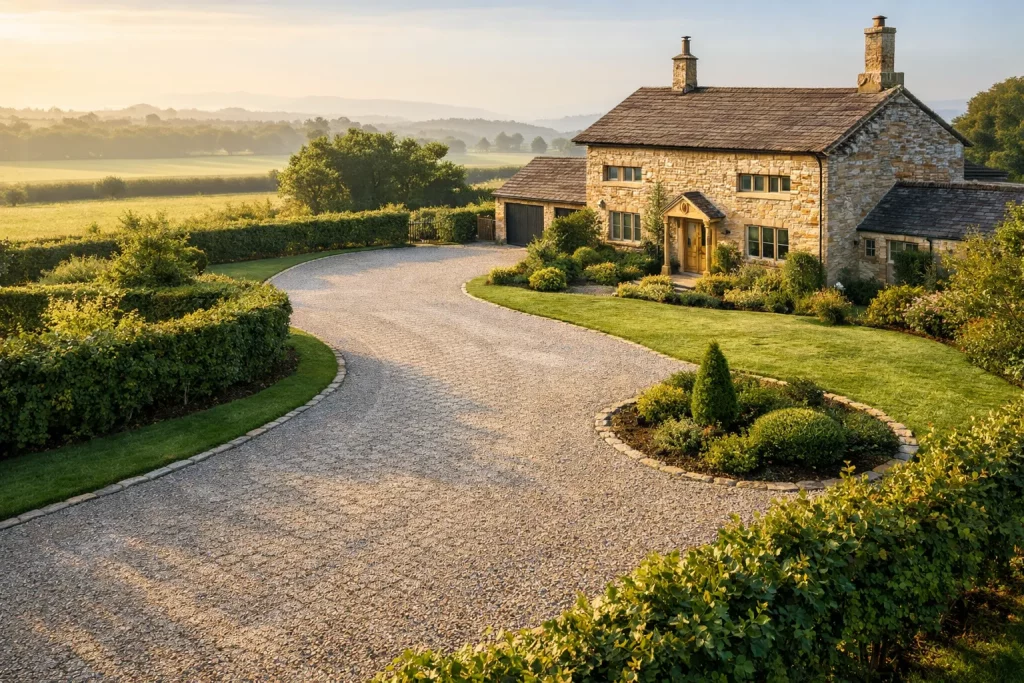
- 🌿 Maintains a soft, natural heritage aesthetic that suits period and rural properties
- ⚙️ Premium systems operate at just 25mm deep, reducing excavation and waste removal costs [1]
- 📉 Modern grids reduce the gravel depth needed by 30-60% compared to loose-fill installations [3]
- 🏗️ Load ratings range from 8-12 tonnes for residential use up to 350-500 tonnes/m² for commercial-grade geocell systems [3]
- ♻️ Many systems use 100% recycled or recyclable HDPE, making them a genuinely sustainable choice [3]
- 🛠️ Integrated geotextile backing suppresses weeds while allowing drainage, cutting ongoing maintenance [4]
- ⏱️ Interlocking 1m² panels allow fast installation, even on sloped or steep driveways [1]
- 💰 Material savings from reduced gravel depth and minimal excavation often offset the grid cost
What are hidden gravel grids and how do they work?
Hidden gravel grids are interlocking panels made from HDPE (high-density polyethylene) or polypropylene, laid beneath the gravel surface to create a rigid cellular structure. Each honeycomb-shaped cell grips the gravel from below, preventing it from shifting under load.
Think of it like an invisible skeleton for your driveway. The gravel sits inside the cells rather than on top of loose subgrade, so it simply cannot migrate, rut, or scatter the way traditional loose gravel does.
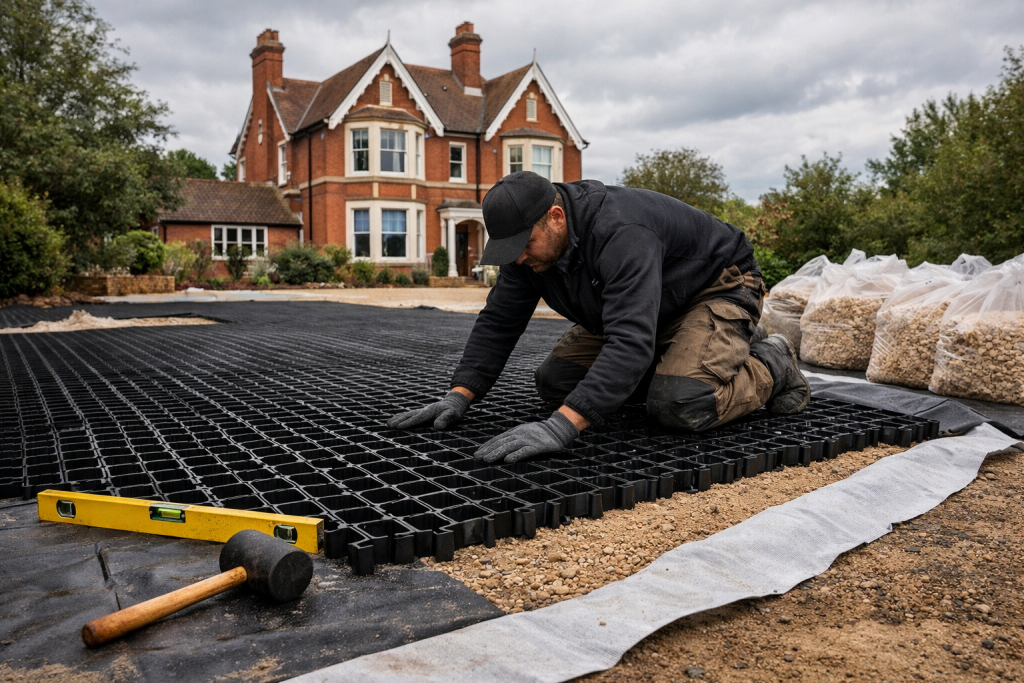
The panels interlock like puzzle pieces, typically in 1m² sheets, and sit on a compacted sub-base with a geotextile membrane beneath. Once filled with your chosen aggregate, they disappear completely. [1]
How the layers stack up:
Layer | Purpose |
|---|---|
Compacted sub-base (MOT Type 1) | Structural foundation |
Geotextile membrane | Weed suppression and separation |
HDPE/PP grid panels | Gravel confinement and load distribution |
Aggregate fill (3/8″ to 3/4″ gravel) | Surface finish and drainage |

Why are gravel driveways reimagined for 2026 better than traditional loose gravel?
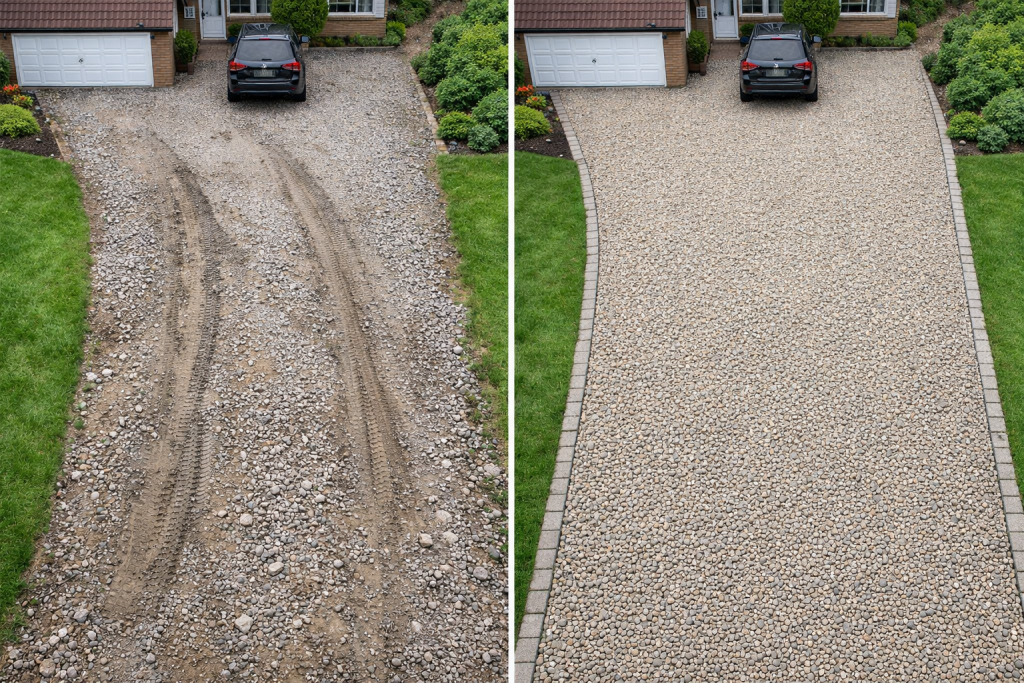
Traditional loose gravel driveways have two well-known problems: gravel migrates onto lawns and paths, and vehicles create ruts that deepen over time. Grid systems solve both issues at the root cause.
By confining each stone within a cell, the grid increases the effective load-bearing capacity of the subgrade by 200-500% [3]. That’s the difference between a surface that holds firm under a 2.5-tonne SUV and one that sinks and shifts within months.
Tony Flook, Managing Director: “We’ve installed gravel driveways for 25 years, and the single biggest complaint from homeowners has always been maintenance. Gravel going everywhere, ruts appearing after winter. Grid systems genuinely change that equation. It’s the same beautiful finish, but it actually stays that way.”
Practical advantages over loose gravel:
- ✅ No ruts forming under regular vehicle use
- ✅ No gravel scatter onto paths, lawns, or roads
- ✅ Reduced dust during dry weather, as stones stay confined [5]
- ✅ Less top-up gravel needed over the driveway’s lifetime
- ✅ Suitable for sloped driveways where loose gravel is particularly problematic
For more on managing challenging gradients, our guide to safe and stylish steep driveway solutions covers what to consider before you commit to any surface.
Do gravel grids meet UK drainage regulations in 2026?
Yes. This is one of the strongest arguments for choosing a grid system. Because the surface remains fully permeable, rainwater drains straight through the gravel and grid into the ground below.
Under UK planning regulations, a permeable driveway surface does not require planning permission for front garden installations. A solid, impermeable surface does. Grid-stabilised gravel keeps you on the right side of that rule automatically.
The fully porous design also satisfies SUDS (Sustainable Urban Drainage Systems) requirements, which are increasingly enforced across England and Wales. [1] Our detailed breakdown of SUDS-compliant driveway options in the UK explains exactly what the regulations require and how different surfaces measure up.
Ben Sperring, Surfacing Manager: “Drainage compliance isn’t just a box-ticking exercise. A permeable surface actively protects your property from surface water pooling. We always specify geotextile-backed grids because they allow drainage while keeping fines and silt from migrating upwards and contaminating the finish.”
Quick decision rule: If your driveway is in a front garden and you want to avoid planning permission, a permeable surface like a gravel grid system is the straightforward choice.
What load can a gravel grid driveway actually handle?
More than most homeowners expect. Residential-grade HDPE grid systems comfortably support axle loads of 8-12 tonnes, which covers every standard passenger car, SUV, and light van [3].
For properties with heavier requirements, such as small commercial sites or driveways used by delivery vehicles, heavy-duty geocell systems can support up to 350-500 tonnes/m² [3]. That’s a significant margin above anything a residential driveway will encounter.
The key is correct specification. Grid thickness, cell size, and sub-base depth all affect the final load rating.
Choosing the right spec:
- 🚗 Standard cars and SUVs: residential HDPE grid, 25mm depth, compacted sub-base
- 🚐 Vans and light commercial: medium-duty grid, deeper sub-base, larger cell aperture
- 🚛 HGVs or commercial areas: heavy-duty geocell system, engineered sub-base required
If you’re comparing gravel grids against other surfaces for a commercial or prestige project, our best driveway material comparison gives an honest side-by-side breakdown.
How much gravel do you actually need with a grid system?
Significantly less than a traditional loose-fill installation. Modern grid systems reduce the required gravel depth by 30-60% compared to conventional methods [3]. Where you might previously have needed 8-12 inches of aggregate, a grid system with a proper sub-base typically requires just 4-6 inches.
The cells themselves act as structural fill, so you’re not relying on sheer depth of gravel to achieve stability. The grid does that work instead.
Mike Clancy, Non-Executive Director: “The material savings alone make grids worth a serious look. Less gravel to buy, less to deliver, less to spread. On a typical residential driveway, that’s a meaningful cost offset against the grid panels themselves. Over a 25-year service life, the economics are compelling.”
What this means in practice:
- Lower material costs upfront
- Fewer delivery loads (and less disruption to your property)
- Less excavation depth required, which reduces spoil removal costs
- UV and chemical-resistant HDPE panels carry a 25-75+ year service life with minimal degradation [3]
For a full picture of what goes into premium gravel driveway installations, including material choices and what to expect from a professional installation, Driveways Plus covers the complete process.
What gravel works best with a hidden grid system?
The best aggregate for grid-stabilised driveways is angular or rounded stone in the 10-20mm (3/8″ to 3/4″) size range [3]. This size interlocks well within the cells, drains freely, and gives the natural aesthetic most homeowners are after.
Popular choices in the UK include:
- 🪨 Pea gravel (rounded, soft appearance, suits heritage and rural properties)
- 🪨 Golden flint (warm tones, popular in Cotswolds-style settings)
- 🪨 Slate chippings (contemporary, darker finish, suits modern homes)
- 🪨 Cotswold stone (natural cream/honey tones, classic English look)
- 🪨 Scottish pebble (grey-blue tones, clean and neutral)
Avoid very fine aggregates below 6mm, as they can migrate through cell apertures and reduce stability. Very large stones above 25mm won’t seat properly within the cells either.
Browse our top gravel driveway options for UK homes for a detailed look at aggregate choices, colours, and what suits different property styles.
How is a gravel grid driveway installed? A step-by-step overview
Installation is straightforward when the groundwork is done properly. Rushing the sub-base is the most common mistake, and it’s the one that causes problems years later.
Step-by-step installation process:
- Excavate to the required depth (typically 150-200mm for residential use, accounting for sub-base and grid)
- Compact the formation level with a plate compactor
- Lay MOT Type 1 sub-base to the specified depth and compact thoroughly
- Install geotextile membrane over the sub-base to separate layers and suppress weeds [4]
- Interlock grid panels across the area, cutting to fit edges with a saw or angle grinder [9]
- Secure perimeter edging to contain gravel at the borders
- Fill cells with aggregate, raking level and slightly proud of the grid top
- Compact lightly with a plate compactor to seat the gravel into the cells
The interlocking 1m² panel format means a competent team can cover a standard double driveway in a single day [1]. For sloped driveways, panels can be pinned to prevent movement during installation.
Ben Sperring, Surfacing Manager: “The sub-base is everything. We’ve seen grids installed over poorly compacted ground and they’ll eventually show movement. Get the foundations right and the grid does its job perfectly for decades.”
How does a grid gravel driveway compare to resin-bound or tarmac?
Each surface has its place, and the right choice depends on your property, budget, and priorities.
Feature | Grid gravel | Resin-bound | Tarmac |
|---|---|---|---|
Natural aesthetic | ✅ Excellent | ✅ Good | ❌ Industrial |
Fully permeable | ✅ Yes | ✅ Yes | ❌ No |
Rut resistance | ✅ High | ✅ Very high | ✅ Very high |
Planning permission (front garden) | ✅ Not required | ✅ Not required | ⚠️ May be required |
Maintenance | Low | Very low | Very low |
Cost (installed, approx.) | £ | ££ | £ |
Heritage/rural suitability | ✅ Excellent | ✅ Good | ❌ Poor |
If you’re weighing up alternatives, our expert driveway material guides cover resin, tarmac, block paving, and concrete in detail, with honest pros and cons for each.
Frequently asked questions
Can a gravel grid driveway handle an electric vehicle or large SUV without sinking? Yes. Residential-grade HDPE grid systems are rated for axle loads of 8-12 tonnes [3], which comfortably exceeds the weight of any standard EV or SUV. The key is a properly compacted sub-base beneath the grid; the grid itself distributes the load across a wider area than loose gravel ever could.
Will weeds grow through a gravel grid system? Weed growth is dramatically reduced compared to loose gravel. Integrated geotextile backing beneath the grid prevents weed seeds from establishing in the subgrade, and the confined gravel makes surface germination difficult [4]. Some seasonal surface weeds may appear, but a quick spray with a path weedkiller handles these easily.
How long does a gravel grid driveway last? The HDPE or polypropylene grid panels are UV and chemical-resistant, with manufacturers quoting service lives of 25-75+ years [3]. The gravel fill may need occasional topping up, but the structural grid itself should outlast most other driveway surfaces.
Is a gravel grid driveway suitable for a steep slope? Yes, and it’s actually one of the best solutions for sloped driveways where loose gravel would wash or migrate downhill. Panels can be pinned during installation, and the cellular structure holds aggregate in place under gravity and vehicle movement. Our steep driveway advice guides cover the additional considerations for sloped installations.
Do I need planning permission for a grid gravel driveway in the UK? In most cases, no. Because the surface is fully permeable, it falls within permitted development rights for front garden driveways in England. Always check with your local planning authority if your property is listed or within a conservation area, as additional rules may apply.
Can I install a gravel grid system myself, or do I need a contractor? The panel installation itself is manageable for a competent DIYer. However, the sub-base preparation requires the right equipment (plate compactor, level checking) and experience to get right. A poorly prepared sub-base will undermine the entire system. For most homeowners, professional installation is worth the investment.
Conclusion
Gravel driveways reimagined for 2026 with hidden grid systems genuinely solve the problems that put homeowners off gravel in the first place. No more ruts. No more scatter. No more annual top-ups eating into your weekend. The natural, permeable finish remains, and so does the heritage charm, but the structural performance underneath is a different proposition entirely.
With 25-75+ year panel lifespans, reduced gravel requirements, full SUDS compliance, and load ratings that handle anything a residential driveway encounters, a grid-stabilised gravel surface is one of the most practical and cost-effective choices available in 2026.
Your next steps:
- Measure your driveway area and note any slopes or drainage challenges
- Choose your aggregate (10-20mm angular or rounded stone works best)
- Get a professional sub-base assessment, as this is where most installations succeed or fail
- Request a free quote from Driveways Plus to discuss your specific property and get expert guidance from a team with 25+ years of installation experience
For further inspiration, browse our portfolio of completed driveway projects to see what’s possible across a range of property styles and budgets.
References
[1] The Hidden Secret To A Perfect Gravel Driveway 2 – https://landscapeinstitute.org/blog/the-hidden-secret-to-a-perfect-gravel-driveway-2/
[2] Permeable Driveways – https://www.truegridpaver.com/applications/permeable-driveways/
[3] The 10 Best Geo Grid Driveway Review – https://www.bpmgeogrid.com/the-10-best-geo-grid-driveway-review/
[4] Gd Gravel – https://www.greendriveway.com/products/gd-gravel/
[5] Ask Washington Rock What Are The Pros And Cons Of Using Gravel Grids – https://www.wa-rock.com/ask-washington-rock-what-are-the-pros-and-cons-of-using-gravel-grids/
[9] How To Lay Gravel Grids – https://www.ibran.com/pages/how-to-lay-gravel-grids