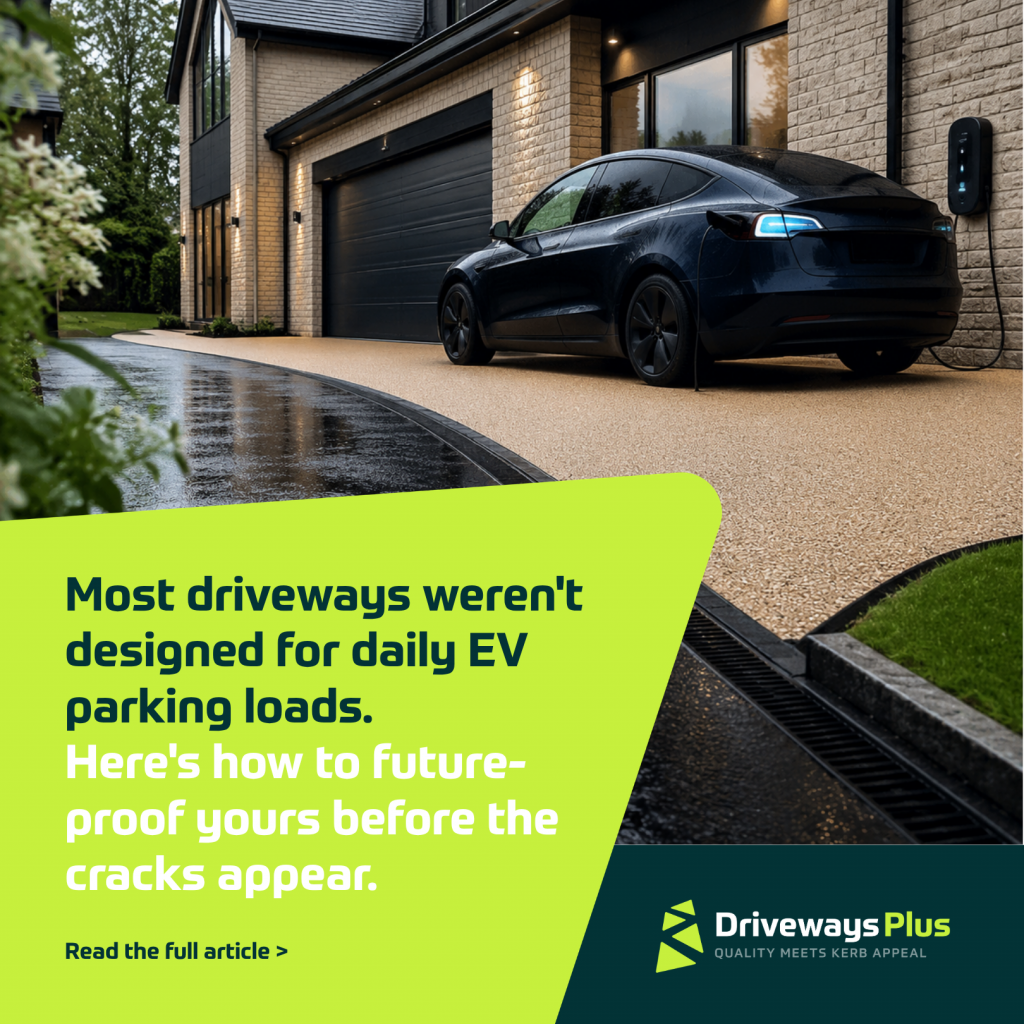
Last updated: 15 May 2026
Quick answer
Electric vehicle driveways need more than a tidy surface. They need a reinforced base, safe drainage, stable parking bays, and sensible cable routing for home charging. In 2026, resin-bound and tarmac remain two of the most practical choices for UK homeowners. Both can be engineered for repeated EV parking loads, wet weather, and daily use.
The right call depends on your property, budget, design goals, charger position, and drainage.
Key takeaways
- Design an EV driveway with vehicle weight, charging access, drainage, and long-term surface performance in mind.
- The sub-base matters more than the decorative finish. Weak foundations cause dips, cracking, and ponding.
- Resin-bound suits premium homes where appearance, permeability, and kerb appeal are priorities.
- Tarmac suits longer drives, shared access, larger parking areas, and tighter budgets.
- Plan cable route, ducting, and drainage before surfacing begins, not after.
- Manage rainwater properly to support SuDS expectations.
What makes an EV driveway different?
Not much, in one sense. An EV doesn’t need a special “electric” surface. It needs a driveway built properly for the way the vehicle parks and charges.
But EVs are usually heavier than equivalent petrol or diesel cars because of the battery pack. That repeated parked load exposes weak sub-bases, thin wearing courses, soft edges, and poor compaction far quicker than a lighter car would.
A driveway built for EV charging should account for static wheel loads, charger position, surface water flow, edge strength near turning zones, safe foot access from house to cable, and ducting for future charger upgrades.
“Homeowners often focus on the charger first, but the surface underneath it is part of the same investment.”
Tony Flook, Managing Director, 25+ years
Common mistake: installing the charger first, then designing the driveway around the leftover space. Plan both together.
Resin or tarmac: the headline differences
Factor | Reinforced resin-bound | Reinforced tarmac |
|---|---|---|
Best for | Premium homes, visible bays, decorative finishes | Long drives, larger areas, daily vehicle movement |
Appearance | Wide colour and aggregate choice | Clean black or red, simple and practical |
Drainage | Can be permeable with correct base | Needs planned falls or drainage channels |
Maintenance | Sweep, wash, treat organic growth | Clean, inspect, seal or repair when needed |
Typical concern | Poor base or weak edging | Thin overlay or weak edges |
Value position | Premium finish | Strong cost-to-performance choice |
Reinforced resin and tarmac compared for EV use.
Both can work brilliantly. Poor installation makes either one fail early.
When resin works best
Choose resin if the charging bay sits close to the house, the finish matters as much as the function, and you want a permeable surface that blends with stonework, render, or landscaping. “Reinforced” here doesn’t mean thicker resin; it means commercial-grade preparation beneath: a properly compacted sub-base, the right base layer, proper bay edges, and careful detailing around drainage and charger routes.
“If the base moves, the surface pays the price. Resin looks refined, but it still needs commercial-level preparation beneath it, especially where an EV sits in the same place every night.”
Ben Sperring, Surfacing Manager, 25+ years
When tarmac works best
Choose tarmac for longer drives, shared access, multiple vehicles, larger EV parking areas, or budget-led projects. It handles daily movement and turning well when laid over a properly compacted base with the right thickness, falls, and drainage. Watch for soft edges where wheels turn off the drive, thin overlays on broken surfaces, and poor falls that send water towards the charger.
For a wider comparison, see our best driveway material comparison guide.
Planning and drainage essentials
The safest designs feel obvious once finished. The car parks neatly, the cable reaches without crossing a trip route, and rainwater drains away from the charging area.
Before any excavation, agree:
- Parking position – where the vehicle sits most nights.
- Cable reach – it shouldn’t stretch across steps, paths, or walking routes.
- Ducting installed before surfacing, even if the charger comes later.
- Base condition – cracks, sinking, rocking blocks, and ponding all suggest deeper repair.
- Drainage falls that move water away from the home, charger, and garage threshold.
- Edges and turning zones – EV tyres often follow the same daily path, so edges need support.
A flat driveway isn’t safer than a falling one. Surfaces that appear level often hold water, encourage algae, and create slippery patches near the charger. Permeable construction supports SuDS, but only if the whole build-up is permeable, not just the top.
“The details you can’t see often decide whether a driveway still feels right in five years.”
Mike Clancy, Non-Executive Director, 30+ years
What about cost?
EV driveways usually cost more than basic like-for-like resurfacing because they may need stronger preparation, cable ducting, drainage work, and bay detailing. Final price depends on area size, excavation depth, surface choice, access, waste removal, and whether the charger route is included.
Insider tip: ask for the quote broken into preparation, sub-base, surface finish, drainage, edging, charger ducting, waste, and aftercare. Clear pricing makes quotes easier to compare and avoids nasty surprises later.
Maintenance basics
Resin: sweep leaves and grit often, wash with a hose or light pressure wash, treat algae before it goes slippery, avoid harsh chemicals unless approved, and keep drainage points clear.
Tarmac: clean oil or fluid marks promptly, watch for soft edges or early cracks, keep drainage channels clear, avoid sharp trailer legs or heavy point loads, and consider sealing or targeted repair when wear shows.
For both surfaces, don’t pressure wash too aggressively. Overpowered cleaning damages resin aggregate bonds and roughens older tarmac.
FAQs
Can any driveway support an EV?
Most can, with a sound base. Weak or poorly compacted surfaces sink, crack, or rut under repeated parking. Get a professional inspection first.
Is tarmac better than resin for heavy EVs?
Tarmac often wins for heavy daily use and larger parking areas. Resin wins where appearance, permeability, and a premium finish matter more.
Should charger cables run under the driveway?
Underground ducting is a tidy way to future-proof. The electrical work needs a qualified EV installer; your surfacing contractor handles the route, protection, and reinstatement.
The bottom line
The smartest EV driveways are designed as one system: surface, base, drainage, and charger position together. Mark where the EV will park, decide where the charger should sit, then ask a specialist to assess the base, drainage, and finish before work starts.
Request a no-obligation assessment for advice tailored to your property.

Your Premium Driveway & Paving Specialists
Quality Meets Kerb Appeal.
Not just our tagline...it’s our promise.
- No obligation
- Transparent pricing
- Local references available