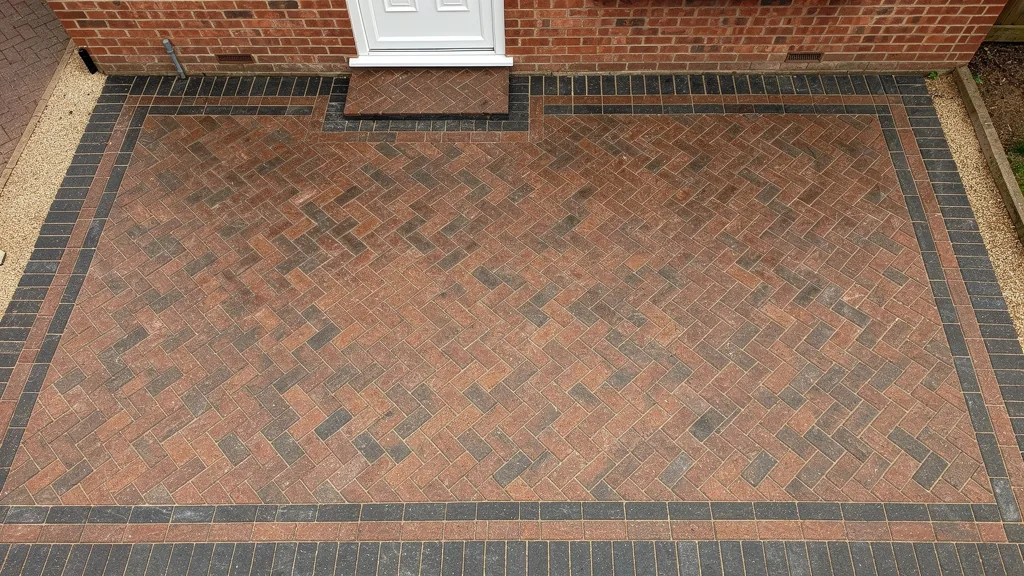
For a driveway, the pattern that matters is herringbone, laid at either 90 or 45 degrees in 50 mm blocks. It interlocks under braking and turning in a way no other layout does. Every other block paving pattern, stretcher bond, basketweave, circles and fans, has a place, but that place is usually a path, a patio, or a feature set inside a herringbone field. Choose the pattern first, then the colour: brindle for red brick, grey and charcoal for modern render, buff and natural stone for Bath and the Cotswolds. This guide covers all six patterns, the colour families that suit UK houses, and five combinations we lay regularly.
Why block paving is still the UK’s favourite driveway design
Block paving gives you something most surfaces can’t: structural interlock for vehicles, a vast range of colours and textures, and easy, localised repairs if a block gets damaged. Choose the right paving pattern and block thickness, and you’ll enjoy a driveway that looks smart, lasts decades, and is simple to maintain. Done properly, a new driveway can add meaningful value to a home.
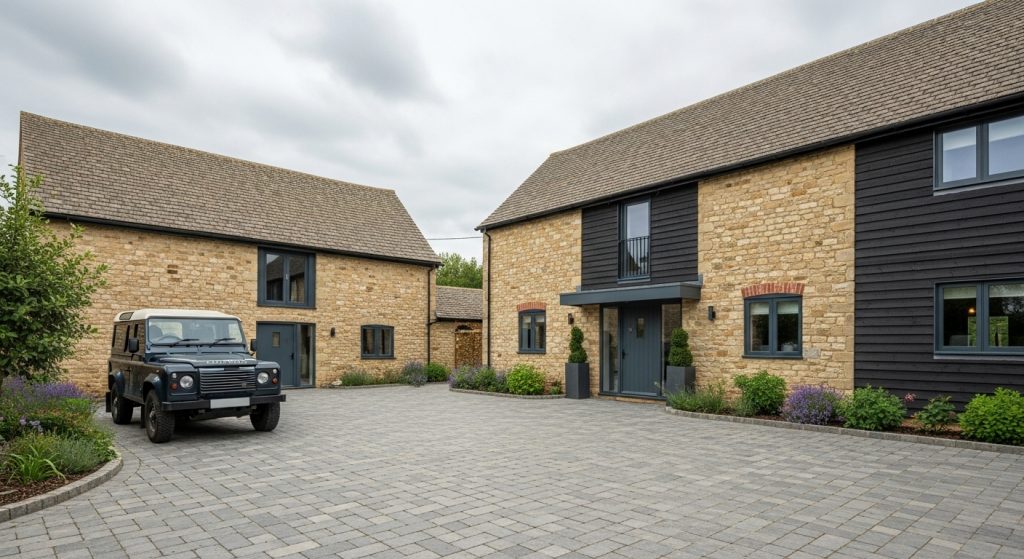
“We find homeowners are often surprised how much the right paving pattern changes the whole look of a property,” says Ben Sperring, Surfacing and Civils Manager at Driveways Plus. “A well-laid block driveway isn’t just about durability, it is the first impression people get when they pull up to your home.”
Block paving patterns explained: six layouts and where each one belongs
Pattern does two jobs at once. It sets how much load the surface can carry, and it sets how the drive reads from the pavement. Those two jobs pull in different directions, which is why almost every well-built driveway uses one pattern for the field and a second for the border. If you are still deciding on a surface rather than a layout, start with our driveway design ideas guide and come back here once block paving is settled.
Pattern | Strength under vehicles | Cutting and waste | How it reads | Best used on |
90° herringbone | Highest | Lowest | Ordered and classic | Any driveway, especially straight rectangular ones |
45° herringbone | Highest | Higher, more edge cuts | Longer and wider, more movement | Short, narrow, or awkward drives, and period frontages |
Stretcher bond | Low in small units | Lowest | Calm and linear | Paths, patios, banding, and large-format slabs |
Basketweave | None | Low | Traditional and woven | Patios and paths beside a herringbone drive |
Circles and fans | Feature only | Highest | Formal and focal | Turning heads, entrances, and seating areas |
Soldier course | Edge restraint | Low | Framed and finished | The perimeter of all of the above |
90° herringbone: the default for driveways
Blocks run square to the edges of the drive in a repeating zigzag, each one locking against its neighbours on two sides. That interlock is the whole point. When a car brakes or turns on the spot, the load spreads across a dozen blocks rather than one, so nothing creeps, rocks, or sinks. It is the standard layout for vehicle areas, and it is what we lay unless there is a reason not to.
It also cuts the least. The zigzag meets the border at 45 degrees on both sides, so you get a run of clean half blocks against the edge and very little waste. On a straight rectangular drive it is the quickest pattern to lay and the cheapest per square metre.
Choose it when you want maximum strength, a tidy classic look, and the best value. Pair it with a double soldier course in a contrasting colour and it will still look deliberate in twenty years.
45° herringbone: the same strength, a longer look
The same interlock, rotated. The zigzag runs diagonally across the drive rather than square to it, which does something useful to the eye. Diagonal lines carry it further than straight ones, so a short drive reads longer and a narrow one reads wider. On a plot where the parking is tight, that is worth more than it sounds.
The trade is cutting. Every block meeting the border needs a diagonal cut, so you pay for more waste and more time on site, usually five to ten per cent on top. Structurally the two are identical, so decide between 45 and 90 degrees on looks and budget, not on strength.
Choose it when the drive is short, narrow, or an awkward shape, or the house is a period property where a diagonal reads as more traditional. It is at its best in clay pavers on a Victorian frontage. For tight plots, our narrow driveway solutions cover the layout decisions that sit alongside the pattern.
Stretcher bond: calm lines for paths, patios, and large formats
Rows of blocks laid end to end, each row offset by half a block, exactly like a brick wall. It is the calmest pattern there is, and the one large-format porcelain and stone almost always uses, because a 900 by 600 slab cannot interlock in any meaningful way.
The catch is continuous joint lines running in one direction. Under repeated vehicle loads those lines let small blocks creep, and a drive laid this way shows ruts and lipping within a few years. On a path, a patio, a banding course, or large-format slabs on the correct build-up, none of that applies.
Choose it when you are paving a path or patio, running a contrasting band across a herringbone drive to break up a large area, or laying large-format slabs where the bed does the work the interlock would otherwise do.
Basketweave: traditional, and not for wheels
Pairs of blocks laid flat alternating with pairs laid upright, so the surface reads as a woven grid. It is the traditional English garden pattern and it looks superb on a Victorian or Edwardian path, particularly in clay.
It is not a driveway pattern. Basketweave has continuous joints in both directions and no interlock at all, so vehicle loads push it apart. Where clients want it, we lay basketweave on the patio or path and herringbone on the drive, usually in the same block so the two areas read as one scheme.
Choose it when you are paving a patio, a side path, or a front garden no car will cross. If you want an unbroken finish next to a block drive instead, our resin patios page covers the alternative.
Circles and fans: a focal point, not a field pattern
A paving circle is a kit of tapered blocks that builds concentric rings, usually 1.8 to 2.6 metres across, finished with squaring-off pieces that blend it into the surrounding field. A fan is a half or quarter circle used against a wall or at an entrance.
Treat it as a feature rather than a surface. Circles have radial joints that give no interlock, so put one where cars stand or turn slowly rather than where they brake hard. Set into a herringbone field with a soldier course around the outside, a circle gives a wide frontage a centre and stops it reading as a car park.
Choose it when the drive is wide enough to need a focal point, usually over six metres across, or you have a turning head, a sweep in front of the door, or a seating area to define.
Soldier courses and borders: the detail that makes the rest look deliberate
A soldier course is a line of blocks laid end-on around the perimeter, running with the edge rather than across it. It does two jobs. Structurally it is the edge restraint that stops the field spreading sideways, which is the single most common reason a block drive fails. Visually it draws a frame, and a framed drive reads as designed rather than as an area that was covered.
Charcoal is the default border colour because it defines the shape against almost any field colour and hides the scuffing that builds up where wheels turn. A double row costs little and reads properly from the pavement. Where a drive meets a lawn or planting, steel edging or a natural stone kerb does the same job with a thinner line.
Choose it when always. Every driveway needs a restraint. The only decisions are colour, how many rows, and whether the restraint is block, steel, or stone.
Block paving colours: grey, charcoal, brindle, and buff
Colour is the second decision, and the one people change their mind about most. Two rules save most of the trouble. Match the tone of your house rather than the exact shade, because a near match draws attention to how close it is without being right. And judge samples outdoors, wet, at the time of day you usually pull onto the drive.
Grey block paving driveway ideas
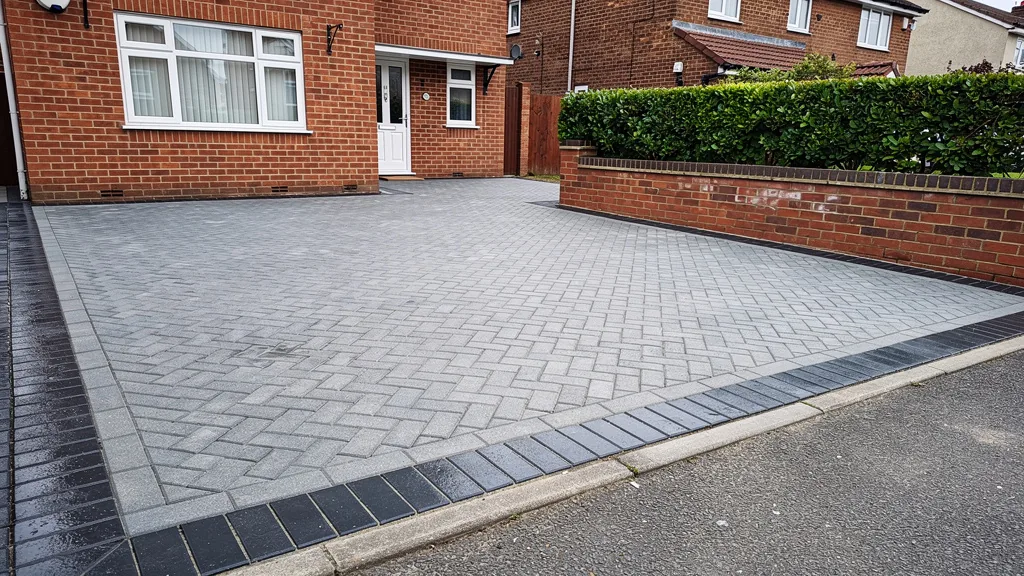
Grey is the most requested colour we lay, and it suits more houses than any other. Light grey against white or cream render reads clean and modern. Mid grey works on almost anything, red brick included, where it cools the frontage without competing with it. Silver and pale greys make a small frontage feel larger, though they show oil sooner than a darker tone.
Three ways to use grey without the drive reading flat:
- Grey field, charcoal frame. A light or mid grey in 90 degree herringbone with a double charcoal soldier course. It is the safest modern combination there is, and it photographs well, which matters if you sell.
- Two greys. A light field with a mid grey banding course set a metre in from the edge, so the drive has a shape rather than a single expanse. Works best on frontages over 40 square metres.
- Grey with a charcoal apron. A darker area in front of the door or garage, in the same block, gives the eye somewhere to land and takes the worst of the tyre marking where you park.
Grey does show rubber and oil more than a multi-tone block. If you park a work van, or the drive doubles as a workspace, take the mid or dark grey over the silver and seal it once the jointing sand has settled.
The other colour families, and what each one is really for:
- Charcoal. The border colour by default, and a strong field colour on modern barns and rendered houses. It hides marks better than any grey and gives tumbled blocks their weight. On a small frontage it can close the space in, so keep it for the frame.
- Brindle. A blend of reds, browns, and charcoal in one block. It hides everyday dirt better than anything else on this list, which is why it has been the standard on 1970s to 2000s red-brick suburbs for thirty years. Pick it if the house is red brick and you want the drive to disappear into the architecture rather than announce itself.
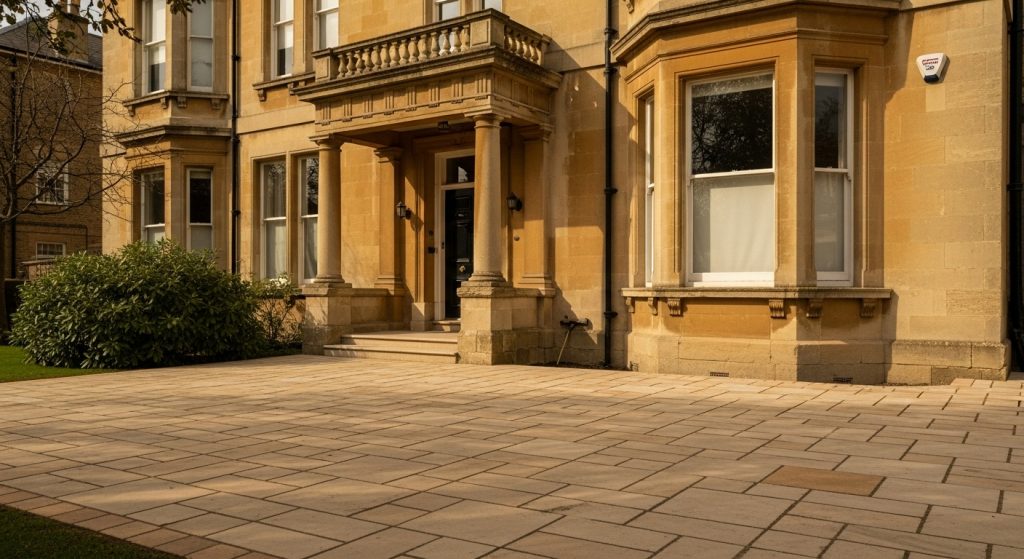
- Buff and natural. Warm sand and honey tones, in concrete or in sandstone setts. This is the Bath and Cotswolds answer, where a grey drive in front of honey stone looks wrong in a way that is hard to unsee. Buff shows algae in shaded spots, so keep planting off the surface.
- Black and near-black. Dramatic against white render and aluminium. It also shows dust, pollen, and salt more clearly than any other colour, so it needs washing more often and a contrasting border to stop the frontage reading as a hole.
- Mixing. Two colours plus a border is the limit. Beyond that the pattern stops being legible and the drive looks busy from the road, which is the one distance that matters.
How to choose the right block paving pattern, colour, and block type
Use this quick framework to match your driveway design to your property and lifestyle.
- Pattern for strength: For driveways, pick herringbone at 90° or 45° for superior interlock under braking and turning. It is the industry standard for vehicle areas.
- Block thickness: Domestic driveways should use 50 mm blocks as a minimum; consider 60 mm if you run an SUV, van, or caravan.
- Format & size: The 200 × 100 × 50 mm rectangle is the UK’s workhorse paver because its 2:1 ratio suits herringbone interlock.
- Material choice: Concrete is the versatile, value-led standard; clay brings timeless colour; natural stone setts add prestige; porcelain delivers ultra-low maintenance and a contemporary look.
- Colour strategy: Greys feel modern and hide marks; multi-tone Brindle blends complement red brick and mask day‑to‑day dirt. Frame with a charcoal edge for a crisp, “finished” look.
Pro tip: Pattern first, colour second. Get the structure right, then fine‑tune the aesthetics.
The UK’s top 5 block paving combinations (with local fit for Bristol, Bath, and the Cotswolds)
Each option includes the best use cases, regional fit, and what to pair it with for maximum impact.
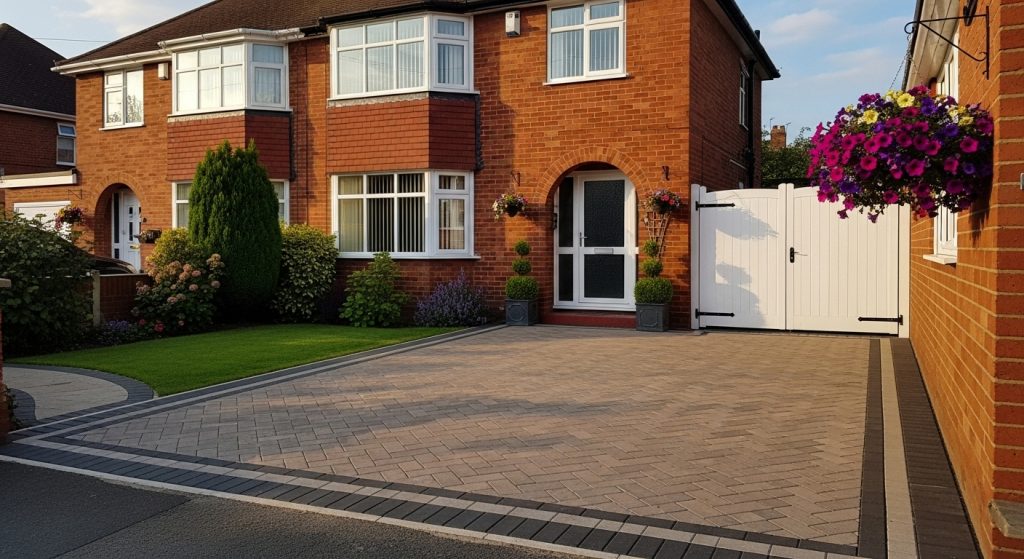
1) Brindle herringbone with a charcoal border (concrete blocks)
- Why it works: The 90° herringbone pattern provides maximum interlock, resisting the twisting forces from wheels. The Brindle mix of red and charcoal hides tyre marks and everyday dirt. A charcoal edge frames the paved area and boosts kerb appeal.
- Best for: 1970s–2000s red‑brick semis and detached homes across Bristol and South Wales. It ties the driveway to the brickwork for a harmonised look.
- Spec to use: 200 × 100 × 50 mm concrete blocks, 90° herringbone, double-row charcoal border.
- Good to know: Consider a permeable version if you want a SuDS‑friendly build.
Design note: Add a simple garden path in the same Brindle block laid in stretcher bond to contrast the driveway’s zigzag pattern and add visual interest.
2) Charcoal ‘Tegula’ (tumbled) in a mixed-size random pattern
- Why it works: Tumbled “aged” blocks give instant character without feeling faux; Charcoal keeps it sharp and modern while hiding stains. Mixed sizes create an easy, random pattern that suits curves.
- Best for: Modern barn conversions and rural properties in the Cotswolds and Thames Valley; also upgrades period homes in Bristol and Bath without clashing.
- Spec to use: Trio packs in three sizes, lay as random course, 50–60 mm thickness depending on vehicle loads.
- Good to know: Ask about permeable ‘Hydropave’ Tegula if drainage is a concern.
Design note: Use a lighter silver haze border or a natural stone kerb to soften transitions to planting.
3) Natural sandstone setts (buff or ‘Raj Green’) in random courses
- Why it works: Natural stone setts deliver premium texture and colour variation that ages beautifully, perfect for Bath stone properties and Cotswold cottages. The random layout avoids long joint lines and feels authentic.
- Best for: Heritage homes and statement frontages where you want that “bespoke, crafted” look.
- Spec to use: Hand-cut or calibrated setts; 100–200 mm formats; pair with sawn stone or granite edges for definition.
- Good to know: Natural stone tends to be heavier on budget; a tumbled concrete sett can deliver a similar look for less.
Design note: Consider a paving circle or fan feature near the driveway entrance for a formal touch.
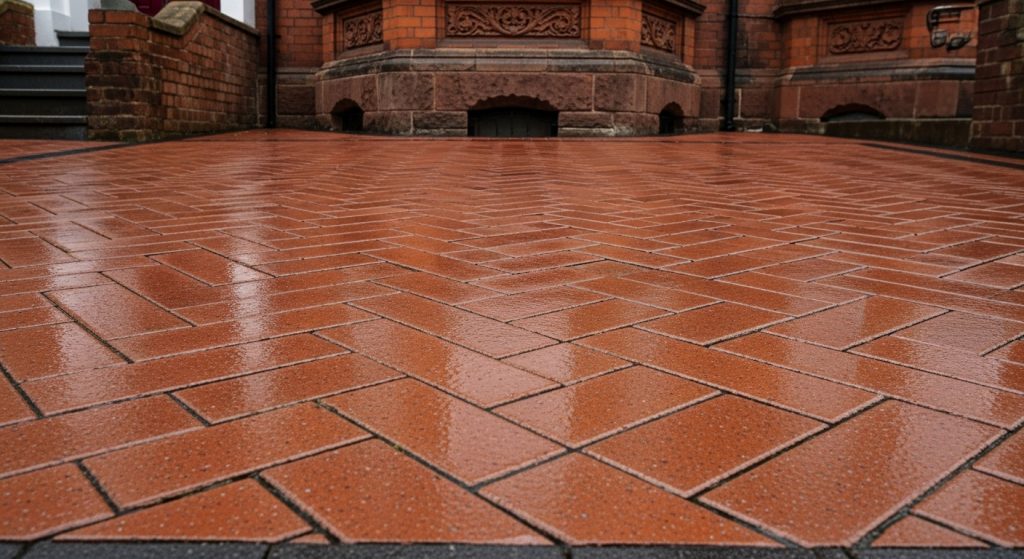
4) Clay brick pavers in a 45° herringbone
- Why it works: Clay’s colour runs all the way through the paver, so it stays rich for decades. 45° herringbone adds movement and looks superb on Victorian terraces in Bristol.
- Best for: Period properties where authenticity matters and you want that crisp, traditional brick aesthetic.
- Spec to use: 200 × 100 × 50–60 mm clay pavers; 45° herringbone with a soldier-course border to lock edges.
- Good to know: Clay is typically pricier than concrete, but the colour fastness is unrivalled.
Design note: Echo your garden paving with the same clay in basketweave on a patio to create continuity between drive and outdoor space.
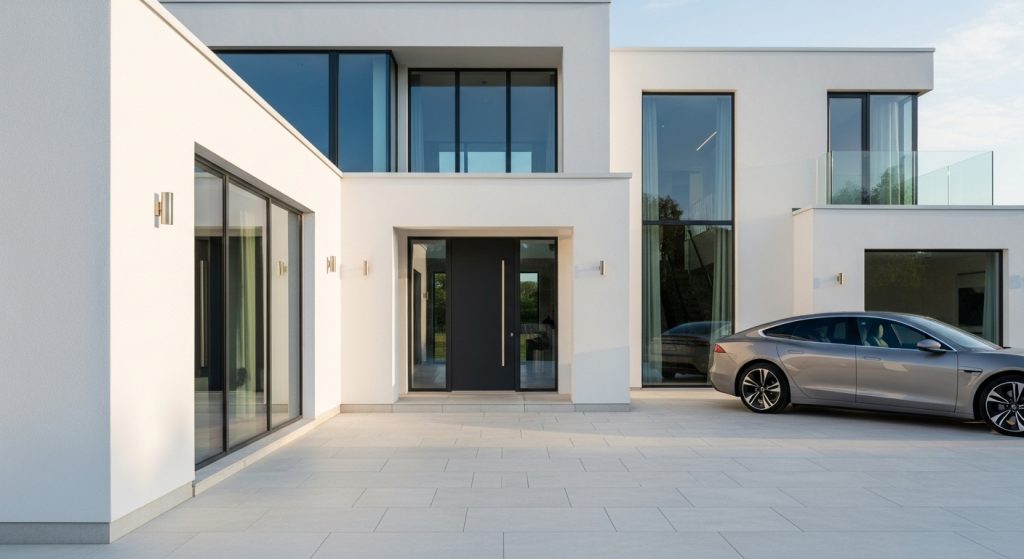
5) Light grey porcelain in stretcher bond (large format)
- Why it works: Porcelain is ultra‑dense and virtually non‑porous, so it shrugs off stains and frost. Large format, light grey slabs deliver that minimalist, modern driveway vibe for new builds.
- Best for: Contemporary homes with white or grey render and aluminium windows in Bristol’s suburbs and the Thames Valley.
- Spec to use: 900 × 600 mm driveway‑rated porcelain on a suitable build-up; stretcher bond with tight joints; verify slip resistance and loading class.
- Good to know: Keep lines straight and geometry clean; this style rewards precision.
Design note: Pair with a charcoal edge for definition and to protect slab edges where vehicles turn.
Explore block paving driveways »
Case study: Clifton family home transformation
A homeowner in Clifton, Bristol, recently replaced their tired concrete driveway with a Brindle herringbone design bordered in charcoal. The property is a 1980s red-brick detached, and the brindle picked up the brickwork so closely that the frontage reads as one piece. The project was completed within five days, including full sub-base reconstruction and permeable drainage. “The difference was night and day,” says the homeowner. “It feels like a new house from the kerb.”
Quick comparison table: materials, costs, and maintenance
Indicative supply-and-install ranges for typical domestic projects; site conditions vary.
Material | Typical installed cost | Colour stability | Maintenance | Style fit |
Concrete block paving | £70–£100 per m² | Good | Low | Versatile; traditional to modern |
Clay brick pavers | £90–£130 per m² | Excellent | Low | Heritage; red brick & terraces |
Natural stone setts | £110–£180+ per m² | Excellent | Low–Med | Premium period & Bath stone homes |
Porcelain paving | £100–£160+ per m² | Excellent | Very low | Minimalist, contemporary |
Source synthesis from our research and manufacturer data.
Engineering that protects your investment
- Sub‑base: For most domestic drives, allow 150 mm compacted Type 1. Increase on weaker ground.
- Laying pattern: Herringbone is the default for driveways because it maximises interlock under vehicle loads.
- Block thickness: Use 50 mm minimum; upgrade to 60 mm for heavier vehicles or frequent deliveries.
- Edges: Strong, well‑haunched edge restraints stop lateral spread, especially if you choose stretcher bond for patios or paths.
- Drainage: Choose a compliant solution: permeable block paving or channels to a soakaway within your boundary.
- Sealants: Sealing helps lock in jointing sand, repel oil stains, and curb weed growth. Re‑apply every two to five years.
See our new driveway process »
Local design guidance for Bristol, Bath, and the Cotswolds
- Bristol: Red‑brick terraces and 20th‑century semis love Brindle herringbone or clay at 45°. For new‑builds, consider grey block paving or porcelain with a charcoal edge.
- Bath: For Bath stone frontages, play up the natural warmth with buff sandstone setts or tumbled Charcoal ‘Tegula’ with a natural stone kerb.
- Cotswolds: Rustic properties suit random patterns in tumbled blocks or natural stone; modern barns pop with Charcoal ‘Tegula’ and clean landscaping lines.
FAQs: block paving designs and driveway ideas
Which block paving pattern is strongest?
Herringbone, at either 45 or 90 degrees. Each block locks against its neighbours on two sides, so braking and turning loads spread across many blocks instead of one. Stretcher bond, basketweave, and circles all have continuous joint lines and no interlock, which is why they belong on paths, patios, and features rather than under wheels.
45° or 90° herringbone?
Structurally identical, so this is an aesthetic and budget choice. 90 degrees is the common one: straightforward to lay, fewer edge cuts, classic look. 45 degrees carries the eye further, so it makes a drive appear longer and wider, but every edge block needs a diagonal cut, which typically adds five to ten per cent. For most rectangular drives, 90 degrees is the practical answer.
What pattern suits a small or narrow driveway?
45 degree herringbone in a light block, with a single rather than double border. The diagonal lines stretch the space and a thin frame gives more of the area back to the field. Skip circles on anything under six metres wide, because a feature that fills the space stops being a feature.
Can I lay basketweave or stretcher bond on a driveway?
Not in standard 200 by 100 blocks. Both patterns run continuous joints, so blocks creep under vehicle loads and the surface develops ruts and lipping within a few years. Large-format porcelain or stone in stretcher bond is a different case, because it is laid on a bound bed that does the work the interlock would otherwise do. If you love basketweave, put it on the patio and run herringbone on the drive.
Which block paving colour hides dirt best?
Brindle, because the red, brown, and charcoal in a single block break up any mark that lands on it. Charcoal is next. Mid greys are workable. Light greys, silver, and buff show oil and rubber soonest, so if you park a work van, either go darker or plan to seal and wash more often.
Will a new block paving driveway add value to my property?
There is no reliable UK study putting a percentage on it, and any installer quoting you a firm 5 to 10 per cent is repeating a number with nothing behind it. What is measurable is narrower and more useful. Around 30 per cent of UK households have no off-street parking at all (Energy Systems Catapult, 2021), so creating a space where there was none changes who will consider the house. Replacing a tired drive with a well-laid one mostly affects how quickly a house sells and how the frontage photographs. We set out the evidence in full in our guide to which driveway adds the most value.
Can I drive on block paving straight away?
Wait 24 hours before heavy use so the jointing sand settles and the surface locks up properly. That is quicker than the alternatives: tarmac wants two to three days before you load it, and a concrete slab needs longer still.
Concrete or clay pavers?
The difference is colour permanence. Concrete uses pigments that can fade under UV over 10 to 15 years. Clay’s colour is inherent to the fired material, so it does not fade at all. Clay usually costs 20 to 30 per cent more. On a period property where authenticity matters, clay earns it. On most suburban homes, good concrete is the better value.
What maintenance does block paving need?
Day to day, very little: sweeping, and a wash once a year. The joints are what need attention. Weeds take hold in sand-filled joints and want pulling or treating, and every three to five years the joints should be re-sanded with kiln-dried sand brushed in and compacted, which is what keeps the interlock working. Sealing every three to five years is optional, and it helps most on pale colours and drives that see oil.
Does block paving work on a slope?
Up to roughly 1 in 10, standard block paving with proper edge restraints is fine. Steeper than that and you want textured or non-slip blocks, or stepped levels. Herringbone matters more on a slope than anywhere else, because the interlock is what stops blocks sliding downhill. Our guide to steep driveway solutions covers the options in detail.
Will it take heavy vehicles?
Yes, if it is specified for them. Standard 50 mm blocks are designed for domestic cars. If you regularly park a motorhome, a horsebox, or commercial vehicles, specify 60 mm or 80 mm blocks and a deeper sub-base, typically 150 to 200 mm of compacted Type 1 and more on soft ground. Herringbone is not optional at that point.
External resources
Planning Portal: Planning Permission for Front Garden Paving
Official government resource explaining when planning permission is required for driveways. Essential authority on the 5m² threshold and permeable material exemptions
Marshalls: BS 7533-101 design guidance
Guidance on the current British Standard BS 7533-101 (updated August 2021), which is essential for all modular paving designs in the UK.
British Geological Survey: Sustainable Drainage Systems
Academic and government-backed resource explaining SuDS philosophy and effectiveness.
Key takeaways
- Pick herringbone and 50–60 mm blocks for any driveway that sees real vehicle use.
- Match colour to your architecture: Brindle for red‑brick, greys for modern builds, stone for heritage.
- Use strong edge restraints and the right sub‑base to avoid movement.
- Consider permeable options for SuDS compliance and cleaner detailing.
- Add a charcoal border to make any design feel sharp and intentional.
Ready to transform your driveway?
A short, friendly chat with a specialist is the quickest way to narrow choices and design something that fits your home perfectly.
Book your free bespoke design consultation with Driveways Plus. We’ll map options to your budget, create a clear specification, and show you how the right block paving pattern can lift your home’s kerb appeal.
Request your consultation · See what’s possible · Compare materials